

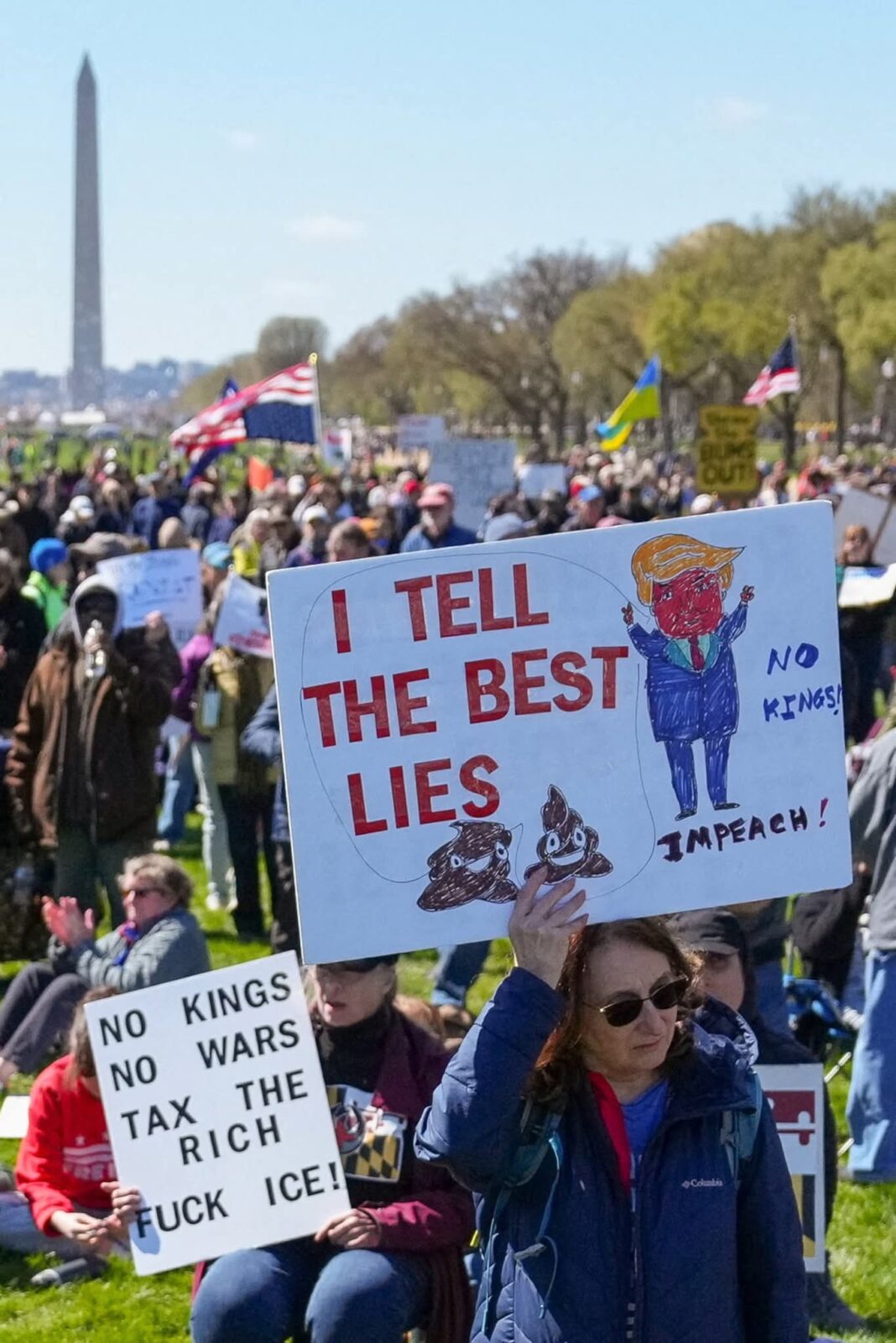

Tens of thousands of Americans are already on the streets. Yet, the number is still growing.
From the bustling city of Boston, to the suburbs of Minneapolis, Philadelphia, San Diego, several locations across the United States of America (USA) have been besieged by demonstrators, in what they regarded as “No Kings” protest against the policies of President Donald Trump.
In major cities like Washington D.C., New York City, Chicago, the rally is even densely intense, as protesters were captured moving in bee-clouds.
The protesters at this time were very mean with their message: the images of vast crowds filling city boulevards and town squares served as a stark reminder that “no one rules alone.”
The latest wave of the nationwide demonstration erupted on Saturday, March 28, signified the limit of the mob against what organisers described as Trump’s “increasingly autocratic style of governance. The recent event also marked the third major round of such outcry since President Trump’s took over control of the White House for his second term.
In some locations, the organisers estimated the crowds in the hundreds of thousands. And in other cities such as New York, Los Angeles, Chicago, Houston, and Washington, D.C., the number rose above million. Also, smaller but symbolic rallies unfolded in mid‑sized towns like Shelbyville, Kentucky, Michigan, and Howell.
Protesters carried banners that suggested direct defiance to the ongoing Trump-US-sanctioned war against Iran, federal immigration enforcement, and the rising cost of living. These mixed factors sparked widespread public discontent that resulted in a coordinated national display.
In many urban centres, streets were lined with signages reading “No Kings, No Tyrants,” “End the War in Iran,” and “Stop ICE Raids,” highlighting the multiplicity of reasons that the movement aimed to represent.
At the centre of the rally are students, parents, union members, faith groups, and veterans. The cross-section representation employed the usage of democracy language and civil liberties to stage dissatisfaction against the government’s policies.
Why “No Kings”?
At the core of the “No Kings” campaign is a critique of what activists see as a drift toward authoritarianism under President Trump’s second administration.
According to the organisers, the President’s aggressive use of executive power, expansive military actions overseas, and hard‑line immigration measures have collectively eroded checks and balances, which they framed as concentration of authority in the presidency.
In a statement released ahead of the rallies, the organisers declared: “Trump aims to dominate us like a tyrant. However, this is America, and authority resides with the populace, not with aspiring monarchs or their wealthy allies.”
This message captured diverse grievances, ranging from foreign‑policy decisions to economic hardship, under a single, easily recognisable slogan “No Kings.”
Protesters flagged the ongoing war in Iran, which began with a joint U.S.–Israeli military operation in early 2026, as a baseless and resource draining exercise. They argued that the escalating conflict has heightened global instability.
They also identified the stepped‑up role of Immigration and Customs Enforcement (ICE), whose raids and detention operations have drawn condemnation from civil‑rights groups and local communities.
In addition, demonstrators are viciously dissatisfied over the rising cost of living, including soaring housing, healthcare, and energy prices, which they blame on administration policies that favour corporate interests over ordinary households.
Many protest placards blended slogans about war, immigration, and economic justice, illustrating how the “No Kings” movement depicts a wide array of progressive causes.
Recall that the previous “No Kings” protest organised in June 2025 amid Trump’s celebration of his birthday, and another one in October of the same year, were rated among the largest coordinated civil resistance actions in the history of the US.
Meanwhile, government officials and pro‑Trump supporters have dismissed the rallies as partisan agitation, arguing that the President’s policies enjoy substantial support among voters who prioritise national security and economic growth.