

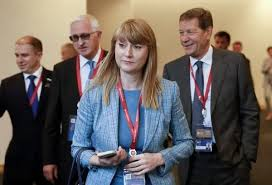

For the first time since Russia launched its invasion of Ukraine in February 2022, a delegation of five Russian lawmakers visited the United States in an effort to restore parliamentary contacts between the two countries, marking a cautious but significant step toward thawing relations. The visit, confirmed by Vyacheslav Nikonov, Deputy Chairman of the Russian State Duma’s Foreign Affairs Committee, represents a rare engagement amid years of escalating tensions and widespread sanctions.
Speaking to TASS, the Russian state news agency, Nikonov explained that the delegation’s meetings with U.S. administration officials were scheduled for Friday, with discussions focused on creating a joint parliamentary group and exploring the possibility of a reciprocal visit to Moscow in May. “This visit is an important signal of willingness to maintain dialogue despite the current situation in Ukraine,” Nikonov said, adding that the delegation hoped to foster constructive parliamentary exchanges moving forward.
The U.S. host for the visit is Republican Congresswoman Anna Paulina Luna, a vocal supporter of former President Donald Trump and a known critic of U.S. military aid to Ukraine. According to Nikonov, Luna’s office facilitated much of the planning for the delegation’s engagements on Capitol Hill, highlighting the influence of U.S. domestic politics on foreign diplomatic initiatives. Western nations have largely severed or sharply curtailed political contacts with Russia since the outbreak of the conflict, in solidarity with Ukraine, making this delegation’s presence in Washington a rare and symbolic move.
“We discussed the creation of a joint parliamentary group, the need for mutual understanding, and the possibility of returning to Moscow for a follow-up visit in May,” Nikonov said, stressing that while the Duma and Federation Council hold secondary roles in Russia’s power structure, these parliamentary channels remain important for dialogue at a time when traditional diplomatic contacts are constrained.
The visit was made possible by the temporary lifting of U.S. sanctions on senior members of the ruling United Russia party, allowing them to travel to Washington without legal impediments. Kremlin spokesman Dmitry Peskov described the trip as an “important step toward normalizing relations” and emphasized that Moscow viewed parliamentary engagement as a practical means of dialogue outside of executive-level interactions.
Analysts note that, although the State Duma and the Federation Council are largely ceremonial bodies within Russia’s governance hierarchy, parliamentary diplomacy can play a strategic role in signaling political intentions and testing the waters for broader negotiations. “This delegation is not just symbolic; it reflects Russia’s attempt to explore any channel that could reduce international isolation,” said Tatiana Stanovaya, a Moscow-based political analyst.
U.S. former President Donald Trump has repeatedly advocated reopening dialogue channels with Russia, arguing that diplomatic engagement could stabilize tensions and potentially reduce the human and economic costs of the war. While the current U.S. administration under President Joe Biden has maintained a firm stance in support of Ukraine, the visit of the Russian delegation indicates that some bipartisan avenues for dialogue remain open, especially through congressional channels. In addition to Capitol Hill meetings, the delegation reportedly planned to meet with policy experts and think-tank representatives in Washington, signaling Moscow’s interest in broader outreach beyond formal governmental contacts.
The trip also underscores the complex intersection of international sanctions, domestic politics, and conflict diplomacy. Since February 2022, Western countries have imposed sweeping economic, financial, and political sanctions on Russia, aiming to weaken its war effort and signal support for Ukraine. These measures have included restrictions on Russian officials, banks, energy exports, and travel, significantly curtailing Moscow’s ability to engage globally.
In this context, the temporary sanction relief to allow parliamentary engagement is noteworthy, suggesting that both sides see value in selective, controlled dialogue even as broader political and military tensions persist. Experts caution, however, that such parliamentary visits are unlikely to dramatically shift the trajectory of the war in Ukraine but may serve as a preliminary step toward reducing bilateral friction and exploring technical or humanitarian cooperation.
This delegation marks the first direct parliamentary-level engagement between Washington and Moscow since the war’s onset, setting a precedent for potential future exchanges. While the State Duma and Federation Council are widely regarded as subordinate to executive power in Russia, their involvement allows Moscow to signal political intent without committing to high-stakes executive negotiations.
As Nikonov summarized, “Even in difficult times, dialogue must continue. We hope this visit demonstrates that cooperation, even if limited, is possible.” Observers in both capitals will be watching closely to see whether this initial engagement can translate into sustained contacts or remain a symbolic gesture amid the ongoing conflict.