

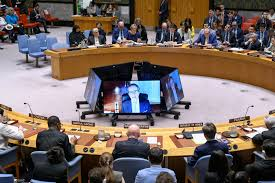

The United Nations Security Council is set to hold closed-door consultations on Friday to discuss the ongoing strikes on Iran, following a formal request by Russia, as the war in the Middle East approaches its second month with growing international concern over civilian casualties and damage to critical infrastructure. According to Russian state media, Moscow requested the emergency consultations amid escalating bombardments across Iranian territory, particularly strikes that have reportedly hit civilian infrastructure including schools and healthcare facilities.
Evgeny Uspensky, spokesman for Russia’s envoy to the United Nations, said the request was prompted by mounting reports of civilian harm. “The Russian Federation has requested closed-door consultations with the UN Security Council due to the ongoing strikes on civilian infrastructure in Iran, including educational and healthcare facilities,” he said, according to the state news agency TASS. The meeting is scheduled to take place at 10:00 a.m. in New York (1400 GMT), with the United States, which holds the rotating presidency of the United Nations Security Council this month, expected to preside over the session behind closed doors.
The conflict began on February 28 when joint U.S.–Israeli strikes on Iranian targets triggered a wider war that has since spread across large parts of the Middle East, raising fears of a broader regional confrontation involving multiple state and non-state actors. Since the initial strikes, Iran has come under near-daily bombardment targeting military facilities, missile installations, and senior leadership figures, according to officials familiar with the military campaign.
In response, Iran has launched retaliatory strikes across the Gulf region and taken steps that have effectively led to the closure of the strategically vital Strait of Hormuz, one of the world’s most important energy shipping routes. The waterway typically handles roughly one-fifth of global crude oil and liquefied natural gas shipments during peacetime, meaning any disruption has immediate implications for global energy markets, shipping costs, and international trade. Analysts warn that prolonged disruption in the strait could trigger spikes in global oil prices and worsen inflation in many economies already dealing with post-pandemic economic pressures and geopolitical instability.
One of the most controversial incidents in the war occurred on the first day of the conflict when a strike hit a school in the southern Iranian city of Minab, killing more than 160 children, according to Iranian authorities. The incident has drawn widespread international condemnation and prompted calls for an independent investigation into what happened. Preliminary findings from a U.S. military investigation, reported by The New York Times, indicated that a U.S.
Tomahawk cruise missile struck the school due to a targeting error, an admission that has intensified global scrutiny of the conduct of the military campaign and the rules of engagement being applied. Human rights groups and international observers have warned that attacks on civilian infrastructure, including schools and hospitals, may constitute violations of international humanitarian law if proven to be deliberate or carried out without adequate precautions to avoid civilian casualties.
The issue of civilian casualties is expected to feature prominently not only at the Security Council consultations in New York but also at a separate meeting of the United Nations Human Rights Council scheduled to take place in Geneva on the same day. That session will focus specifically on the deadly school strike in Minab and broader concerns about the humanitarian consequences of the war. Diplomats say the parallel meetings reflect growing divisions within the international community over the war, with some countries calling for an immediate ceasefire and others defending the strikes as part of a broader effort to weaken Iran’s military capabilities and regional influence.
The United States and Israel have maintained that their military campaign is aimed at degrading Iran’s missile program, military infrastructure, and command structure, arguing that these capabilities pose a threat to regional security. Iran, however, has accused both countries of carrying out unlawful aggression and targeting civilian infrastructure, allegations that Washington and Tel Aviv have repeatedly denied. The war has further strained already tense relations between the United States and Russia, which have found themselves on opposing sides of several major international conflicts in recent years, including the war in Ukraine and ongoing disputes over NATO expansion and global security arrangements.
The closed-door format of the Security Council consultations means that no public statements or resolutions are guaranteed, but diplomats say the meeting could shape future international diplomatic efforts, including possible ceasefire negotiations or humanitarian corridors. Previous conflicts in the region have shown that Security Council divisions, particularly among permanent members such as the United States, Russia, and China, often make it difficult to pass binding resolutions, especially when major powers are directly or indirectly involved in the conflict. Nevertheless, the fact that the meeting was requested and scheduled underscores the growing international alarm over the scale of the war, the rising civilian death toll, and the potential global economic consequences of a prolonged conflict in one of the world’s most strategically important regions.
As the war nears its second month, humanitarian agencies are warning of worsening conditions in affected areas, including shortages of medical supplies, displacement of civilians, and damage to essential infrastructure. With the Strait of Hormuz effectively closed and missile exchanges continuing across the Gulf, the conflict is increasingly being viewed not just as a regional war but as a crisis with global economic and security implications. The outcome of the Security Council consultations and the Human Rights Council meeting may therefore play a critical role in shaping the next phase of international response to the conflict, including whether diplomatic pressure will increase for a ceasefire or whether the war will continue to escalate.