

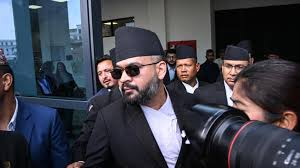

Nepal entered a new political chapter on Friday as rapper-turned-politician Balendra Shah was sworn in as prime minister following a sweeping electoral victory that came in the aftermath of the country’s deadly anti-corruption protests in 2025. The 35-year-old reformist leader, popularly known as Balen, rose to power on a wave of youth-driven political momentum that reshaped Nepal’s political landscape after months of unrest and public outrage over corruption, economic hardship, and governance failures. Shah, dressed entirely in black, including his trademark dark sunglasses, took the oath of office in a ceremony marked by loud cheers and chants from supporters who gathered to witness what many described as a generational shift in leadership. “I, Balendra Shah, in the name of the country and people, pledge that I will be loyal to the constitution,” he declared, as crowds erupted in celebration following his formal assumption of office.
Shah’s rise to power follows a landslide victory by his Rastriya Swatantra Party in the March 5 elections, the first national vote since the 2025 anti-corruption protests that toppled the previous government. His party secured a commanding majority of 182 seats in the 275-member House of Representatives, underscoring the depth of public dissatisfaction with the political establishment and the appeal of his reformist agenda.
Shah campaigned alongside party president Rabi Lamichhane, a combative television host and former deputy prime minister and interior minister, who remains a central figure in the new administration. The election outcome reflected a broader demand among young Nepalese voters for transparency, accountability, and a break from entrenched political elites who have dominated the country’s governance for decades.
In a departure from traditional political communication, Shah addressed the nation a day before his swearing-in through a rap song released on social media, marking his first public statement since his electoral victory. The song quickly gained traction, amassing nearly three million views within hours of its release.
In the lyrics, Shah invoked themes of unity, resilience, and national renewal, declaring, “The strength of unity is my national power,” while visuals showed him on the campaign trail engaging with supporters. He continued with lines that resonated with his youthful base, saying, “My heart is full of courage, my red blood is boiling; my brothers stand with me, this time we will rise,” and adding, “May my breath not run out; I will run like a leopard.” The unconventional message reinforced his image as a leader connected to younger generations and willing to break from established political norms.
The political transformation that brought Shah to power is deeply rooted in the events of the 2025 Gen Z-led protests, a youth uprising that began over a controversial and short-lived social media ban but quickly evolved into a nationwide movement against corruption, unemployment, and rising living costs. The protests, largely organised through digital platforms, saw tens of thousands of young people take to the streets across major cities including Kathmandu, demanding accountability from political leaders and an end to systemic corruption.
What began as a reaction to restrictions on online expression soon tapped into long-standing frustrations over economic inequality, lack of job opportunities, and perceived government indifference to the struggles of ordinary citizens. The demonstrations intensified over weeks, culminating in violent confrontations between protesters and security forces that left at least 77 people dead, including at least 19 young people killed on the first day of the crackdown.
The government at the time, led by four-time prime minister KP Sharma Oli, faced widespread condemnation over its handling of the protests, particularly the use of force against largely unarmed demonstrators. Despite the scale of the violence, no individuals have been convicted for the killings, a fact that continues to fuel public anger and demands for justice. A commission set up to investigate the crackdown later recommended the prosecution of Oli, along with former interior minister Ramesh Lekhak and ex-police chief Chandra Kuber Khapung.
According to a leaked copy of the report, the commission found that Lekhak bore “overall responsibility for home administration, security agencies, and maintaining law and order,” and that both he and Oli “did not appear to have made any effort on the afternoon… to prevent further human casualties.” While the report stated that it was “not established that there was an order to shoot,” it concluded that “no effort was made to stop or control the firing, and due to their negligent conduct, even minors lost their lives.” The findings further revealed that in 48 of the 63 completed autopsies, victims died from bullet wounds, with the majority struck in the chest or head.
Following months of unrest, the government collapsed, paving the way for an interim administration led by former chief justice Sushila Karki, who oversaw the country during a transitional period lasting six months. In a farewell address delivered shortly after Shah’s rap announcement, Karki expressed optimism about the future under youth leadership.
“I am confident that the new government to be formed under the leadership of the youth will work towards ending corruption in the country, establishing good governance, creating jobs within the country, economic development and social justice,” she said. She added, “I am looking forward to the bright future of this country with full confidence — where our unity, honesty and the hard work of every citizen will write a new history.” Karki also confirmed that a report into the protest crackdown would be released, although she did not provide a specific timeline.
The transition of power marks a significant moment in Nepal’s political history, as a younger generation assumes leadership in response to widespread demands for reform and accountability. Shah’s victory over Oli in the latter’s own constituency symbolised the scale of the political shift, as voters rejected long-standing figures in favour of a candidate who embodied change and represented a break from traditional politics.
As Nepal moves forward under Shah’s leadership, expectations remain high that his administration will address the grievances that fueled the 2025 protests, deliver on promises of good governance, and ensure justice for victims of the crackdown. However, analysts caution that translating popular support into tangible reforms will require navigating entrenched political structures and addressing deep-rooted economic challenges that have persisted for years.