

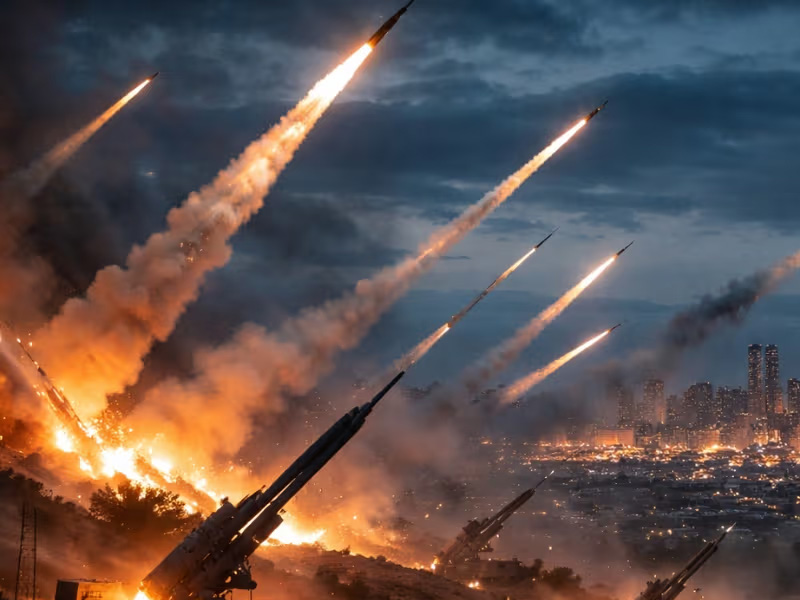

Iran launched multiple waves of missiles at Israel in a major escalation of hostilities in the Middle East, triggering air raid sirens across several parts of the country, including Tel Aviv, as interception blasts were heard in the sky while Israeli defence systems attempted to shoot down the incoming missiles, with authorities confirming that falling debris from intercepted missiles damaged residential buildings in northern Israel, though no deaths were reported, in an attack that significantly raised fears of a wider regional war and came amid conflicting claims over whether diplomatic negotiations were ongoing between Tehran and Washington, a claim strongly denied by Iranian authorities who described statements from the United States as false and misleading.
The escalation came shortly after U.S. President Donald Trump said on Truth Social that the United States and Iran had held “very good and productive” talks aimed at a “complete and total resolution of hostilities in the Middle East,” and that he would delay for five days a planned strike on Iran’s power grid, a statement that initially calmed global markets, pushed shares higher, and drove oil prices below $100 per barrel after days of volatility caused by Trump’s earlier threats of military action and warnings from Tehran that it would retaliate if attacked, creating a brief sense of optimism among investors who believed a diplomatic solution might be possible and that a major disruption to global oil supply could be avoided.
However, Iran swiftly rejected the claims of negotiations, with Iran’s Parliament Speaker, Mohammad Baqer Qalibaf, publicly denying that any talks had taken place and writing on X that, “No negotiations have been held with the U.S., and fakenews is used to manipulate the financial and oil markets and escape the quagmire in which the US and Israel are trapped,” a statement that was followed by a position from the Islamic Revolutionary Guard Corps, which dismissed Trump’s remarks as “psychological operations” and signalled continued military action, including the possibility of fresh attacks on U.S. targets in the region, indicating that Iran was not backing down and that the missile strikes were part of a broader military response amid rising confrontation involving Iran, Israel, and the United States.
The developments also had immediate global economic implications, particularly because of the growing threat to the Strait of Hormuz, one of the most important oil shipping routes in the world through which about 20 percent of global oil and liquefied natural gas supplies pass, meaning that any threat to the strait immediately affects global energy markets, and following Iran’s rejection of the negotiation claims and the renewed missile attacks, markets reacted sharply again as oil prices rebounded, with Brent crude rising to $104.21 per barrel and U.S. crude climbing to $91.93 per barrel, reversing some of the previous day’s losses, while market analysts such as Tony Sycamore warned about the uncertainty surrounding the situation, saying, “The underlying situation is still incredibly fragile or flammable,” highlighting fears that any further escalation, especially involving the Strait of Hormuz, could trigger a major global energy crisis and further economic instability across many countries already struggling with inflation and high transportation costs.
The current escalation is rooted in a long-standing conflict involving Iran, Israel, and the United States, with tensions dating back decades, particularly over Iran’s nuclear programme, Israel’s security concerns, and U.S. efforts to limit Iran’s military and regional influence, as Israel has long accused Iran of attempting to develop nuclear weapons and supporting armed groups hostile to Israel across the Middle East, including Hezbollah in Lebanon and other allied militias in Syria and elsewhere, while Iran has accused Israel and the United States of aggression, sabotage, and attempts to undermine its government, leading to years of proxy conflicts, cyberattacks, targeted assassinations, and indirect confrontations across the region before the conflict escalated into more direct military exchanges.
In recent months, the situation worsened following a series of military strikes, threats, and counter-threats, including warnings from Iran that it could close the Strait of Hormuz if attacked, and warnings from the United States that it would respond militarily if Iran disrupted global shipping routes, while Israel also intensified strikes against Iranian-linked targets in the region, creating a cycle of escalation that eventually led to direct missile attacks, retaliatory strikes, and rising fears of a full-scale regional war involving multiple countries, with global powers closely monitoring the situation due to the potential impact on global oil supply, international trade routes, and geopolitical stability.
As the conflicting signals from Washington and Tehran continue, global markets remain unstable and governments around the world are watching closely, as the combination of missile attacks, military threats, and conflicting statements about negotiations has created uncertainty about whether the region is moving toward diplomacy or a wider war, with analysts warning that the situation could escalate further if attacks continue or if the Strait of Hormuz is closed, a move that would have severe consequences for global energy supply and the world economy, making the current confrontation not just a regional conflict but a global economic and security concern.