

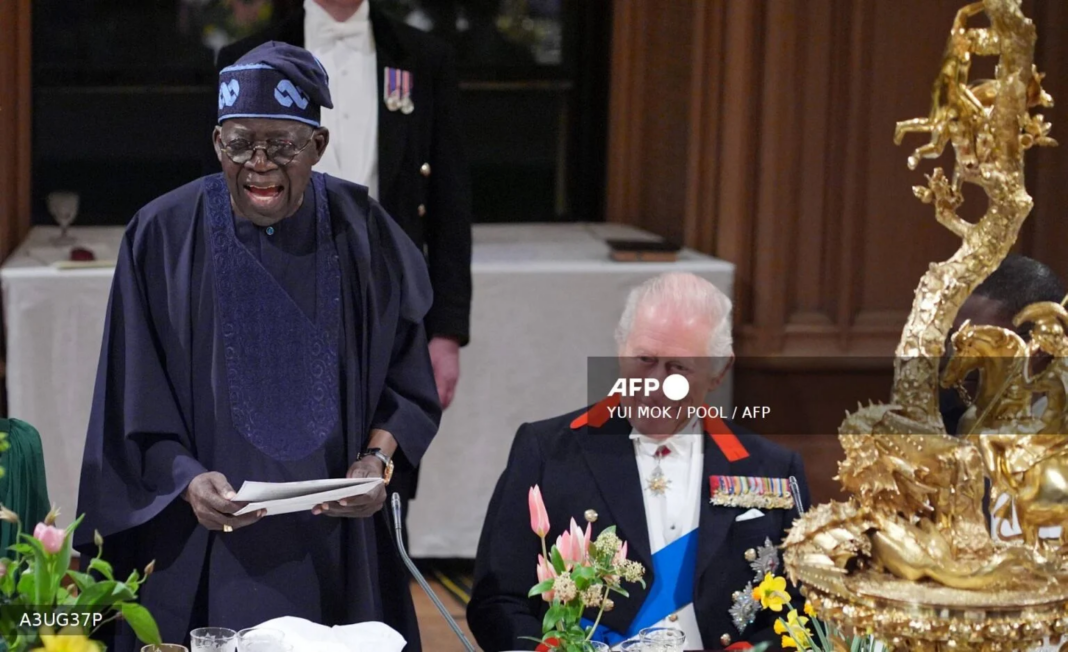

President Bola Tinubu on Wednesday underscored the critical importance of Nigeria’s collaboration with the United Kingdom in addressing insecurity, stating that he would hold key discussions with Keir Starmer on counter-terrorism efforts and challenges to regional stability during a scheduled meeting on Thursday. Speaking at a high-level state banquet, Tinubu emphasized that Nigeria’s security concerns are deeply intertwined with broader regional threats, particularly in West Africa, and reiterated that partnerships with long-standing allies such as the UK remain essential in confronting these issues. His remarks come amid ongoing concerns over terrorism and instability in the Sahel region, where insurgent groups continue to pose significant threats, placing Nigeria at the forefront of efforts to maintain regional peace and security.
The President made these remarks on Wednesday night at a state banquet hosted by Charles III at Windsor Castle, a historic occasion marking the first time a Nigerian leader has addressed a gathering at the centuries-old royal residence. The dinner, which commenced at 9:00pm local time, formed part of a series of engagements lined up for Tinubu’s ongoing state visit to the United Kingdom, a visit that has drawn attention for its diplomatic, economic, and historical significance. Addressing an audience that included Camilla, Prince William, and Catherine, Tinubu highlighted the enduring ties between both nations while reflecting on shared histories and mutual interests.
Focusing on security cooperation, Tinubu made clear that his upcoming meeting with Starmer would center on strengthening joint responses to terrorism and instability in West Africa. “Our West African region faces complex terrorism challenges with roots in the Sahel. Nigeria carries an enormous responsibility to help safeguard regional stability. In confronting these threats, partnership with the United Kingdom remains essential and I look forward to my meeting with Prime Minister Keir Starmer tomorrow (today),” he said. His remarks situate Nigeria as a central actor in regional security architecture, given its size, military capacity, and geopolitical influence, while also acknowledging the transnational nature of threats emanating from the Sahel, where extremist groups have exploited weak governance structures and porous borders to expand their operations.
Beyond security, Tinubu’s speech carried a deeply personal dimension as he reflected on his years in exile during the military dictatorship of Sani Abacha in the 1990s. He recounted how the United Kingdom provided him refuge at a time when pro-democracy activists faced persecution, noting that the Metropolitan Police had placed his residence under surveillance for protection following threats from agents of the military junta. Expressing gratitude, Tinubu stated, “Your Majesty, I wish to express Nigeria’s deep gratitude to this great nation for the refuge and support it extended during the dark years of military dictatorship. Like many Nigerians involved in the pro-democracy struggle, I found safety here, and I recall that my residence was placed under Metropolitan Police surveillance for protection following threats from agents of the junta.
That solidarity remains etched in our collective memory, and it is deeply humbling for me to stand before Your Majesty today as the President of a democratic Nigeria.” His remarks referenced a turbulent period in Nigeria’s history marked by widespread human rights abuses, including the execution of environmental activist Ken Saro-Wiwa and eight other Ogoni leaders, an event that drew global condemnation and intensified calls for democratic reforms.
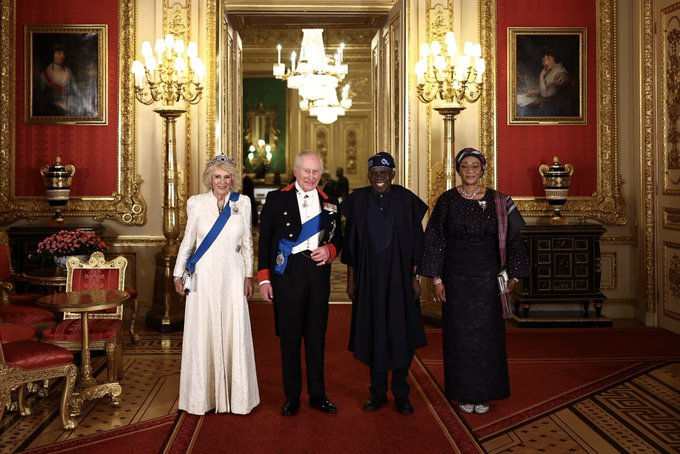
Tinubu further used the occasion to emphasize the historical and institutional connections between Nigeria and the United Kingdom, describing his presence at Windsor Castle as particularly significant. “As the first Nigerian leader to speak here at Windsor Castle, which has served the British Crown for nearly a millennium, is particularly historic,” he said, underscoring the symbolic weight of the moment.
He highlighted how Nigeria’s legal and political systems continue to reflect British influences, noting that “In Nigeria, elements of these traditions continue to inform the institutional foundations of our own republic. Our courts draw upon legal traditions rooted in English common law. Our parliamentary institutions reflect constitutional practices that evolved here over centuries.” These remarks illustrated the enduring legacy of colonial-era structures while also framing them as part of a shared institutional heritage.
Turning to the contributions of Nigerians abroad, Tinubu praised the Nigerian diaspora in the United Kingdom, particularly their role in the healthcare sector. He noted that “Within the National Health Service, Nigerian doctors and nurses play an indispensable role in delivering healthcare. Nigerian-trained doctors are among the largest groups of international medical professionals serving the NHS,” highlighting the significant impact of Nigerian professionals in sustaining key public services in the UK. He also referenced prominent British sports figures of Nigerian heritage, including Maro Itoje, Bukayo Saka, Eberechi Eze, and Anthony Joshua, describing them as examples of the “remarkable human connection” that continues to bind both countries through shared identity and cultural exchange.
The President also situated Nigeria within the broader framework of the Commonwealth of Nations, noting its status as one of the largest member states in the 56-nation body under King Charles III’s leadership. “As one of the largest nations within the Commonwealth, Nigeria looks forward to contributing constructively to the continued growth and vitality of this global community,” he said, reaffirming Nigeria’s commitment to multilateral cooperation and shared development goals within the organization.
Despite acknowledging ongoing security and economic challenges, Tinubu expressed optimism about Nigeria’s future, describing the country as one defined by resilience, diversity, and ambition. He spoke of “diverse and vibrant people, of young people dreaming big, of entrepreneurs with a global outlook, and of a hopeful people determined to realise their full potential,” projecting confidence in Nigeria’s trajectory. He concluded his remarks with a toast “to the special bond between Nigeria and the United Kingdom, and to the bright future that we shall build together,” reinforcing the message of partnership and shared progress that underpinned his address.
The state visit, which runs from March 18 to 19, is notable as the first by a Nigerian president to the United Kingdom in 37 years, following the 1989 visit by former military president Ibrahim Babangida hosted by Queen Elizabeth II. The current visit is expected to yield several memoranda of understanding and agreements spanning trade, investment, defence, and cultural cooperation, including a £746 million financing deal aimed at refurbishing the Lagos Port Complex and Tin Can Island Port. As discussions continue, Tinubu’s engagements in the UK are being closely watched as a potential turning point in strengthening bilateral relations and addressing shared challenges, particularly in the areas of security and economic development.