

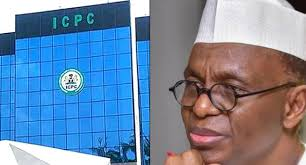

The Independent Corrupt Practices and Other Related Offences Commission (ICPC) on Tuesday clarified that reports suggesting it sought a fresh court order to extend the remand of former Kaduna State governor, Nasir El-Rufai, were inaccurate, stressing that the agency remains strictly within the bounds of the law and court procedures. In a statement issued by its Head of Media and Public Communication, John Odey, the commission explained that it appeared in court on March 17, 2026, solely for the hearing of an application filed by El-Rufai on March 6, seeking to overturn a remand order granted by the court on March 5.
“ICPC wishes to clarify the current legal status of the remand in detention of the former Governor of Kaduna State, Mallam Nasir Ahmad El-Rufai. This statement is necessary to correct inaccurate reports by some media outlets suggesting that the commission was in court today, 17th March 2026, seeking a fresh extension of his detention,” the statement read, emphasizing that no new extension was sought by the commission and that the proceedings pertained exclusively to the former governor’s application challenging the existing remand.
During the March 17 court proceedings, counsel for El-Rufai was formally served with the ICPC’s response to the application, after which the defense lawyer requested an adjournment to allow sufficient time to review and respond to the commission’s submission. Consequently, the presiding magistrate adjourned the hearing to March 31, 2026, to provide the legal team ample opportunity to react to the commission’s response.
The ICPC reiterated that El-Rufai remains in lawful custody under the remand order issued on March 5 and that all actions taken by the commission are strictly in accordance with the court-mandated timeline, including the submission of progress reports to the judiciary as required. The commission emphasized the legal framework under which the remand operates, stating that “the detention of the former governor is authorised by the court in line with the provisions of the Administration of Criminal Justice Act 2015,” highlighting its commitment to due process and procedural compliance.
Outlining the chronology of the case, the ICPC noted that an initial 14-day remand had been granted to facilitate investigations into allegations of money laundering and abuse of office involving El-Rufai. Upon the expiration of that initial period, the commission applied for a further 14-day extension to complete its investigation, which was duly granted by the court on March 5. An earlier attempt by El-Rufai’s counsel to set aside the remand order issued on February 19 was dismissed by the court on March 9, confirming the legality of his detention under existing judicial authority.
In its statement, the commission stressed its adherence to judicial oversight and the importance of resolving all matters through formal legal channels, noting that “the ICPC remains firm in upholding its longstanding policy of avoiding media trials. We believe that legal disputes should be settled in the courtroom, not on newspaper pages and social media platforms. The commission’s leadership remains steadfast and undeterred in confronting any and all challenges in the course of the investigation. We urge the public to avoid spreading unverified information and to rely on official updates from the Commission.”
Further context provided by the ICPC indicated that El-Rufai had returned from Cairo, Egypt, on February 12, 2026, and honoured an invitation from the Economic and Financial Crimes Commission (EFCC) on February 16. Following his administrative bail release by the EFCC on February 19, El-Rufai has been in ICPC custody since that date.
The commission also noted that the Department of State Service has filed a separate suit against El-Rufai for allegedly wiretapping the telephone line of the National Security Adviser, Nuhu Ribadu, adding another dimension to ongoing investigations involving the former governor. These developments have placed El-Rufai’s case under intense public scrutiny, generating widespread media coverage and, in some cases, inaccurate reporting regarding the commission’s actions and intentions.
By issuing the statement, the ICPC sought to reaffirm its commitment to professionalism, the rule of law, and the proper administration of justice while countering misinformation in the media. The agency emphasized that all legal disputes should be resolved in court and that its operations are guided by statutory authority and judicial oversight.
The clarification is intended to reinforce public confidence in the commission’s processes and to highlight that the detention of El-Rufai is lawful, monitored, and subject to continuous review by the courts. As the legal proceedings unfold, the ICPC pointed out the importance of maintaining the integrity of the investigation, stressing that any resolution or developments would be communicated through official channels to ensure accuracy and transparency, while cautioning the public against relying on unverified reports circulating on social media or in the press.