

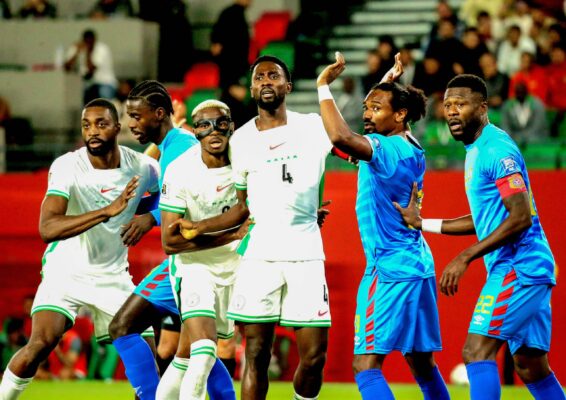

Four months after the highly contested 2026 FIFA World Cup African play-off final between Nigeria and DR Congo, the world football governing body, FIFA, has issued sanctions against both the Nigeria Football Federation (NFF) and the DR Congo Football Federation following disciplinary incidents during the match.
The decisive fixture, played on November 16, 2025, in Morocco, ended with DR Congo defeating Nigeria 4–3 on penalties to advance to the intercontinental play-offs, a result that sparked controversy and subsequent investigations.
According to FIFA’s latest disciplinary overview released for the World Cup qualifiers, both federations were found guilty of separate infractions that violated the FIFA Disciplinary Code, underscoring concerns about order, security, and fair play during the high-stakes encounter.
FIFA’s report detailed that Nigeria was penalised for breaches related to order and security at matches, specifically citing the throwing of objects by spectators during the match, which contravened Article 17 and Article 17.2.b of the FIFA Disciplinary Code. As a result, the NFF was fined 1,000 Swiss francs, reflecting the governing body’s commitment to ensuring safe environments for players, officials, and fans.
On the other hand, the DR Congo Football Federation received a heavier sanction after supporters were found to have used laser pointers or similar electronic devices, an action in violation of Article 17.2.d. FIFA imposed a fine of 5,000 Swiss francs on the Congolese federation, emphasising the severity of the breach and the importance of maintaining integrity during international competitions.
The sanctions come amid heightened scrutiny of both federations following the contentious match, which has already generated widespread debate across African football circles.
Adding to the tension surrounding the fixture, Nigeria’s Super Eagles coach Eric Chelle stirred controversy by accusing DR Congo officials of resorting to voodoo in the aftermath of the defeat, remarking that certain practices observed during the match appeared “beyond the scope of ordinary football.”
His comments intensified the spotlight on the match and amplified discussions about the fairness and integrity of the play-off, even as FIFA’s formal sanctions focused primarily on breaches of spectator conduct.
The disciplinary actions have also fueled speculation about FIFA’s pending verdict on Nigeria’s formal protest concerning the alleged use of ineligible players by DR Congo, raising the stakes for both federations as they await a resolution from the sport’s highest authority.
Nigeria lodged a formal complaint with FIFA on December 15, 2025, challenging the eligibility of several overseas-born players who featured for DR Congo during the African play-off final. The petition alleges that the Congolese federation misled FIFA in securing nationality switches for key players, many of whom were cleared to represent DR Congo only days before the crucial fixture.
The NFF’s documentation, which was later released publicly by journalist Osasu Obayiuwana, listed numerous foreign-born players, including Lionel Mpasi, Aaron Wan-Bissaka, Axel Tuanzebe, Arthur Masuaku, Samuel Moutoussamy, Ngal’ayel Mukau, Noah Sadiki, Nathanaël Mbuku, and Cédric Bakambu in the starting line-up, with substitutes Timothy Fayulu, Matthieu Epolo, Joris Kayembe, Edo Kayembe, Steve Kapuadi, Gédéon Kalulu, Michel-Ange Balikwisha, and Mario Stroeykens also noted.
According to Nigeria, the timing of the clearance granted to several of these players violated FIFA regulations, calling into question the legitimacy of DR Congo’s qualification for the intercontinental play-offs.
As DR Congo prepares for the next stage of the World Cup qualification process, they are set to face the winner of the semi-final between New Caledonia and Jamaica on March 31 for a place at the World Cup. In the meantime, the Congolese squad has made adjustments to its 26-man roster, dropping two of the disputed players—Michel-Ange Balikwisha and Mario Stroeykens—amid the ongoing scrutiny and potential ramifications of Nigeria’s complaint.
The latest FIFA sanctions, coupled with the unresolved player eligibility dispute, have kept the footballing world on edge as fans, analysts, and officials await a decisive ruling that could have far-reaching implications for both federations and the broader African qualification process.