

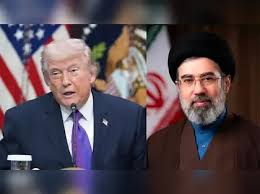

Former US President Donald Trump said he believes the newly appointed Iranian Supreme Leader, Mojtaba Khamenei, whose father was killed on the first day of the US and Israel’s war on Iran, is alive but “damaged,” adding to concerns and speculation over the health and capacity of Iran’s top leadership during a period of intense conflict.
Speaking in an interview on Fox News’ The Brian Kilmeade Show, Trump stated, “I think he probably is (alive). I think he is damaged, but I think he’s probably alive in some form, you know.” The remarks, published by Fox News late Thursday, highlighted both the uncertainty surrounding Khamenei’s condition and the heightened international attention on Iran’s leadership amid ongoing hostilities that have already killed thousands and unsettled global markets.
Mojtaba Khamenei was selected by Iran’s clerical assembly on Sunday following the death of his father, the former Supreme Leader, in the early hours of the conflict. His first public comments, however, were delivered indirectly and read out by a television presenter on Thursday, fueling further speculation about his condition and the continuity of Iran’s leadership. In his first statements, Khamenei pledged to maintain control over the strategic Strait of Hormuz, vowing to keep it closed, and issued a stark warning to neighboring countries to remove US military bases from their territories or face potential targeting by Iran. The tone of these remarks reinforced Tehran’s defiance and highlighted its strategic posture in the ongoing confrontation with the United States and Israel.
Reports from Iranian officials to Reuters indicated that the new Supreme Leader had sustained light injuries but was continuing to operate effectively, following state television reports that described him as war-wounded. The uncertainty surrounding his health has raised questions about Iran’s command structure and its capacity to direct military and political operations during the escalating conflict. Analysts note that in situations of high-intensity warfare, even minor injuries to a national leader can have outsized effects on decision-making, public perception, and the morale of military and civilian populations alike.
The current conflict began on February 28 when US and Israeli forces launched attacks on Iran, immediately triggering retaliatory strikes by Tehran against Israel and Gulf countries hosting US bases. As the war approaches the two-week mark, thousands have reportedly been killed, and financial markets worldwide have experienced significant disruption, reflecting concerns about energy supply, regional instability, and potential escalation into broader international confrontations. Leaders from Iran, Israel, and the United States have all issued statements vowing to continue fighting, signaling that despite the mounting human and economic costs, no immediate resolution is in sight.
The broader consequences of the conflict have extended far beyond the battlefield, with global trade disruptions, surging energy and food prices, and deepening insecurity affecting both regional and international stakeholders. Civilians in the Middle East have borne the brunt of the fighting, with reports of extensive casualties and widespread destruction, while international observers have expressed concern over the humanitarian toll.