

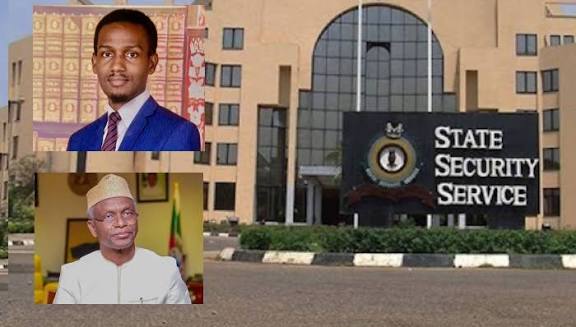

The unresolved disappearance of Abubakar Idris, widely known as Dadiyata, has once again returned to national attention following fresh developments around renewed investigations and an emotional public interview granted by his wife nearly seven years after he was taken from his home in Kaduna.
Dadiyata, a lecturer at the Federal University Dutsinma and a fierce social media critic of political power, was declared missing in August 2019 after unidentified gunmen abducted him from his residence in the Barnawa area of Kaduna, an incident that has since become one of Nigeria’s most prominent cases of alleged enforced disappearance.
Despite repeated public outcries, court actions, and sustained advocacy by civil society groups, his whereabouts have remained unknown, with no official account provided by security agencies for years.
The human cost of the disappearance was laid bare in a recent video interview conducted by Reno Omokri, who visited Dadiyata’s wife, Kadijah, at her residence and released the footage on his X handle. Speaking with visible emotion, the mother of two described the agony of living with uncertainty for years, saying the absence of closure had been more painful than any confirmed outcome.
“We pray that one day, he will come back,” she said quietly when asked how she had coped with her husband’s disappearance over the years. Appealing directly to the public, she added, “They should please do whatever they can to help us know his whereabouts, if he’s alive or not.”
Omokri, who pledged to continue pushing for justice, called on Nigerians and authorities alike to rally around the family, stressing that silence had only deepened their suffering.
Kadijah also recounted the night her husband was taken, saying she watched helplessly from a window as armed men struck just as he returned home. According to her account, the gunmen moved swiftly and deliberately, suggesting that the abduction was targeted rather than random.
“I saw everything from the window,” she said, recalling how he was seized as he alighted from his car within their compound. The trauma of that night, she explained, has remained vivid, compounded by years of unanswered questions and the burden of raising their children alone amid widespread speculation and political controversy surrounding the case.
One of the most painful moments for the family, Kadijah said, came months after the abduction when a social media post attributed to the son of former Kaduna State governor Nasir El-Rufai appeared to mock the public campaign demanding accountability.
The post read, “Those same clowns who encouraged him when he was creating false stories and capitalising on lies that could endanger lives solely for political ends are the same individuals trending hashtags asking, ‘#WhereIsDadiyata.’ Dangerous lies in the public space have consequences.”
Reflecting on the comment, Kadijah said, “It was somebody who showed me because I didn’t have a phone at that time. I felt bad about it. I can’t even explain.”
Human rights advocates at the time condemned the remark as insensitive, arguing that it trivialised a grave case involving a missing citizen whose fate had not been established by any court or investigation.
The case has since remained entangled in political disputes, resurfacing again in February 2026 when El-Rufai publicly denied any involvement in Dadiyata’s disappearance and insisted that the missing lecturer was not a critic of the Kaduna State government but of the Kano State administration.
“Dadiyata was not a fierce critic of the Kaduna State government. He was a fierce critic of the Kano State government,” El-Rufai said, adding, “I didn’t even know him. We only got the report of Dadiyata’s existence after the family reported to the police that he was abducted.”
He further argued that if any government was to be questioned, it should be Kano State, not Kaduna. The remarks reignited public debate and drew sharp reactions from political actors and civil society groups.
Former Kano State governor Abdullahi Ganduje swiftly rejected the claim, describing it as an attempt to deflect responsibility. In a statement issued through his former Commissioner for Information, Ganduje said the allegations were “reckless, unfounded, and a clear attempt to shift responsibility for an incident that occurred entirely within Kaduna State.”
He maintained that Dadiyata was widely known in Kaduna for his criticism of the state government there, adding, “Everyone in Kaduna knew the nature of the criticism he made and who it was directed at.”
Amid the renewed controversy, the Department of State Services has now reopened investigations into the 2019 disappearance, raising cautious hope among the family and campaigners. Security sources say the DSS is set to invite suspects connected to the case and review past intelligence, as part of a broader reassessment of unresolved disappearances from that period.
The Service is also reported to be examining the roles of key political figures who featured prominently in the discourse surrounding the case.