


The Federal Government’s recent policy shift in the management of oil and gas revenues is expected to significantly reshape Nigeria’s fiscal landscape, with federal, state, and local governments projected to receive additional revenue allocations estimated at about N14.57tn following a new Executive Order signed by President Bola Tinubu.
The directive mandates that royalty oil, tax oil, profit oil, profit gas, and all other revenues accruing to the Federation under production sharing, profit sharing, and risk service contracts must now be paid directly into the Federation Account, effectively dismantling long-standing retention and deduction mechanisms within the oil and gas sector.
The projected revenue boost is based on a detailed analysis of revenue inflows for 2025, drawn from monthly earnings submitted to the Federation Account Allocation Committee and obtained by our correspondent in Abuja.
A closer examination of the 2025 remittance profile indicates that the Nigerian National Petroleum Company Limited is projected to forgo approximately N906.91bn previously retained as management fees and Frontier Exploration Fund deductions, while oil and gas royalties amounting to N7.55tn and gas flaring penalties totalling N611.42bn, collected by the Nigerian Upstream Petroleum Regulatory Commission, will now flow directly into the Federation Account.
In addition, the Nigeria Revenue Service will no longer collect Petroleum Profits Tax and Hydrocarbon Tax, which together generated about N4.905tn in 2025, while the Midstream and Downstream Gas Infrastructure Fund recorded N596.61bn in the same period, pushing the cumulative value of affected revenue streams to roughly N14.57tn.
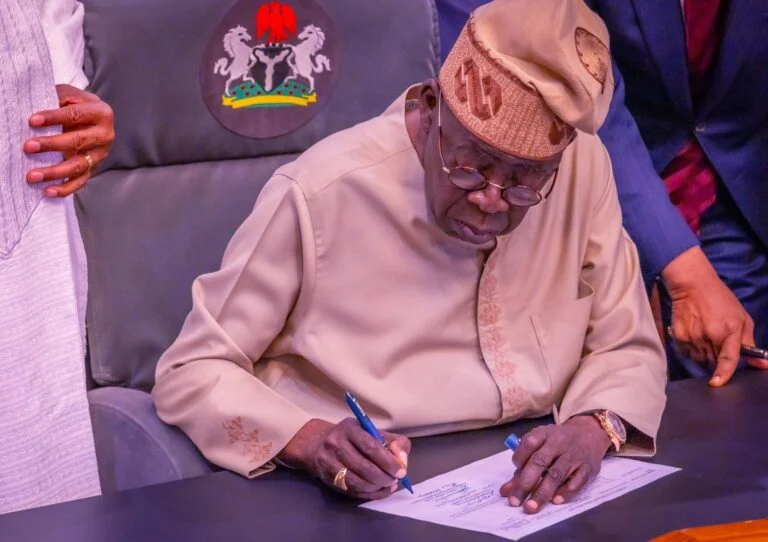
The Executive Order, signed and made public on Wednesday, formally directs that all royalty oil, tax oil, profit oil, profit gas, and other Federation revenues arising from production sharing, profit sharing, and risk service contracts be paid straight into the Federation Account without intermediate retention.
The order also abolishes the statutory 30 per cent Frontier Exploration Fund established under the Petroleum Industry Act and terminates the 30 per cent management fee on profit oil and profit gas previously retained by NNPC Limited.
Taking effect from February 13, 2026, the policy is designed to protect oil and gas revenues due to the Federation and substantially improve remittances into the common pool shared by all tiers of government.
According to official details, the President invoked Section 5 of the Constitution of the Federal Republic of Nigeria as amended, anchoring the directive on Section 44(3), which vests the ownership and control of all minerals, mineral oils, and natural gas in the Government of the Federation.
Sources further disclosed that although the Executive Order took formal effect in February, its implementation quietly commenced in January, with its financial impact expected to become evident in revenue allocations at the next FAAC meeting scheduled for next week.
Since the enactment of the Petroleum Industry Act in 2021, only 40 per cent of proceeds from Production Sharing Contracts had been paid into the Federation Account, with the remaining 60 per cent retained by NNPC Limited and split evenly between the Frontier Exploration Fund and management fees.
Under the new directive, this structure has been dismantled, ending NNPC’s role in collecting and managing the 30 per cent Frontier Exploration Fund and marking a major shift in the fiscal architecture of the oil and gas sector.
The Frontier Exploration Fund was originally designed to finance hydrocarbon exploration activities in Nigeria’s frontier basins, including the Chad Basin in the North-East, the Sokoto Basin in the North-West, the Bida Basin in North-Central Nigeria, the Benue Trough, and parts of the Dahomey Basin, regions outside the traditional Niger Delta producing belt.
These areas were targeted to expand Nigeria’s hydrocarbon reserves, reduce geographic concentration of oil production, and enhance long-term energy security through seismic surveys, exploratory drilling, geological studies, and appraisal campaigns.
The fund was created under the Petroleum Industry Act to address the high-risk and capital-intensive nature of frontier exploration, which policymakers considered critical to sustaining exploration momentum.
Beyond ending the Frontier Exploration Fund, the Executive Order also strips NNPC Limited of the 30 per cent management fee on profit oil and profit gas revenues and directs all operators and contractors under Production Sharing Contracts to remit royalty oil, tax oil, profit oil, profit gas, and other government interests directly into the Federation Account.
In addition, payments of gas flare penalties into the Midstream and Downstream Gas Infrastructure Fund have been suspended, with the Nigerian Upstream Petroleum Regulatory Commission now required to remit all such penalties directly to the Federation Account, while all expenditures from the gas infrastructure fund must comply strictly with existing public procurement laws.
President Tinubu, in a post on his verified X handle, said excessive deductions, overlapping funds, and structural distortions had for years weakened remittances to the Federation Account, warning that the practice had slowed national development and must be brought to an end.
He stressed that revenues intended for federal, state, and local governments had been trapped in layers of charges and retention mechanisms, depriving Nigerians of the full benefits of their natural resources.
He further emphasised that oil and gas revenues must serve Nigerians first, describing the reforms as a step toward fairness and fiscal responsibility while safeguarding funds needed to strengthen national security, expand education and healthcare, stabilise the economy, and support Nigeria’s energy transition.
The President also stated that NNPC Limited would now operate strictly as a commercial enterprise in line with the law, declaring that the era of duplicative deductions and fragmented oversight in the sector was over.
He announced the approval of an implementation committee to ensure coordinated and effective execution of the Executive Order and disclosed that his administration would undertake a comprehensive review of the Petroleum Industry Act to address structural and fiscal weaknesses undermining national revenue, reaffirming that the reforms align with his Nigeria First policy agenda.
An analysis of FAAC revenue data for 2025 suggests the reallocation could have wide-ranging implications for government earnings and sector institutions, with NNPC Limited potentially losing about N906.91bn split evenly between management fees and Frontier Exploration Fund deductions of N453.455bn each.
Records show that frontier exploration receipts fell short of the N710.520bn budgeted for 2025, leaving a deficit of N257.066bn, while monthly inflows fluctuated sharply, reflecting volatility in Production Sharing Contract profits throughout the year. Similar volatility characterised NNPC’s management fees, which mirrored frontier deductions month by month.
Other institutions may face deeper financial and operational adjustments, particularly the Nigerian Upstream Petroleum Regulatory Commission, which stands to forgo oversight of oil and gas royalty collections worth N7.55tn in 2025, along with N611.42bn in gas flaring penalties, potentially reducing its cost-of-collection revenue used to fund operations.
The Nigeria Revenue Service will also relinquish direct control over Petroleum Profits Tax and Hydrocarbon Tax collections amounting to N4.905tn, while the Midstream and Downstream Gas Infrastructure Fund, which recorded N596.61bn in 2025, will now be subject to stricter public finance rules governing statutory allocations.
Cumulatively, the affected revenue streams amount to approximately N14.72tn, though actual inflows will continue to depend on crude oil production levels, exploration activity, and global market conditions.
The anticipated surge in direct remittances is expected to deliver a substantial boost to sub-national finances, potentially easing budget deficits, strengthening fiscal buffers, and enabling more consistent funding for infrastructure and social services across the federation.
Over the years, bodies such as the Nigeria Extractive Industries Transparency Initiative and the National Assembly of Nigeria have repeatedly raised concerns about revenue leakages, delayed remittances, and opaque deductions in the oil and gas sector, and the new directive signals what many analysts see as a decisive step toward greater transparency, discipline, and accountability in Nigeria’s most critical revenue-generating industry.
Experts weigh in on revenue reform order
Energy economists and capital market scholars have offered contrasting but largely supportive reactions to President Bola Tinubu’s recent Executive Order mandating the direct remittance of oil and gas revenues to the Federation Account, with calls for caution, legal clarity, and strong institutional safeguards to ensure the reform achieves its objectives without undermining statutory frameworks or investor confidence. Commenting on the policy shift, the Chair of the Oil, Gas, and Energy Policy Forum, Wumi Iledare, urged the Federal Government to carefully consider the broader legal and institutional implications of the order, even as he acknowledged its stated fiscal intentions.
He described the directive as a “significant fiscal intervention” aimed at strengthening revenue transparency, curbing discretionary retention of public funds, and ensuring that statutory remittances flow more efficiently to the federal, state, and local governments at a time of heightened fiscal pressure.
In a statement obtained by The PUNCH on Thursday and titled “PEWI Responds to Presidential Executive Order on Direct Remittance of Oil and Gas Revenues”, Iledare said the objectives outlined by the administration were understandable given Nigeria’s current economic realities, particularly rising public debt and constrained budgets.
“Safeguarding public revenues, curbing inefficiencies, and enhancing fiscal discipline are legitimate public finance priorities, particularly in a period of budgetary strain and debt sustainability concerns,” he said.
However, he cautioned that elements of the Executive Order may intersect with existing statutory provisions under the Petroleum Industry Act of 2021, including the Frontier Exploration Fund, the Midstream and Downstream Gas Infrastructure Fund, and established fiscal arrangements under Production Sharing Contracts, raising questions about legal alignment and implementation certainty.
Iledare warned that while the President possesses executive authority under the Constitution to implement laws, substantive changes to fiscal frameworks created by statute may require legislative backing to avoid constitutional and institutional conflicts.
“While Section 5 of the Constitution empowers the President to implement and enforce laws, substantive changes to statutory fiscal frameworks may require legislative amendments to ensure constitutional alignment and institutional certainty,” he noted. He further stressed the importance of clearly distinguishing between contractual entitlements owed to operators, corporate retained earnings of Nigerian National Petroleum Company Limited, and funds statutorily earmarked under the PIA, warning that blurring these lines could create confusion and disputes. “Clarity in these distinctions is critical to avoid conflating contractual entitlements with discretionary fiscal practices,” he explained.
On the specific issue of direct remittance of royalty oil, tax oil, and profit oil into the Federation Account, the policy forum acknowledged the potential benefits of improved transparency and reduced intermediation in revenue flows but stressed that reforms must be carefully sequenced.
According to Iledare, abrupt changes without adequate consultation could unsettle contractual stability and weaken investor confidence in Nigeria’s oil and gas sector. “NNPC Limited’s dual role as both commercial operator and concessionaire under certain arrangements has long presented institutional tensions within the post-PIA framework,” he said, adding that, “Any reform aimed at reinforcing NNPC’s commercial identity must be anchored in legal clarity and predictable governance mechanisms.”
As a result, the forum recommended a three-pronged approach involving prompt legislative consultation to ensure statutory coherence, transparent engagement with operators and investors, and a phased reform rollout that balances fiscal urgency with institutional stability.
“Reforms that improve transparency and fiscal integrity are welcome,” the statement concluded, “but sustainable reform must align with constitutional processes, statutory frameworks, and investor predictability. PEWI will continue to monitor developments and provide objective, technically grounded analysis in the public interest.”
In contrast, the Capital Market Academics of Nigeria (CMAN) expressed strong support for the President’s action, describing it as a landmark correction of what it termed a long-standing fiscal imbalance introduced by the Petroleum Industry Act.
In a statement released on Thursday, the President of CMAN, Uche Uwaleke, hailed the signing of Executive Order 9 of 2026, which mandates the direct remittance of 60 per cent of oil and gas profits to the Federation Account, as a decisive and historic intervention.
“This marks one of the most courageous reforms of his administration and a decisive step toward strengthening fiscal transparency and equity in revenue distribution,” Uwaleke said.
According to Uwaleke, the previous arrangement, under which a significant portion of oil and gas proceeds was retained outside the Federation Account, undermined the principle of collective ownership of national resources and weakened the fiscal capacity of sub-national governments.
He argued that by reversing this structure, the President had restored fairness in revenue sharing and reinforced the constitutional principle that natural resources belong to all Nigerians.
“By correcting this anomaly, the President has ensured that all tiers of government benefit equitably from the nation’s oil and gas wealth. NNPCL, as a limited liability company, must operate independently on its own revenues rather than relying on public funds,” he said.
While applauding the reform, CMAN also stressed the importance of strong institutional oversight to guarantee transparency and accountability in implementation. The group specifically called for the inclusion of the Chairman of the Revenue Mobilisation Allocation and Fiscal Commission on the committee overseeing the execution of the Executive Order, arguing that such representation would strengthen credibility and public trust.
“CMAN underscores the importance of including the RMAFC Chairman to ensure transparency and accountability. This development is a victory for the Federation Accounts Allocation Committee and for fiscal justice in Nigeria,” the statement said.
The capital market scholars further urged the Federal Government to extend the reform framework to Joint Venture oil and gas assets, contending that revenues from such arrangements should also be returned fully to the Federation Account to maximise national earnings.
According to CMAN, the anticipated increase in revenue inflows would significantly enhance the capacity of federal, state, and local governments to deliver essential public services while also stimulating activity in the capital markets through improved fiscal stability.
“We remain committed to advocating for policies that strengthen transparency and fairness,” Uwaleke concluded. “We call on all stakeholders to support the President’s reform agenda for the benefit of all Nigerians.”