

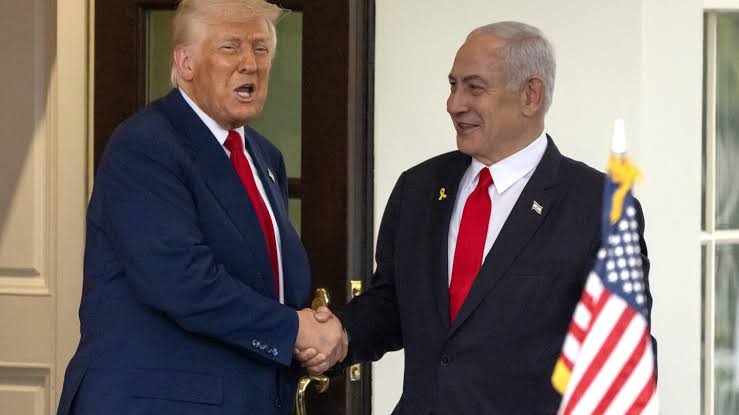

President Donald Trump is set to welcome Israeli Prime Minister Benjamin Netanyahu to the White House on Wednesday as both leaders seek to navigate rising tensions across the Middle East and advance negotiations over Iran’s nuclear programme. The visit comes at a critical moment in regional diplomacy, with disagreements over how to contain Iran’s enrichment of uranium and its support for proxy militias like Hamas and Hezbollah.
Netanyahu, arriving in Washington amid heightened geopolitical pressure, told reporters before his departure that he would present Trump with “our outlook regarding the principles of these negotiations.” His remarks set the stage for what is expected to be a detailed discussion on how the United States and Israel can align their approaches to curbing Tehran’s nuclear ambitions, as well as broader security concerns.
Iran has made it clear that it will not agree to limit uranium enrichment unless Western nations ease the economic sanctions that have weighed heavily on its economy. This impasse underscores the challenge facing both Washington and Jerusalem as they seek to chart a diplomatic path forward without escalating into open conflict.
Netanyahu’s visit marks his sixth trip to the United States since Trump returned to office, more than any other world leader, reflecting the close strategic relationship between the two countries. A statement from his office said he plans to urge Trump to push for an expanded agreement that would go beyond nuclear restrictions to include limits on Iran’s ballistic missiles and its backing of militant groups.
“The Prime Minister believes that any negotiations must include limiting ballistic missiles and ending support for the Iranian axis,” his office said in a pre-trip statement, highlighting Jerusalem’s broader security demands.
Trump, for his part, has indicated cautious confidence in reaching a deal with Iran. In recent comments, he acknowledged Tehran’s interest in an agreement but maintained that any settlement must include stringent enforcement measures. “Iran wants to make a deal very badly,” Trump said in an interview with Axios, while stopping short of committing to a specific outcome.
The White House has also bolstered the U.S. military presence in the region. Trump said he was considering dispatching a second aircraft carrier strike group to deter potential threats from Iran if negotiations collapse. The USS Abraham Lincoln carrier was already moved to the Middle East last month, following Trump’s earlier threats of “action” should diplomacy fail.
A key backdrop to these high-stakes talks is the longstanding dispute over the 2015 Joint Comprehensive Plan of Action (JCPOA), the nuclear deal from which the U.S. withdrew in 2018 under Trump’s previous administration. That withdrawal, intended to tighten pressure on Iran’s nuclear ambitions, has been a central factor in the renewed confrontations between Tehran and its adversaries.
Iran’s own internal stability adds another layer of complexity. Mass protests across Iranian cities since late 2025 sparked by economic strain and political discontent have made Tehran domestically vulnerable, with estimates suggesting tens of thousands have been killed in the crackdown.
Netanyahu’s visit also occurs against the backdrop of a fragile Israel-Hamas ceasefire, agreed in October 2023 to halt a devastating war triggered by a Hamas attack that killed about 1,200 people in Israel. Since then, renewed violence and delays in implementing subsequent phases of the truceincluding disarmament and reconstruction have kept the region on edge.
Israeli officials have made it clear that Jerusalem reserves the right to act militarily against Iran if diplomacy does not sufficiently safeguard its security interests. “We want peace but must ensure Iran does not threaten our existence,” one Israeli official said, reflecting concerns shared by Netanyahu’s far-right government partners.
Experts suggest that the U.S. and Israel believe they hold leverage in negotiations due to Iran’s weakened position following the protests and military engagements in the region last year. “The Iranian regime today is really vulnerable,” said a Middle East analyst, noting that both Washington and Jerusalem see an opportunity to press Tehran for more concessions.
Despite the urgency, some former U.S. officials warn that Trump may be cautious about direct military confrontation with Iran, especially as he enters an election year. “I don’t think Trump wants a major military confrontation with Iran going into an election year,” said a former ambassador, pointing out that Tehran is likely aware of this calculation.
The planned discussions will likely also touch on the ongoing situation in Gaza and the next phase of peace efforts, including a new “Board of Peace” initiative launched by Trump to oversee ceasefire implementation and reconstruction, backed by several international partners.
A White House spokesperson said Israel “has had no better friend in its history than President Trump” and reiterated that Washington continues to work “closely with our ally Israel to implement President Trump’s historic peace agreement and to strengthen regional security.”
As Netanyahu and Trump prepare to sit down at the White House, the broader implications for U.S.-Iran diplomacy, Israel’s security strategy, and the future of peace efforts in Gaza remain uncertain. Observers say the outcome could significantly influence the trajectory of Middle East stability in the months ahead.