

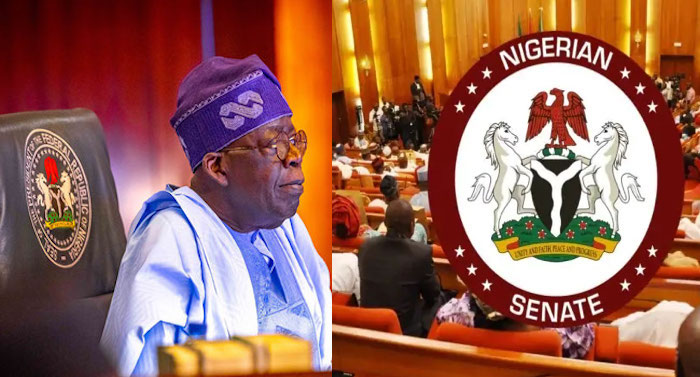

Amid heightened public scrutiny over proposed changes to Nigeria’s electoral framework, the Senate on Tuesday endorsed a revised provision that allows polling unit results to be sent electronically to the Independent National Electoral Commission’s Result Viewing Portal (IReV), while also retaining manual collation through Form EC8A where technological limitations prevent digital transmission. The move came after an emergency review of a contentious section of the Electoral Act (Repeal and Re-enactment) Amendment Bill, 2026, which had drawn widespread reactions from political actors, civic groups, and young Nigerians concerned about the integrity of future elections.
The reconsideration followed days of criticism and debate across the country, with stakeholders questioning earlier wording of the clause and urging lawmakers to clarify how technology would be used in result management. While the Senate affirmed electronic transmission as part of the process, it did not make the measure mandatory in all circumstances and declined to insert language that would expressly require real-time uploading of results, a demand that had featured prominently in public discourse.
According to the reviewed provision, presiding officers are expected to transmit polling unit outcomes electronically to the IReV portal after completing the required documentation and certification procedures at the polling station. The amendment, however, introduces a contingency: where communication or network challenges prevent electronic transmission, the manually completed Form EC8A becomes the principal document for collation and declaration.
As the matter was put to a voice vote, Senate President Godswill Akpabio called on dissenting lawmakers to follow parliamentary procedure if they opposed the revision. “It’s very simple. If you disagree with him, move your counter motion. So, if you agree with him, you agree with me when I put the votes,” he told the chamber, seeking to restore order as debate intensified.
Akpabio explained that the motion before senators was intended to revisit and rescind an earlier decision relating to Section 60(3) of the Electoral Act, which had generated public unease. “When I ask for the votes, when I ask for your consent, let me read the motion. His earlier motion, which passed in our last sitting, he has sought to rescind that. That is in respect of Section 60, Subsection 3. And this is what he said,” he stated before reading the revised wording aloud.
Quoting the amended clause, the Senate President said, “That the presiding officer shall electronically transmit the results from each polling unit to the IReV portal. And such transmission shall be done after the prescribed Form EC8A has been signed and stamped by the presiding officer and/or countersigned by the candidates or polling agents, where available at the polling units, because sometimes you don’t see any polling agent.”
He further clarified the fallback arrangement built into the amendment, noting, “Provided that if the electronic transmission of the results fails as a result of communication failure — in other words, maybe network or otherwise — and it becomes impossible to transmit the results electronically in Form EC8A signed and stamped by the presiding officer and/or countersigned by the candidates or polling agents where available at the polling units, the Form EC8A shall in such a case be the primary source of collation and declaration of results.”
Despite the explanations offered on the Senate floor, the revised clause has continued to prompt debate among opposition figures and civil society organisations, many of whom argue that prioritising manual documentation in cases of transmission failure could create vulnerabilities in areas where network access is unreliable. These groups maintain that the strength of the electoral process lies in minimising discretion and ensuring that technology, where available, serves as a transparent and verifiable tool in result management.
Sudden Turn of Events
Proceedings in the Senate took a turbulent turn before the eventual reconsideration of the disputed clause, as lawmakers found themselves locked in a heated procedural battle over how the earlier decision on the Electoral Act amendment had been handled. What began as a routine sitting quickly shifted into a tense confrontation after the Senate Chief Whip, Senator Tahir Monguno, rose on a point of order to challenge the chamber’s previous approval of Section 60(3) of the bill, arguing that the matter required urgent review under the Senate’s internal rules.
Citing Orders 1(b) and 52(6) of the Senate Standing Orders, 2023 (as amended), Monguno formally moved that the earlier resolution be rescinded to allow for fresh consideration of the clause. His motion, seconded by Senator Abdul Ningi, immediately altered the atmosphere in the chamber, drawing audible reactions from lawmakers seated across party lines as many struggled to follow the procedural implications of the request and what it meant for the wording already adopted in the bill.
The situation deteriorated rapidly as senators began to rise simultaneously on points of order, with voices raised and arguments flying across the aisle. The tension deepened when Monguno proceeded to read out what he described as the revised wording of the clause, omitting the phrase “real-time” and substituting the word “transmission” with “transfer,” a change that some lawmakers interpreted as more than a semantic adjustment.
Among the most vocal critics was Senator Enyinnaya Abaribe, who repeatedly interrupted the proceedings, insisting that the chamber adhere strictly to the original text as contained in the committee report. His objections, delivered through successive points of order, were met with counter-arguments from other senators, creating a noisy and disorderly scene that required repeated interventions from the presiding officer.
The crux of the dispute centred on the officially documented wording of the clause as captured on page 45 of the report of the Senate Committee on Electoral Matters, which stated that presiding officers “shall electronically transmit the results from each polling unit to the IReV portal in real time” after completing the required documentation. The removal of “real time” and the alteration of key terminology became the focal point of the disagreement, with some lawmakers warning that the integrity of the legislative process itself was at stake.
As the exchanges grew more heated and attempts to restore calm proved difficult, Abaribe escalated the matter by invoking Order 72 of the Standing Orders, formally requesting a division of the chamber so that senators’ positions could be clearly recorded rather than decided through voice vote.
Committee Set Up to Reconcile Bill
As debate over the Electoral Amendment Bill intensified, the Senate moved to establish a conference committee to resolve differences between its version of the legislation and that earlier passed by the House of Representatives. The announcement was made during the emergency plenary by Senate President Godswill Akpabio, who said the step was necessary to fast-track agreement on the final wording of the bill.

Akpabio named Senator Simon Lalong as chairman of the 12-member committee. Other members listed were Senators Orji Uzor Kalu, Tahir Monguno, Adamu Aliero, Abba Moro, Asuquo Ekpenyong, Aminu Iya Abbas, Tokunbo Abiru, Niyi Adegbonmire (SAN), Jibrin Isah, Ipalibo Banigo, and Onyekachi Nwebonyi. The Senate President noted that the size of the committee had been increased after consultations with the leadership of the chamber.
“After consultation with the leadership, we have moved the number from nine to 12. I will now read out the names of the conference committee members from the Senate,” Akpabio told lawmakers. He urged the panel to treat the assignment as urgent and time-sensitive.
“When you meet, you should recognise that this is a matter of urgency. I believe that if you are able to conclude within the next few days or one week, the President should be able to sign the amended Electoral Bill into law within the month of February,” he added. He further stated that once harmonised, the document would be forwarded to President Bola Tinubu for assent before the end of the month.
Reacting to the development, Senator Orji Uzor Kalu expressed support for the Senate’s position, describing it as practical and inclusive. In a message shared on his Facebook page, he wrote, “Today at emergency plenary, I supported and added my voice to the Senate’s new position approving the electronic transmission of election results from polling units across Nigeria.”
Kalu explained that the amendment recognises electronic transmission as the main method where infrastructure allows. “This means electronic transmission becomes the primary method where the technology is available and functional. However, where it fails or becomes impossible, the duly signed Form EC8A remains the valid and primary source of results,” he stated.
He added that the arrangement was designed to prevent the exclusion of communities facing connectivity challenges. “This balanced approach strengthens transparency, fairness, and credibility in our electoral process, while ensuring that voters in network-challenged communities are not disenfranchised. Our democracy must work for every Nigerian, everywhere,” Kalu said.
However, not all senators were in agreement. Senator Natasha Akpoti-Uduaghan openly disagreed with the direction taken by the Senate, insisting that the law should clearly retain real-time electronic transmission of results as originally proposed.
In a Facebook post ahead of the sitting, she wrote, “As I step into the Senate chamber today, I carry with me the hopes and expectations of millions of Nigerians who yearn for stronger democratic safeguards enshrined in our laws.” She argued that digital transparency is central to restoring trust in elections.
“Real-time electronic transmission of election results is a critical step toward deepening transparency, preserving the sanctity of the people’s mandate, and restoring public confidence in our electoral process,” she said, adding, “Nigeria deserves elections that inspire trust, strengthen unity, and reflect the genuine will of the people.”
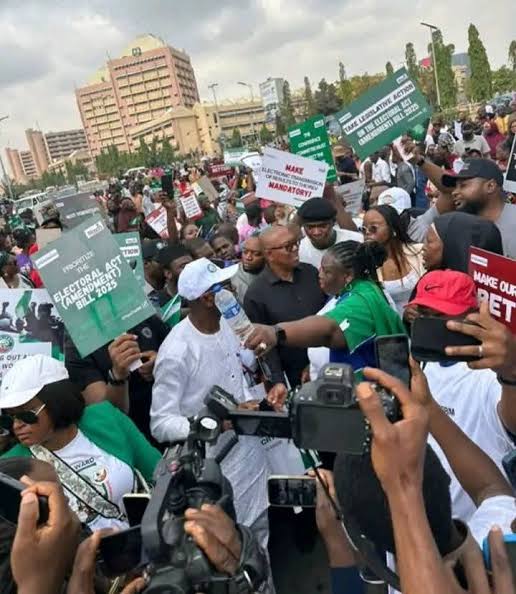
Her remarks came amid protests outside the National Assembly Complex by demonstrators under the banner “Occupy the National Assembly,” who accused lawmakers of weakening earlier reforms as the country prepares for the 2027 general elections.
Leaders Demand Real-Time Results
Several prominent political figures and activists have openly criticised the Senate’s recent decision to retain manual collation as a fallback in the proposed Electoral Act amendment, arguing that the approach could undermine confidence in future elections. Their reactions came from different parts of the country and in various public forums, but shared a common concern about the absence of an explicit requirement for real-time electronic transmission of results from polling units.
Former Vice President Atiku Abubakar voiced his reservations during a press briefing in Minna, Niger State, after a private meeting with former Military President, General Ibrahim Babangida. He said the combination of electronic and manual processes could complicate election management and confuse both voters and officials. “The expectations of Nigerians were for real-time electronic transfer at every stage of the election process, but what we have now is a mixture of electronic and manual transmission, which is going to cause more confusion than clarity,” Atiku said.
He argued that a single, clearly defined system would be more effective in strengthening transparency. “A one-tier system based strictly on real-time electronic transmission would have been our preference. There is a need for opposition parties to come together and push for this,” he added, describing the Senate’s position as a compromise that did not go far enough in addressing public concerns.
Atiku further stated, “We shouldn’t allow it to rest where they wanted it to rest today. I don’t support that,” signalling his intention to continue advocating for changes to the clause before the bill is finalised.
Former Rivers State Governor, Rotimi Amaechi, also joined demonstrators at the National Assembly complex in Abuja, lending his voice to calls for clearer safeguards in the law. Addressing the crowd, Amaechi said real-time transmission could help reduce election-related violence. “The advantage is that very few people will die during elections. You are saving the lives of Nigerians,” he told protesters.
Amaechi warned that electoral malpractice often fuels conflict, urging citizens to remain vigilant. “If you think they won’t rig, you’re wasting time. To stop them from rigging, we must come out in large numbers. When they see how many people are watching, they will be careful,” he said, expressing frustration at what he described as official indifference to citizens’ concerns.
He added, “The only way to reduce electoral violence is to allow proper transmission and re-transmission of results,” stressing that transparency at polling units is critical to preventing disputes later in the process.

Former Anambra State Governor and 2023 presidential candidate, Peter Obi, criticised Nigeria’s electoral system after joining a protest at the National Assembly on February 9. He described the current framework as a “disgrace to the continent” and called for full use of technology to safeguard election integrity.
Obi dismissed claims that poor network coverage in some areas makes electronic transmission impractical. “Financial institutions operate nationwide through secure digital networks to conduct transactions and collect taxes daily. If banking systems function seamlessly, our electoral system can and should do the same,” he said.
He stressed that anyone seeking public office must emerge through a transparent and honourable process. “Anyone seeking office must participate in open campaigns, engage in public debates, and fully comply with constitutional requirements,” Obi said.
On election results, Obi was clear about the need for speed and accuracy. “Most importantly, election results must be transmitted electronically and in real time to protect the people’s mandate and eliminate manipulation,” he added.
Obi also praised Nigerian youths for turning out in large numbers during the protest. “Young people have shown their strength and resolve. They must continue to push for credible elections and ensure that democratic accountability is upheld in every election cycle,” he said.
He said Nigeria’s electoral system must catch up with other sectors. “We cannot continue to rely on outdated systems that invite fraud and confusion. Technology is not a luxury it is a necessity for credible elections,” Obi stated.
Obi urged all stakeholders, including political parties and civil society, to demand that electronic transmission is fully implemented. “The people must insist that their votes are counted accurately and reported instantly. Anything less undermines democracy,” he said.
He warned against complacency among political leaders. “It is not enough to promise reforms. Citizens must see them implemented effectively. Without action, rhetoric is meaningless,” Obi added.
Obi highlighted the disparity between the banking system and elections. “If millions of financial transactions can be processed daily without errors, there is no excuse for delayed or manipulated election results. Our democracy deserves the same efficiency,” he said.
He criticised reliance on manual transmission as a safeguard. “Excuses about network issues should not hinder the adoption of electronic transmission. Our systems are capable; the will to implement must match the capacity,” Obi said.
Obi called on political parties to fully commit to transparent elections. “Parties must embrace reforms, accept oversight, and ensure that their candidates are subjected to fair competition. Without accountability, elections lose legitimacy,” he said.
He encouraged youth groups to sustain pressure on lawmakers and electoral officials. “The energy we saw during the protest must continue. Civic engagement is the cornerstone of electoral reform. Without it, nothing will change,” Obi added.
Obi framed the push for technology as a moral responsibility. “Credible elections are not just a political issue—they are a matter of justice for every Nigerian. We must demand systems that reflect the people’s will faithfully and transparently,” he said.
He stressed that reforms must leave manual collation only as a last resort. “Electronic transmission should be the standard. Manual backups are acceptable only when all else fails,” Obi said.
Former Kaduna State Governor, Nasir El-Rufai, speaking during an interview on Trust TV, said he would have participated in the protest if he had been in Nigeria. He criticised the Senate for what he described as watering down key provisions on electronic transmission. “It’s unfortunate I have not been able to return to Nigeria. I would have joined other leaders in asking the National Assembly to restore real-time and mandatory transmission of results,” El-Rufai said.
According to him, “Real-time electronic transmission is one of the strongest tools against manipulation. Resistance to it is largely political.” He suggested that reluctance to adopt the measure fully was linked to partisan interests rather than technical challenges.
El-Rufai noted that while the House of Representatives appeared more receptive to the reform, the Senate had yet to fully align with that position. He maintained that adopting a stricter digital process would greatly improve the credibility of elections.
Former presidential candidate and activist Omoyele Sowore also appeared at the National Assembly to support protesters calling for stronger electoral safeguards. Addressing supporters, Sowore criticised the political class and accused elected officials of abandoning reform promises once in office.
“Prepare to see the end of this political class. Nobody can reform them. Some of the people who supported these reforms before are now voting against them,” he said. He urged Nigerians to remain united and persistent in demanding accountability.
Sowore added, “We are not here for a one-day protest. We are here to prepare for the future,” suggesting that sustained civic engagement would be necessary to bring about meaningful changes to the electoral system. He concluded by saying, “Elections alone may not solve Nigeria’s problems. There has to be an electoral awakening that forces real change.”
Opposition and Civil Society Push Back on Manual Transmission Clause
Opposition parties and civil society organisations have continued to express concern over the Senate’s decision to retain a manual transmission clause in the proposed Electoral Act amendment, warning that it could weaken transparency in future elections. The Peoples Democratic Party (PDP) described the move as a “backdoor attempt” that could undermine reforms, calling on lawmakers to adopt the version passed by the House of Representatives.
In a statement, the PDP’s National Publicity Secretary, Ini Ememobong, said, “We have taken note of the Senate’s reconsideration, which introduced an addendum permitting manual transmission where technology is said to fail. We hold the firm view that this addendum is a backdoor attempt to achieve the same objective as the earlier outright rejection of electronic transmission.” The party also questioned claims that technology could fail, pointing out that systems such as the Bimodal Voter Accreditation System have worked effectively in past elections.
The PDP urged the National Assembly’s conference committee to harmonise the bill in line with the House’s version to ensure that the 2027 elections are conducted with maximum transparency. “We call on the conference committee to adopt the House version as the harmonised bill ahead of the general elections,” the party added.
The New Nigeria People’s Party (NNPP) also raised concerns about the Senate’s proviso. Its National Publicity Secretary, Ladipo Johnson, said the clause leaves room for manipulation and could compromise electoral integrity. “The Senate and the APC generally have proved themselves to be unwilling participants in the process of ensuring that our democracy becomes more transparent and efficient. Therefore, it is difficult to trust them,” he said.
Johnson added, “They have left a proviso. That proviso means that if they decide to rig, nothing stops polling unit officers from saying ‘my network is not going, and I have to take it by hand.’ Nigerians should remain wary, as this party has shown reluctance to push democracy forward.”
The African Democratic Congress (ADC) commended citizens for influencing the Senate to reverse some of the more controversial provisions. In a statement by National Publicity Secretary Bolaji Abdullahi, the party said, “The decision of the 10th Senate to urgently reverse the contentious provisions of the Electoral Amendment Bill is a significant victory for the Nigerian people. It demonstrates that when citizens act with unity, clarity of purpose, and resolve, they can move mountains.”
Abdullahi urged Nigerians to stay vigilant until the bill is signed into law and fully implemented. “We must remain vigilant to ensure there are no last-minute betrayals or technical ambiguities that could undermine the will of the people,” he said, highlighting that the Senate’s reversal marked only a partial step forward.
Dr Yunusa Tanko, National Coordinator of the Obidient Movement Worldwide, described the Senate’s decision as inconclusive. He argued that allowing manual transmission could create confusion and give officials opportunities to manipulate results. “The pressure on the Senate led to this inconclusive decision. It’s going to lead to chaos at polling units and give room for people to manipulate the system,” Tanko said.
He continued, “There must be clarity. If an agent claims an area has no network, even when there is one, how can we ensure results are transmitted correctly? It’s embarrassing in the 21st century that network challenges are still being used as an excuse. Countries like India manage real-time transmission across billions of people in a single day. It’s not rocket science.”
Civil society organisations also criticised the Senate’s decision. The Executive Director of the Civil Society Legislative Advocacy Centre, Auwal Musa, also known as Rafsanjani, said, “What they have done is to give Nigerians something with one hand and take it back with the other.” He warned that retaining manual collation could allow manipulation and undermine public trust. “Election rigging starts from the legal framework,” Musa said.
Agianpe Onyema, Coordinator of the Nigeria Civil Society Situation Room, said civil society groups would focus on engaging the conference committee to ensure credible reforms. She stressed, “What we are asking for is simple — real-time, mandatory electronic transmission of results, no more, no less.”
The PDP, NNPP, ADC, and civil society groups have all called for a harmonised version of the bill that enshrines mandatory electronic transmission as the primary method, with manual collation only as an absolute last resort in case of genuine technical failure.
Analysts note that the decision of the National Assembly and the conference committee will be closely watched in the run-up to the 2027 general elections. According to political observers, the outcome may significantly influence public confidence in Nigeria’s electoral process and the credibility of its democratic institutions.
Observers also highlight that the current controversy has mobilised youth movements, activists, and opposition parties, creating sustained pressure on lawmakers to prioritise transparency over political expediency. “The citizens’ vigilance has already forced the Senate to reconsider some provisions. The focus now is to ensure they do not backtrack at the final stage,” one analyst said.
As attention shifts to President Bola Tinubu’s eventual assent and the final harmonisation of the bill, both political actors and civil society groups are expected to continue monitoring developments closely. The consensus among observers is that any loopholes left in the legal framework could have lasting consequences for electoral integrity in Nigeria.
Ultimately, the debate underscores the growing demand for electoral reforms that balance technological efficiency, transparency, and inclusivity, while preventing any opportunities for manipulation or disenfranchisement in future elections.