

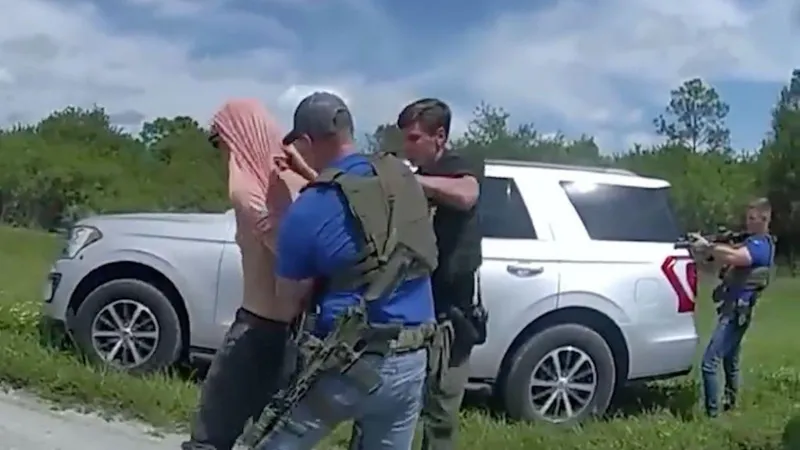

In a dramatic conclusion to a high-profile federal trial, Ryan Routh, 59, was sentenced to life in prison on Thursday for attempting to assassinate former President Donald Trump at the Trump International Golf Club in West Palm Beach, Florida, in September 2024. The attempted attack occurred while Trump was still a presidential candidate, and the case has drawn intense national attention due to the premeditated nature of the crime and the audacity of carrying it out on a public golf course. Federal authorities described the incident as a narrowly averted tragedy after a US Secret Service agent, patrolling the area, spotted a rifle barrel protruding from the bushes where Routh had concealed himself and fired, forcing him to flee. Routh was apprehended shortly thereafter nearby, and the events set in motion a legal process that culminated in the life sentence handed down by Judge Aileen Cannon, who described the crime as “undeniably warranting a life sentence” and highlighted the calculated planning, the willingness to kill anyone in his path, and the absence of remorse expressed by Routh throughout the investigation and trial.
During the sentencing, Judge Cannon emphasized the extensive steps Routh had taken over months to prepare for the assassination attempt, underscoring that his actions reflected a deliberate intent to carry out a violent act against a major political figure. “[H]e took steps over the course of months to assassinate a major Presidential candidate, demonstrated the will to kill anybody in the way, and has since expressed neither regret nor remorse to his victims,” Cannon stated, noting that the gravity of the crime demanded the harshest available sentence under federal law. In response to the sentencing, Routh’s defense attorney, Martin Ross, indicated the legal team would pursue an appeal, maintaining that procedural and evidentiary questions raised during the trial warrant review. The life sentence concludes a trial marked by a series of courtroom disruptions and extraordinary behavior by Routh, who opted to represent himself and frequently diverted proceedings by issuing tangential remarks referencing historical figures such as Adolf Hitler and contemporary world leaders, including Russian President Vladimir Putin, as well as making seemingly erratic personal statements.
Routh’s background added layers of complexity to the trial proceedings, highlighting his movement across states and his reported behavioral instability. A native of North Carolina who had resided in Hawaii prior to his arrest, Routh demonstrated increasingly erratic conduct throughout the court proceedings, including an infamous moment when he challenged Trump to a game of golf during the trial, actions that repeatedly drew rebukes from Judge Cannon. Following the jury’s guilty verdict, Routh attempted to stab himself in the neck with a pen, prompting immediate intervention by US marshals. This episode underscored both the volatility of the defendant and the psychological intensity surrounding the case. Prosecutors presented extensive evidence detailing the assassination attempt, including the discovery of a semiautomatic rifle with a scope and an extended magazine at the site where Routh had been hiding, a notebook listing locations where Trump was likely to appear, and a written note addressed to an acquaintance in which he described his intent as “an assassination attempt.” Lead prosecutor John Shipley told jurors that the “mountain of evidence” clearly demonstrated the degree to which Routh had prepared for and almost executed his plan, emphasizing that the crime was not spontaneous but the result of meticulous and sustained preparation.
The trial itself, which began on September 8, 2025, was marked by Routh’s insistence on self-representation and frequent courtroom theatrics that challenged the decorum of the proceedings. Court records detail multiple interruptions and statements that were tangential or irrelevant, compelling Judge Cannon to frequently remind the jury of their focus and to adjourn for recesses to maintain order. Throughout the trial, Routh’s behavior ranged from bizarre to alarming, with comments on international affairs, historical events, and personal ambitions that had little bearing on the case at hand. Despite this, the jury considered the totality of the evidence, focusing on the tangible preparations, the weaponry, and the documented intent, ultimately finding him guilty of attempting to assassinate a presidential candidate. Observers noted that Routh’s conduct, both inside and outside the courtroom, reinforced the seriousness of the charges and underscored the premeditation and danger involved in the crime.
While the attempted attack did not result in physical harm to Trump, the incident is viewed as the second attempt on his life in 2024, following the July shooting at a campaign rally in Butler, Pennsylvania, by 20-year-old Thomas Crooks. That earlier incident resulted in one death and multiple injuries among attendees, and the shooter was killed by law enforcement at the scene. In both cases, authorities highlighted the escalating threats facing political candidates during campaign activities and the heightened security measures necessary to prevent such attacks. Federal investigators stressed that the Florida incident, unlike the Pennsylvania shooting, involved a well-concealed and heavily armed assailant with a list of potential target locations, indicating that the threat level posed by Routh was significant and that the intervention by the Secret Service agent likely averted a far more catastrophic outcome.
The prosecution meticulously laid out the timeline and evidence during the trial, presenting digital communications, physical evidence recovered at the scene, and expert testimony on the lethality of the weapons involved. Routh’s meticulous planning extended over months, as federal agents revealed, and included surveillance of locations frequented by Trump, the acquisition of firearms and tactical equipment, and detailed notes indicating his intent to kill. The jury was also informed of Routh’s behavioral history and prior mental health evaluations, which, while not exonerating him, provided context for his erratic courtroom behavior. Judge Cannon’s sentencing memorandum underscored that Routh’s lack of remorse and continued focus on unrelated topics demonstrated an ongoing disregard for the gravity of his actions and the potential consequences had the attempt succeeded.
In addition to Routh’s erratic courtroom behavior, the case drew attention to broader questions surrounding political security and federal preparedness for targeted attacks on candidates. Security experts pointed out that the concealment of a semiautomatic rifle in a public recreational area, coupled with the potential for unimpeded access to the target, highlighted vulnerabilities in existing protective measures. The swift detection by a Secret Service agent, which prevented a potential assassination, has been cited as a testament to the efficacy and training of protective personnel, but also as a reminder of the persistent threat posed by determined assailants. Federal law enforcement agencies have since reiterated their commitment to ongoing vigilance and enhanced protective protocols for high-profile political figures.
Routh’s sentencing comes amid an already fraught political landscape, with heightened awareness of domestic threats and an ongoing dialogue about the security of public officials. The case has prompted congressional discussions and public commentary regarding the adequacy of existing protective measures and the coordination among federal, state, and local authorities. Judge Cannon’s ruling has been widely covered by national media, with analysts noting that the life sentence sends a clear signal regarding the judiciary’s stance on politically motivated violence and the seriousness with which attempts on elected officials’ lives are treated under federal law. The verdict also has implications for broader counterterrorism efforts, highlighting the intersection between domestic threats and the need for robust intelligence and rapid response mechanisms.
Following the sentencing, Routh’s lawyer Martin Ross confirmed plans to appeal, emphasizing procedural concerns and potential questions regarding Routh’s capacity to represent himself. Ross indicated that the appellate process would challenge certain evidentiary decisions made during the trial and argued that his client’s constitutional rights were fully preserved throughout the proceedings. Meanwhile, prosecutors, led by John Shipley, reinforced that the overwhelming evidence presented to the jury left little room for alternative interpretations and highlighted the necessity of the life sentence in reflecting the magnitude of the offense and the potential consequences had the attack succeeded.
Federal authorities have also stressed the importance of lessons learned from the incident in West Palm Beach, particularly regarding predictive threat assessments and coordination among federal agencies, including the Secret Service, FBI, and local law enforcement. Investigators noted that Routh had prepared lists of Trump’s likely appearances and had conducted reconnaissance over time, highlighting the methodical nature of his planning. While the attack was foiled before physical harm to the candidate occurred, the case demonstrates the continuous and evolving nature of threats against political figures in the United States, and the need for comprehensive intelligence-gathering and risk mitigation strategies.
Observers have drawn comparisons between Routh’s attempted assassination and previous attacks on political figures, emphasizing that even unsuccessful attempts carry significant implications for national security, public confidence, and campaign operations. Security consultants have recommended ongoing reassessment of public event protocols, including access restrictions, surveillance, and emergency response training, to ensure that candidates and attendees are protected. The Routh case, in particular, underscores the unpredictable nature of lone actors and the challenges inherent in preventing attacks by individuals acting independently yet with careful planning and intent.
Throughout the trial, multiple eyewitness accounts, including the testimony of the Secret Service agent who first observed Routh, played a pivotal role in reconstructing the events of September 2024. The agent described noticing the rifle barrel protruding from foliage and acting immediately to neutralize the threat, an intervention that federal prosecutors said likely saved numerous lives. Jurors were presented with a clear narrative of Routh’s attempted actions, the subsequent pursuit and arrest, and the discovery of weapons and written materials that corroborated the planning and intent behind the attack. These accounts reinforced the premeditated and deliberate nature of the offense and provided a factual foundation for the life sentence imposed by Judge Cannon.
The Florida incident, while narrowly prevented from causing mass casualties, has also prompted renewed attention to mental health considerations, security clearance protocols, and the challenges of addressing erratic individuals who pose lethal threats in public spaces. Federal agencies have emphasized the need for continued vigilance, noting that individuals like Routh can exhibit unpredictable behavior that complicates prevention efforts. The trial’s extensive documentation of his behavior, coupled with the physical evidence recovered at the golf club, provides a case study for law enforcement in identifying and mitigating similar threats in the future.
While Routh did not succeed in harming Trump, the case has reverberated across political and media landscapes, reigniting conversations about campaign security, firearm access, and domestic threats to elected officials. Analysts have highlighted that, unlike the July Pennsylvania rally shooting, which resulted in immediate casualties, Routh’s attempt relied on concealment and premeditation, representing a different type of threat that is not always immediately visible to security personnel. Federal authorities have stressed that ongoing vigilance, rapid response, and coordination among agencies remain essential in preventing both spontaneous and planned attacks on high-profile figures.
Judge Cannon’s sentencing remarks also emphasized the broader societal implications of Routh’s conduct, noting that “attempts on the lives of elected leaders undermine the very foundation of our democratic institutions” and that imposing the maximum sentence was essential to deter similar acts. Legal scholars have observed that the sentence reflects both the gravity of the offense and the judiciary’s commitment to protecting public officials from politically motivated violence, sending a clear message to potential future offenders regarding the consequences of such actions.
In the aftermath of the trial, law enforcement and security officials have conducted detailed reviews of the September 2024 incident, assessing gaps in surveillance coverage, response time, and intelligence sharing. These reviews aim to enhance future security planning for high-profile events, including political rallies, public appearances, and recreational settings frequented by prominent figures. The intervention of the Secret Service agent in West Palm Beach has been widely praised as a decisive action that prevented a potential national tragedy, underscoring the critical role of trained personnel in safeguarding public officials.