

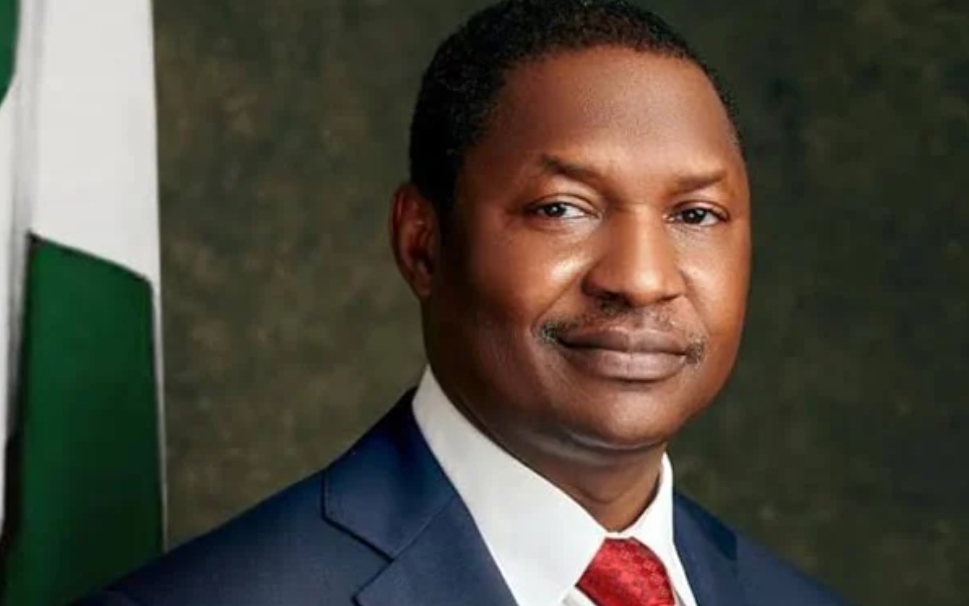

Nigeria’s Department of State Services has filed a five-count criminal charge against former Attorney General of the Federation and Minister of Justice, Abubakar Malami, and his son, Abdulaziz Abubakar Malami, over allegations of terrorism financing and illegal possession of firearms.
The defendants were arraigned before the Federal High Court in Abuja, where they pleaded not guilty to the charges brought by the domestic intelligence agency. The charges include allegations of knowingly aiding terrorism financing and possessing firearms and ammunition without a licence. The matter has been assigned to Justice Joyce Abdulmalik, with the court expected to set trial dates after preliminary proceedings. 
According to the charge sheet, Malami is accused of deliberately refusing to prosecute individuals suspected of terrorism financing whose case files were submitted to his office during his tenure as Attorney General. Prosecutors argue that such alleged inaction amounted to abetting terrorism financing under Nigeria’s counterterrorism laws. The DSS also accused Malami and his son of preparing to commit an act of terrorism by unlawfully possessing a Sturm Magnum firearm and ammunition, including live cartridges and expended rounds, without the required licence. 
Abubakar Malami is a Senior Advocate of Nigeria who served as Nigeria’s Attorney General and Minister of Justice from 2015 to 2023 under former President Muhammadu Buhari. As AGF, he was the country’s chief law officer, overseeing federal prosecutions, advising the federal government on legal matters, and supervising agencies such as the EFCC and ICPC.
During his tenure, Malami was a powerful figure in Nigeria’s legal and political architecture, often involved in high-profile cases, legal reforms, and politically sensitive prosecutions. His office also had the constitutional power to discontinue or initiate prosecutions, a discretionary authority that has historically attracted controversy in Nigeria’s justice system.
In December 2025, the Economic and Financial Crimes Commission filed 16 counts of money laundering and conspiracy charges against Malami, his son, and associates, alleging they concealed proceeds of unlawful activities amounting to about ₦8.7 billion and used corporate entities and real estate transactions to launder funds. The EFCC alleged the offences occurred between 2015 and 2025 and involved luxury property acquisitions in Abuja, Kano, Kebbi, and other locations.
Investigators claimed the alleged scheme involved multiple bank accounts, corporate fronts, and high-value property deals, with the funds believed to have originated from unlawful activities. The former AGF and his co-defendants pleaded not guilty to those charges.
Following his detention by the EFCC, Malami was reportedly re-arrested by the DSS shortly after his release, signalling parallel investigations by Nigeria’s anti-corruption and intelligence agencies into his activities. Security sources said the DSS sought extended detention due to the sensitive nature of the terrorism related allegations.
Malami has previously dismissed terrorism financing allegations as politically motivated and part of a smear campaign, insisting he had never been investigated or charged for terrorism financing before the current proceedings. His media team had earlier described claims linking him to terrorism funding and multiple bank accounts as false and malicious. 
His legal team is expected to challenge the DSS charges, arguing that the allegations are politically driven and lack an evidentiary basis.
If sustained, the charges could represent one of the most consequential prosecutions of a former Attorney General in Nigeria’s history. Terrorism financing offences carry severe penalties under Nigerian law, including long prison terms and asset forfeiture. The firearms allegations also fall under strict weapons control legislation, with stiff sanctions for illegal possession.
Nigeria has been under intense international scrutiny over terrorism financing due to its long-running insurgency and banditry crises. The government has pledged to prosecute terrorism financiers to comply with global anti-money laundering and counterterrorism frameworks, including Financial Action Task Force recommendations.
Samuel Aina