

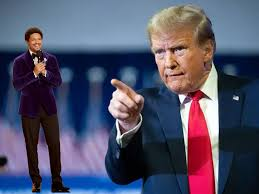

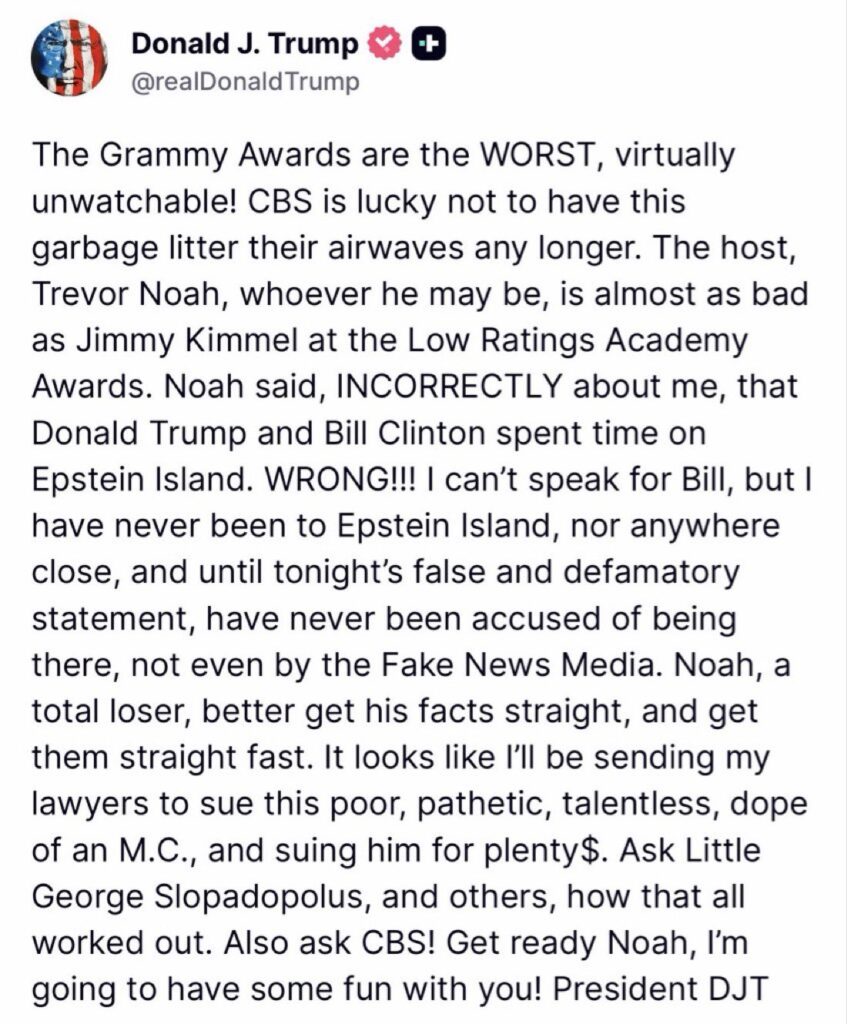
U.S. President Donald Trump has announced plans to sue comedian Trevor Noah after the latter made a joke referencing Trump and the late convicted sex offender Jeffrey Epstein during the 2026 Grammy Awards. The president described Noah’s comments as “false and defamatory” and said he would be “sending my lawyers to sue” the South African-born comedian. In a series of posts on his social media platform Truth Social, Trump emphasized, “Noah said, INCORRECTLY about me, that Donald Trump and Bill Clinton spent time on Epstein Island. WRONG!!! I can’t speak for Bill, but I have never been to Epstein Island, nor anywhere close, and until tonight’s false and defamatory statement, have never been accused of being there, not even by the Fake News Media. Noah, a total loser, better get his facts straight, and get them straight fast. Get ready Noah, I’m going to have some fun with you!”
The controversy stems from a quip Noah made while hosting the Grammys. He remarked, “Song of the Year — that is a Grammy that every artist wants almost as much as Trump wants Greenland, which makes sense because Epstein’s island is gone, he needs a new one to hang out with Bill Clinton.” The joke was part of a broader segment satirizing celebrity ambitions and political affairs, but it immediately drew Trump’s attention due to the reference to Epstein, whose private island has been the subject of intense public scrutiny due to documented sex trafficking and abuse allegations.
While Trump has acknowledged a past acquaintance with Epstein, he has consistently denied any knowledge of Epstein’s criminal activities, stating that the two fell out around 2004. There are no allegations or evidence that Trump ever visited Epstein’s private island, Little St. James, or engaged in any illegal activity connected to Epstein. Similarly, Bill Clinton, who has also been associated with Epstein in public reporting, has never been accused of wrongdoing by Epstein’s victims. Clinton has confirmed he never visited Epstein’s island, and his spokesperson noted that past trips on Epstein’s plane were connected to work with the Clinton Foundation. The U.S. Department of Justice has also stated that claims of criminal conduct by Trump related to Epstein are unfounded and false.
Jeffrey Epstein, a financier who cultivated relationships with politicians, business leaders, and celebrities, was convicted in 2008 for soliciting prostitution from a minor and later arrested in 2019 on federal sex trafficking charges involving underage girls. Epstein’s death in a New York prison while awaiting trial sparked significant public scrutiny and controversy. His private island, Little St. James, became a focal point in investigations as survivors alleged it was a location where trafficking and sexual abuse occurred. The broader Epstein case has continued to attract attention due to the high-profile nature of his associates and ongoing civil lawsuits filed by survivors seeking justice and accountability.
Trump’s threat to sue Noah fits into a wider pattern of the former president pursuing legal action against media organizations and public figures. In December 2025, Trump filed a multi-billion-dollar defamation lawsuit against the BBC over a Panorama programme, alleging the outlet edited content in a misleading manner. He has also previously targeted major newspapers such as the New York Times and the Wall Street Journal in lawsuits concerning allegedly false reporting. Legal analysts note that Trump’s approach reflects a broader strategy of using civil litigation to challenge narratives he perceives as damaging to his reputation.
Trevor Noah, a comedian and political commentator originally from South Africa, hosted The Daily Show on Comedy Central in the U.S. for seven years before moving to freelance projects and hosting major award shows like the Grammys. Noah is widely known for his satirical take on politics, social issues, and celebrity culture, often blending sharp commentary with humor. His references to political figures, including Trump, have previously sparked debate, though rarely escalating to the level of direct legal threats. Analysts suggest that the high-profile nature of the Grammys and the public visibility of Noah’s platform contributed to Trump’s decision to respond aggressively.
The dispute raises questions about the intersection of defamation law, freedom of speech, and the role of satire in American public life. Legal experts note that public figures, especially presidents, face a higher bar in defamation cases due to First Amendment protections, which require plaintiffs to prove “actual malice” that is, that the defendant knew the statement was false or acted with reckless disregard for the truth. This standard often makes it challenging for public figures to prevail in lawsuits against comedians or satirists, whose work is generally protected under free speech and artistic expression.
Experts also highlight the broader societal implications, emphasizing that humor and political satire serve as tools for public commentary and civic engagement. Professor Linda McBride, a media law scholar, noted, “While Trump may view this joke as defamatory, satire has historically been protected to allow critique of those in power. Courts often differentiate between factual statements and comedic hyperbole, especially when no specific harm can be clearly demonstrated.” This legal distinction will likely shape any potential case against Noah.
Trump’s threatened lawsuit could face practical hurdles. Defamation law in the U.S. requires plaintiffs to prove that statements were false, damaging, and made with knowledge of falsity or reckless disregard. In this instance, Noah’s comments were delivered in a comedic context, which legal experts generally consider as protected speech. Additionally, the public nature of the Grammy Awards and Noah’s track record as a satirist may further complicate Trump’s legal strategy.
Some commentators have raised concerns about the potential chilling effect on comedians and journalists if lawsuits by high-profile figures become commonplace. “Satire is a cornerstone of public discourse,” said media analyst Robert Fields. “If public figures successfully sue over jokes, it could deter critical commentary and undermine free expression, which is vital to democratic debate.”
While no formal lawsuit has yet been filed, Trump’s announcement has created significant anticipation about legal proceedings and public statements. Legal analysts expect that if a case is filed, pre-trial motions will likely focus on First Amendment defenses, the comedic context of the remarks, and the difficulty of proving reputational harm. Observers note that the timeline for any litigation remains uncertain.
Trevor Noah has not publicly responded to Trump’s threat at this time. Historically, Noah has addressed controversies through both social media and his comedic platforms, often clarifying his intent while reinforcing his role as a satirist. Given the attention the Grammy joke has received, analysts predict that any response could become part of a broader public debate on celebrity, politics, and accountability.