

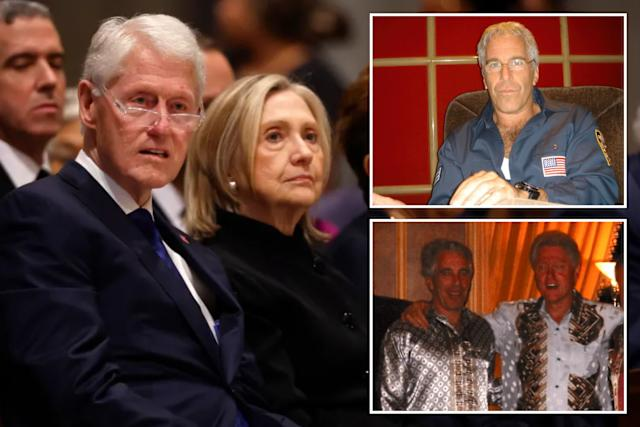

In a dramatic turn in one of Washington’s most closely watched inquiries, former U.S. President Bill Clinton and former Secretary of State Hillary Clinton have agreed to testify before the Republican‑led House Oversight Committee in its investigation into the late convicted sex offender Jeffrey Epstein, officials said on Monday. The decision comes after months of resistance by the couple and just days before a planned vote on whether to hold them in criminal contempt of Congress for initially refusing to appear.
Angel Ureña, deputy chief of staff to Bill Clinton, confirmed the couple’s decision on the social media platform X, saying the Clintons had “negotiated in good faith” and “will appear for depositions” on agreed dates in response to subpoenas from the panel. He also criticized the Oversight Committee for not doing the same, asserting that the couple had already provided sworn statements about what they know.
Oversight Committee Chairman Representative James Comer (R‑Ky.) welcomed the agreement but made clear that details and scheduling remained under negotiation, and that he continued to afford members time to clarify what the Clintons had agreed to. The Committee had advanced contempt resolutions last month after the Clintons repeatedly declined to sit for in‑person, sworn depositions.
The political stakes are high: a decision to hold former senior U.S. leaders in contempt would be unprecedented, and the two sides have sparred over both legal and political interpretations of congressional authority. Comer and other Republicans have said that comprehensive testimony from the Clintons is necessary to fully understand Epstein’s network and activities, even though neither Bill nor Hillary Clinton has been accused of any wrongdoing in connection with Epstein’s criminal conduct.
The Clintons’ resistance to earlier subpoenas was rooted in part in arguments about the scope and validity of those legal demands, and in concerns about perceived partisan motivations. Their attorneys had previously requested alternative formats for testimony — including time‑limited transcribed interviews — a proposal Comer described as insufficient for fulfilling the subpoenas.
Bill Clinton has acknowledged that he flew on Epstein’s private jet several times in the early 2000s on trips connected to charitable work by the Clinton Foundation, but he has denied knowledge of or involvement in Epstein’s criminal activities. Clinton supporters note that he completed diplomatic missions with Secret Service detail and foundation staff on those trips, and that there is no evidence linking him to Epstein’s crimes.
Hillary Clinton has similarly denied personal interactions with Epstein, stating she never flew on his plane or visited his private island, and that she had no substantive connection with him. Both former leaders have emphasized that they have no meaningful testimony to add beyond previously submitted sworn statements.
This development comes as the Oversight Committee’s probe into Epstein’s life and network has intensified in recent months, fueled by the release of millions of pages of internal documents under the Epstein Files Transparency Act, a law passed by Congress in late 2025 requiring the Department of Justice to publish materials related to Epstein’s investigations.
The controversy over the files containing emails, flight logs, photos, and court documents has underscored the political and public interest in understanding Epstein’s connections to powerful figures. While appearances of names in these records do not imply criminal conduct, they have spurred calls from lawmakers on both sides of the aisle for greater scrutiny.
Background on the Epstein Investigation
The investigation into Jeffrey Epstein’s activities has been one of the most enduring and complex legal sagas of the past decade. Epstein was an American financier and registered sex offender who was accused of operating a criminal network that exploited vulnerable people, including trafficking and abuse of minors over many years.
Epstein first came to national attention in 2005 when Palm Beach authorities began investigating allegations of sexual abuse involving minors. He ultimately pleaded guilty in a controversial 2008 plea deal to state charges of soliciting prostitution and procuring a minor, resulting in a short jail sentence with extensive work release.
The case regained heightened attention in 2019 when Epstein was arrested on federal sex‑trafficking charges in New York and New Jersey, alleging broader criminal conduct involving the exploitation of minors. While jailed and awaiting trial, Epstein was found dead in his Manhattan prison cell in August 2019 in what the medical examiner and Justice Department inspector general concluded was suicide.
Epstein’s death effectively ended the criminal case against him, but the investigations and litigation continued, focusing on his associates, his estate, and the release of extensive case files that had long been sealed. Civil suits brought by survivors have resulted in substantial settlements and further scrutiny of the scope of Epstein’s network and connections.
One of Epstein’s closest associates, Ghislaine Maxwell, was convicted in 2021 on federal charges related to her role in facilitating sexual encounters for Epstein, and she is serving a lengthy prison sentence. These developments have kept public and legal attention on the broader context of abuse and exploitation tied to Epstein’s activities and those who may have known him.
The Epstein Files and Public Controversy
In response to bipartisan pressure, Congress passed the Epstein Files Transparency Act in November 2025, which required release of all relevant Department of Justice files within 30 days. While portions of these files were published in December 2025 and January 2026, debates persist about the completeness of the releases and ongoing redaction practices.
The voluminous documents include information on countless interactions, flight logs, and communications involving Epstein and his associates, as well as mentions of various public figures. Lawmakers and survivors alike have called for full disclosure of all material to ensure accountability and transparency.
Despite these releases, some lawmakers argue that the justice system and administrative compliance have fallen short, prompting further congressional investigations such as the one the Clintons are now negotiating to participate in.
Political and Legal Dimensions
The decision by the Clintons to agree to testimony — even as details remain under negotiation signals a notable moment in congressional oversight efforts involving former presidents and secretaries of state. The last time a former U.S. president testified before Congress was in 1983 when Gerald Ford appeared before lawmakers, marking this potential appearance by the Clintons as historically significant.
Legal experts note that while Congress has broad authority to issue subpoenas and conduct oversight, compelling testimony from former top officials raises constitutional questions about separation of powers and executive privilege.
Public and media interest in the Clintons’ testimony has been intense, reflecting ongoing debates about political accountability, transparency, and the role of elite networks in shielding powerful individuals from scrutiny. Both supporters and critics of the Clintons have weighed in, illustrating the highly partisan environment in which this investigation is taking place.