

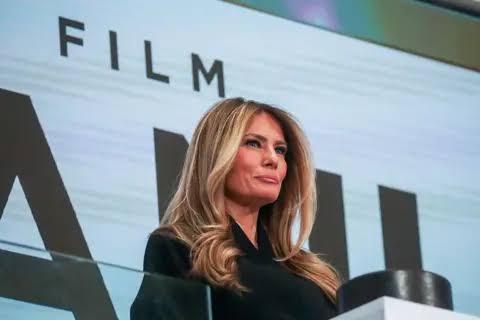

Cinemas across South Africa will not be screening the documentary *Melania*, which follows US First Lady Melania Trump in the 20 days leading up to her husband’s second inauguration. The documentary, set for release worldwide on Friday, will be absent from South African theatres despite Amazon’s significant investment in the film.
The South African distributor, Filmfinity, confirmed to the New York Times and local news outlet News24 that it had decided against a theatrical release. Thobashan Govindarajulu, Filmfinity’s head of sales and marketing, cited “recent developments” and the “current climate” as reasons for the decision but did not provide further details.
Filmfinity’s choice has left the film unlisted on the websites of the country’s two largest cinema chains, Ster Kinekor and Nu Metro. Ster Kinekor’s publicity page for *Melania* is currently inaccessible, while Nu Metro maintains a page for the film without listing any showtimes, contrasting with other releases such as the drama *Hamnet*.
An independent cinema in Cape Town, the Labia, confirmed that Filmfinity had directly instructed it not to screen the documentary. The theatre’s management told the BBC that the distributor had emphasized that the film would not be playing in the territory, effectively blocking any local theatrical release.
Amazon, which produced and distributed *Melania*, reportedly spent $35 million on marketing for the documentary and is believed to have paid around $40 million for the rights to the film. The investment underscores the studio’s intention to secure a major global release, making the South African withdrawal notable.
The documentary follows the First Lady during the critical 20-day period leading up to President Donald Trump’s second inauguration on January 20 of the previous year. The film had been anticipated by international audiences, but South African moviegoers will now be unable to see it in theatres.
The decision comes amid a broader deterioration of US-South Africa relations over the past year. Under Trump’s administration, tensions escalated on multiple fronts, including controversial statements and policy measures affecting bilateral relations.
Trump has repeatedly promoted the widely disputed claim of a “white genocide” against South Africa’s Afrikaner community, a stance that has drawn significant criticism both domestically and internationally. In May of the previous year, he confronted South African President Cyril Ramaphosa in a tense meeting at the White House regarding this allegation.
Relations have further soured due to economic and trade measures. The Trump administration imposed high tariffs on South African goods and cut several aid programmes, creating additional friction between Pretoria and Washington. These moves have contributed to what analysts describe as a cooling of political and diplomatic ties.
Another source of tension has been South Africa’s role in taking a case against Israel to the International Court of Justice (ICJ). The case, related to allegations of genocide against Palestinians in Gaza, was strongly rejected by the US, citing the claim as “baseless.” This diplomatic disagreement has also added to the backdrop in which Filmfinity made its decision.
While Filmfinity has not explicitly linked its choice to the political climate, its statement referencing “recent developments” and the “current climate” suggests the decision may have been influenced by the broader geopolitical context and public sensitivities surrounding US-South Africa relations.
Attempts by the BBC to obtain further comment from Filmfinity, which describes itself as the leading film distributor in southern Africa, have so far been unsuccessful. The company has not elaborated on whether commercial considerations, political sensitivities, or both informed its choice.
The absence of *Melania* from South African theatres marks a rare instance in which an internationally promoted documentary by a major studio has been withheld from release in the country. Observers note that the decision could affect public access to high-profile global media content amid a politically charged environment.
Despite the theatrical withdrawal, the film remains scheduled for release in other international markets. Amazon’s investment in marketing and distribution indicates that the documentary will likely reach global audiences through other platforms, even as South African audiences miss the cinema experience.