

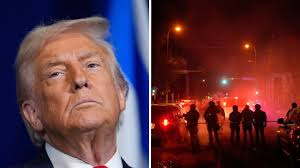

In Minneapolis, Minnesota, federal law enforcement officers fatally shot Alex Pretti on Saturday morning, sparking a cascade of political, legal, and public scrutiny that has placed the Trump administration’s immigration enforcement strategies under intense national examination. The 37-year-old Pretti’s death immediately drew contrasting narratives: initial statements from top administration officials painted him as a violent domestic threat, while video evidence and eyewitness accounts quickly challenged that characterization. Within 24 hours, the White House shifted its messaging, moving away from its long-established “deny and attack” approach toward a more measured tone, emphasizing political blame on Democrats and presenting a law-and-order framing of the situation. The shooting has ignited heated debate over federal law enforcement protocols, ICE operations, public safety, and broader immigration policy, with political ramifications that could contribute to a partial government shutdown scheduled for Friday if congressional disputes over DHS funding remain unresolved.
The initial administration response was swift and unequivocal. Homeland Security Secretary Kristi Noem described Pretti as intending to “inflict harm” while “brandishing” a weapon, painting him as a domestic terrorist. US Border Patrol Commander Gregory Bovino echoed this framing, asserting that the incident “looks like a situation where an individual wanted to do maximum damage and massacre law enforcement.” Senior presidential adviser Stephen Miller amplified these assertions, labeling Pretti a “would-be assassin.” This response mirrored the Trump administration’s traditional “deny and attack” strategy, a method frequently employed to discredit critics and defend contentious actions, particularly in high-profile law enforcement or immigration cases. Officials presented the shooting as a necessary defensive measure against a clear threat, underscoring the administration’s longstanding emphasis on aggressive enforcement against perceived domestic risks.
Public and media scrutiny quickly challenged the administration’s initial narrative. Multiple videos circulating online showed Pretti filming ICE agents with his mobile phone and assisting a woman who was knocked over before both individuals were pepper-sprayed, undermining early claims that he was armed and threatening. The footage appeared to show Pretti not holding a gun when wrestled to the ground, raising questions about the proportionality of federal force used. In response, Pretti’s parents issued a statement condemning the administration’s portrayal of their son, calling the depiction “reprehensible and disgusting” and demanding a full accounting of the events leading to his death. Department of Homeland Security officials maintained that Pretti possessed a 9mm semi-automatic handgun and two magazines of ammunition, noting he was a legal gun owner under Minnesota law, which permits concealed carry with a proper permit. These contradictory accounts fueled public debate over the credibility of federal claims, the adequacy of law enforcement training, and the transparency of official narratives.
As public pressure mounted, the administration adjusted its messaging, shifting the focus from Pretti’s actions to broader political and partisan considerations. President Trump, along with Vice President JD Vance, emphasized that Democrats were responsible for what they described as ensuing chaos, deflecting attention from the actions of federal officers and the victim. Trump announced the dispatch of border czar Tom Homan to Minnesota, a seasoned law enforcement operator known for overseeing deportation efforts under the Obama administration, presenting Homan as a politically measured official capable of managing the situation without the heightened rhetoric previously employed. Veterans Affairs Secretary Doug Collins offered condolences to the Pretti family, while Trump personally engaged in discussions with Minnesota Governor Tim Walz, a Democrat, describing their call as constructive and suggesting a potential for de-escalation and coordination at the state level. These developments indicate a calculated attempt to balance political messaging, public perception, and operational oversight while the situation remains fluid.
The political implications of the incident have been substantial. Congressional Democrats sharply criticized the administration’s immigration enforcement policies, mass deportation strategies, and ICE’s aggressive tactics, framing Pretti’s death as indicative of broader systemic issues. Senate Democrats announced their intent to block funding for the Department of Homeland Security, a move that could trigger a partial government shutdown on Friday. Public opinion surveys have amplified these concerns: a CBS survey conducted before the weekend’s shooting indicated that 61% of respondents believe ICE is excessively harsh in stopping and detaining people, while 58% disapproved of Trump’s overall handling of immigration. These figures underscore the political risks the administration faces as it navigates public backlash, legislative pushback, and the challenge of enforcing contentious immigration policies.
Local law enforcement officials and political figures from both parties have weighed in on the response. Minneapolis Police Chief Brian O’Hara criticized the federal officers’ use of force, noting that his department successfully conducted hundreds of arrests of violent offenders in the prior year without resorting to fatal shootings. Republican leaders also expressed concern, with Vermont Governor Phil Scott describing federal law enforcement coordination in Minnesota as a “complete failure of acceptable public safety and law enforcement practices, training, and leadership,” and warning that the approach risked deliberate intimidation and escalation. Utah Senator John Curtis criticized Noem’s “premature” statements, asserting that such declarations weakened confidence in law enforcement operations. Meanwhile, congressional Homeland Security committees in both the House and Senate have announced plans to hold public hearings to examine the incident, signaling the likelihood of intensified oversight and accountability measures.
This shooting also carries historical context, echoing federal law enforcement actions three weeks earlier in Minneapolis when officers fatally shot Renee Good. In that case, officials described Good as a terrorist who “weaponized” her vehicle to target ICE agents, a narrative subsequently challenged by local authorities, eyewitness accounts, and family members. Together, the Pretti and Good incidents underscore recurring concerns regarding federal-local coordination, proportionality of force, and adherence to legal and procedural safeguards, raising questions about the consistency and transparency of federal responses to civilian encounters, particularly in states with strong local oversight traditions.
The evolving federal response reflects an effort to reconcile initial messaging with public perception and political reality. White House Press Secretary Karoline Leavitt, when questioned about Miller’s characterization of Pretti, declined to fully endorse the “would-be assassin” label, instead emphasizing that a thorough investigation would be conducted. Trump’s subsequent communications, including public statements on Truth Social, coupled with the deployment of Tom Homan and engagement with Governor Walz, suggest a strategic recalibration aimed at mitigating political fallout and restoring confidence in federal law enforcement operations while maintaining aggressive immigration enforcement policies. Analysts note that this shift may be intended to temper national outrage and reduce the likelihood of further civil or legislative confrontations.
Amid these developments, Democrats have leveraged the incident to press for legislative oversight and enhanced accountability for ICE, framing Pretti’s death as symptomatic of excessive federal authority and mismanagement. Senator Brian Schatz of Hawaii announced his intention to withhold DHS funding until stricter controls are implemented, citing repeated violent incidents nationwide. While such actions carry political risks, particularly given historical challenges in passing funding bills, Democrats appear intent on asserting checks on executive power in the context of immigration enforcement, balancing political objectives with public safety concerns.
The national conversation has also highlighted disparities in law enforcement practices and public trust. Videos and eyewitness accounts documenting Pretti’s final moments contradict federal claims of imminent threat, fueling skepticism about the administration’s narratives and reinforcing calls for more robust oversight. Minnesota Attorney General Keith Ellison noted that Tom Homan’s involvement could provide a framework for cooperation between state and federal authorities, stating, “I don’t want to foreclose the possibility that reasonable minds can prevail, but we are here exactly because the federal government had unreasonable positions.” This underscores the necessity of measured, legally compliant responses in high-stakes enforcement operations.
Survey data suggests that public sentiment is increasingly critical of ICE and Trump’s immigration policies. Concerns over aggressive enforcement, potential human rights violations, and disproportionate use of force are shaping perceptions of both the administration and federal law enforcement agencies. Analysts highlight that this public scrutiny is intensifying political pressure on both the executive branch and Congress, particularly as debates over DHS funding and federal oversight converge with midterm and pre-election political calculations.
Veteran political observers note that the administration’s initial “deny and attack” response strategy may no longer be tenable in the face of widespread digital documentation and real-time social media dissemination. The contrast between early statements portraying Pretti as a violent actor and video evidence showing him unarmed has amplified criticism and heightened the stakes of federal messaging, compelling a more nuanced and cautious approach to public communication.
The deployment of Tom Homan and the engagement with Governor Walz represent tactical moves designed to mitigate tensions and foster limited cooperation. Homan’s experience with prior federal deportation operations and reputation for measured enforcement is viewed as an attempt to stabilize law enforcement operations and present a politically palatable narrative that addresses public concerns while sustaining the administration’s immigration policy agenda. Observers caution, however, that without substantive policy adjustments, public trust and intergovernmental cooperation may remain strained.
Congressional oversight mechanisms are expected to intensify as House and Senate Homeland Security committees schedule hearings to examine the Minneapolis incidents in detail. Lawmakers from both parties have emphasized the need for transparency, accountability, and adherence to legal standards, reflecting widespread concern over executive authority, federal-local coordination, and civil liberties protections in the context of federal immigration enforcement operations.