

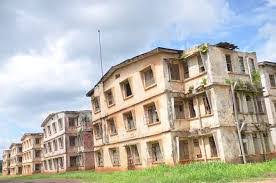

A long-standing debate has arisen around properties donated by Dr. Nnamdi Azikiwe, Nigeria’s first President and founding father of the University of Nigeria, Nsukka (UNN), as stakeholders, including members of Azikiwe’s family, community groups and educational advocates, intensify calls for dialogue and clarity on the future of these assets.
Dr. Azikiwe ( affectionately known as Zik of Africa ) gifted valuable estates and buildings to the university during his lifetime, most notably Zik’s Flats, a large housing complex originally intended to support student accommodation and contribute to the institution’s growth. The donation was made in the 1980s as a social contribution to the young university’s infrastructural development.
Rising Concern Over Zik’s Flats and Institutional Neglect
Over the years, Zik’s Flats ( once a sprawling facility with multiple residential blocks, bungalows and commercial spaces ) has fallen into serious disrepair and abandonment. Multiple reports and investigations note that the estate, which originally provided thousands of beds for students, now stands largely unused and deteriorating. Signs of neglect include overgrown vegetation, broken windows, and structures that have become unsafe for habitation.
The decline of Zik’s Flats has become a symbolic concern, not only because of its historical value but because it represents a tangible link to Azikiwe’s legacy of educational support. UNN’s growing student population faces accommodation challenges, with many students relying increasingly on high-cost private hostels around the campus — a shift that contrasts starkly with the original intention behind the donation.
Azikiwe Family’s Position and Push for Action
Members of Dr. Azikiwe’s family, particularly Emeritus Professor Uche Azikiwe, his widow, have publicly expressed frustration and disappointment over the state of the properties. In earlier statements, the former first lady lamented the dilapidated condition of Zik’s Flats and stressed that while the family was not engaged in any legal battle with UNN over ownership, they were deeply troubled by the lack of meaningful action to rehabilitate the estate.
Professor Azikiwe has encouraged dialogue with university authorities, advocating that if UNN cannot effectively manage or restore the properties, the family should be allowed to take over the rehabilitation and management through a Build-Operate-Transfer (BOT) arrangement or similar partnership. Such an approach, she contended, would honour her late husband’s vision and preserve his contributions for future generations.
Her remarks deliberately dismissed rumours — circulating on social media — that the family was in court with the university. Instead, she clarified that the core issue is preserving the legacy and practical use of the donated property, not battling over ownership rights.
UNN’s Response and Need for Dialogue
University officials, including the Vice-Chancellor and management spokespeople, have historically been less forthcoming on the matter, often deferring comment or highlighting broader infrastructure challenges within the institution. On previous occasions, representatives acknowledged accommodation issues at the university but stopped short of committing to immediate action on Zik’s Flats, citing funding constraints and complex maintenance requirements.
Amid these ongoing tensions, civil society advocates, alumni groups and Nsukka community stakeholders have urged both the family and UNN leadership to establish a structured dialogue forum. Such a platform would bring together institutional administrators, representatives of the Azikiwe family, government education officials and accommodation advocates to craft a constructive plan that respects historical intent while addressing current infrastructural needs.
Balancing Legacy, Practicality and Institutional Mission
The debate over Zik’s Flats at UNN highlights a broader challenge facing Nigerian universities: how to balance historical legacies and modern institutional capacity. Many of the country’s older universities face critical infrastructure gaps, with aging facilities struggling to meet the needs of rapidly expanding student populations.
For UNN, a transparent and inclusive approach would offer tangible benefits. Restoring or repurposing Zik’s Flats could:
- Alleviate accommodation shortages at a time of significant demand.
- Preserve a key piece of national and educational history, reinforcing the legacy of Nigeria’s first President.
- Create revenue-generating assets that support broader campus development.
At the same time, any meaningful solution must be anchored in respect for legal frameworks, clear terms of engagement between stakeholders, and mechanisms to ensure accountability and sustainability.
Conclusion: Opportunity for Constructive Engagement
What started as concern over deteriorated infrastructure has evolved into an urgent call for grandfathered legacy assets to be reintegrated into UNN’s strategic planning. Rather than viewing the situation as a dispute, many educational leaders see it as an opportunity — to reaffirm the university’s commitment to its founding principles and to engage all parties in a constructive dialogue that respects both legacy and contemporary student needs.
Both the Azikiwe family and UNN stand to benefit from a clear, agreed path forward, whether through formalised partnerships, rehabilitation projects or jointly managed heritage-preservation initiatives. For many in the academic and community circles of Nsukka, a collaborative approach would honour the intentions of Dr. Nnamdi Azikiwe — ensuring that his contributions continue to serve generations of Nigerian students.