

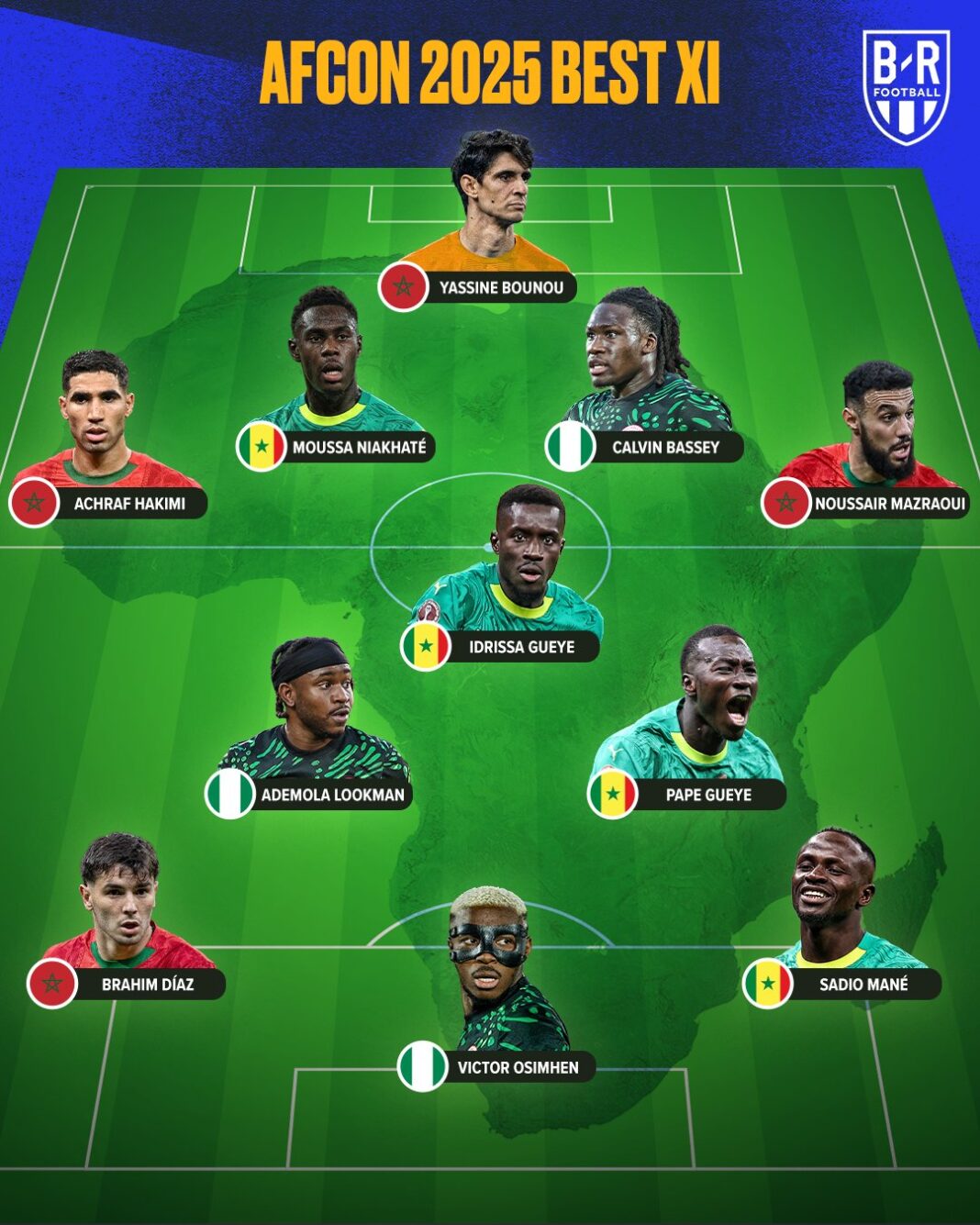

Three Nigerian players—Victor Osimhen, Ademola Lookman, and Calvin Bassey—have been named in the official Team of the Tournament for the 2025 Africa Cup of Nations, following a thorough and detailed technical assessment by the CAF Technical Study Group (TSG).
The inclusion of three Super Eagles in the prestigious Best XI comes on the back of Nigeria’s impressive third-place finish at the tournament, underscoring the pivotal role these players played in securing one of the nation’s best performances in recent AFCON history. Nigeria’s campaign was characterized by attacking flair, defensive resilience, and tactical discipline, and the recognition of Osimhen, Lookman, and Bassey reflects not only their individual brilliance but also their contribution to the team’s overall success. For a nation seeking to establish itself as a powerhouse in African football, the selection of multiple players in the Team of the Tournament signals a strong statement of intent on the continental stage and highlights the depth of talent currently available to coach José Peseiro.
Victor Osimhen, the prolific striker, stood out as Nigeria’s primary attacking threat, featuring in six of the country’s seven matches and scoring four goals, averaging a goal every 135 minutes. His performances were marked by consistency and versatility, with the Galatasaray forward recording an average of 3.5 shots per game, 1.7 of which were on target, while scoring two headed goals and one apiece with his right and left foot. Osimhen’s ability to create opportunities, combine with midfielders, and remain a constant danger to opposing defences made him a natural choice for the TSG’s Best XI.
Alongside him, winger Ademola Lookman impressed with his dual contribution in scoring and creating chances, appearing in five matches and registering three goals and four assists. Lookman created five big chances and averaged 2.7 key passes per game, demonstrating his influence in both the final third and build-up play, while maintaining a 25 percent goal conversion rate and high passing accuracy. His combination of creativity, pace, and precision made him a standout performer and a crucial component of Nigeria’s attacking strategy.
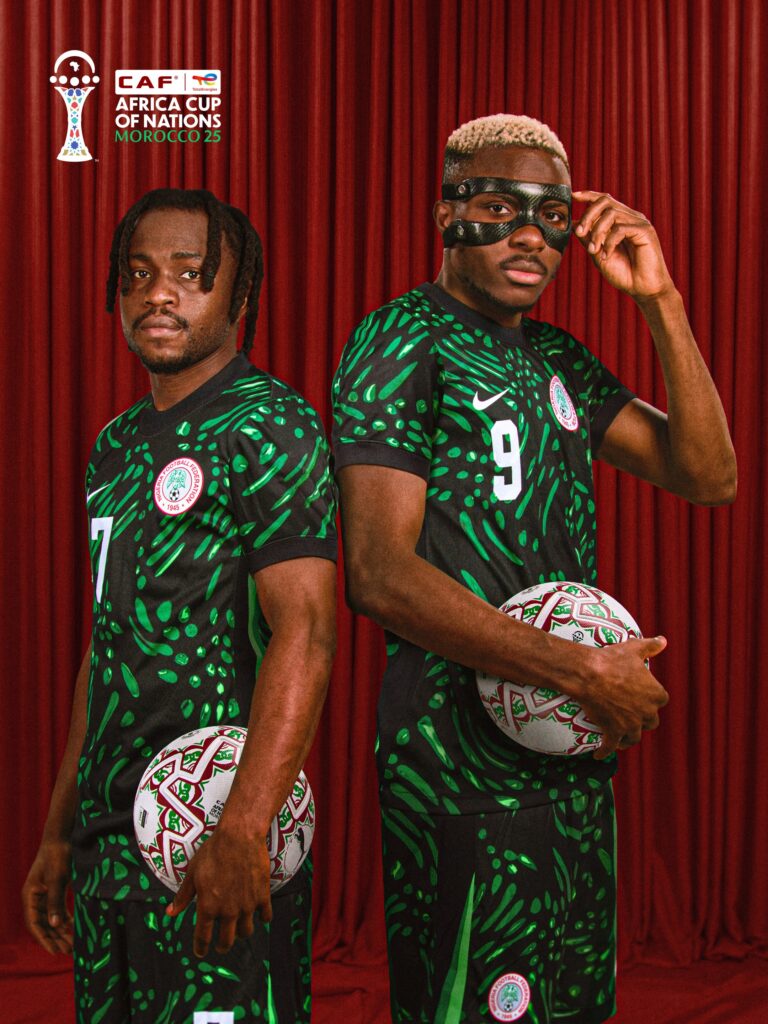
Defensively, Calvin Bassey was instrumental in providing stability and resilience at the back. The Fulham defender played every minute as Nigeria’s left-sided centre-back until he was suspended for the third-place playoff against Egypt, anchoring a defensive unit that kept clean sheets throughout the knockout stages. Bassey’s statistics highlighted his defensive prowess, averaging 5.3 ball recoveries per game, 3.2 clearances, and winning 61 percent of his duels, all while committing no errors leading to shots or goals. His tactical awareness, physicality, and composure under pressure were key to Nigeria’s ability to withstand high-intensity attacks from some of Africa’s strongest teams. Together with Osimhen and Lookman, Bassey’s presence on the Team of the Tournament reflects a balance of offensive and defensive excellence and illustrates the holistic contribution of Nigerian players to their side’s successful campaign.
CAF’s Technical Study Group employed a fully integrated evaluation system to determine the Team of the Tournament, combining remote and on-site assessments, live data platforms, multi-angle video feeds, and dedicated video analysts. This method ensured that all players were evaluated objectively, with their contributions across matches assessed using both qualitative and quantitative data. While Nigeria’s trio earned well-deserved recognition, the Team of the Tournament was dominated by finalists Senegal and Morocco, each contributing four players. Senegal, crowned champions for a second time, had defender Moussa Niakhaté, midfielders Pape Gueye and Idrissa Gueye, and forward Sadio Mané, who was named Player of the Tournament, included. Morocco’s representation included goalkeeper Yassine Bounou, forward Brahim Díaz, and full backs Achraf Hakimi and Noussair Mazraoui. The inclusion of the Nigerian trio alongside these continental stars not only celebrates individual excellence but also acknowledges Nigeria’s collective performance, highlighting the country’s emerging prominence in African football and signaling the potential for even greater achievements in future international competitions.