

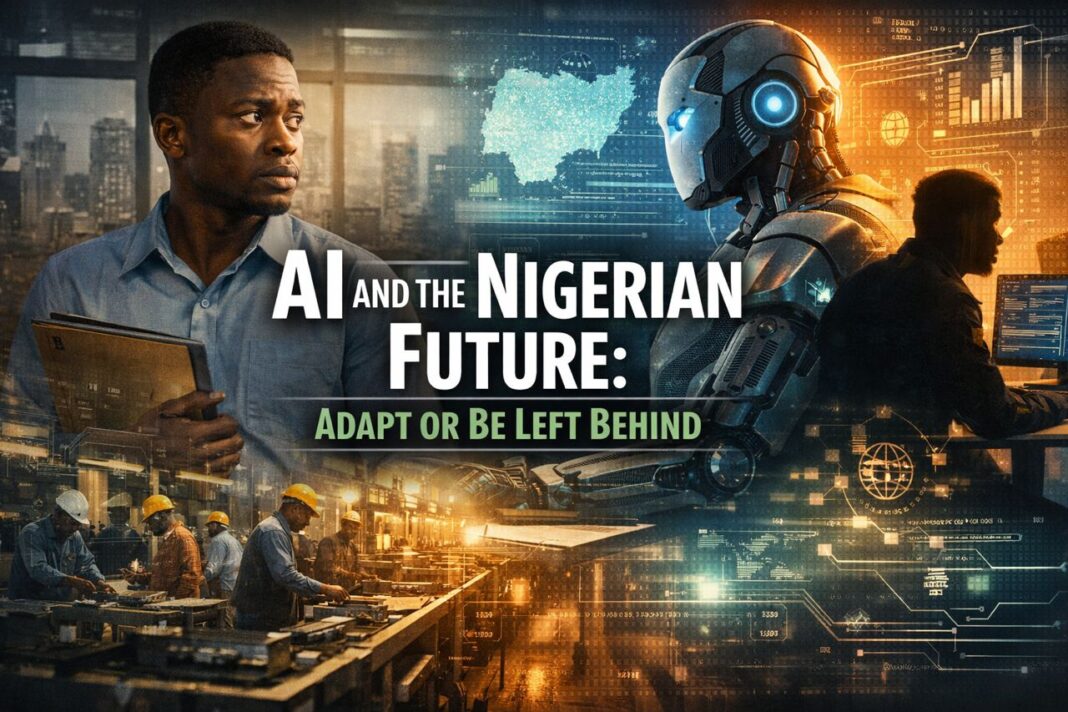

Fear assumes something is approaching. Artificial intelligence is not approaching Nigeria. It is already here. It is banks that decide who qualifies for loans. It is in recruitment software that filters CVs before a human ever reads them. It is in content moderation, fraud detection, logistics planning, customer service, and increasingly in writing, design, and analysis. The question is not whether it will take jobs. It already has. The deeper question is whether Nigeria understands what kind of future it is stepping into and whether it is choosing to participate or to be dragged along.
There is a familiar pattern Nigerians have seen before. A new technology arrives. At first, it feels distant and elite. Then it becomes normal. Then it becomes unavoidable. Those who adapted early gained leverage. Those who waited adjusted under pressure. This happened with computers, with the internet, with mobile phones, with social media, and with digital banking. Artificial intelligence follows the same arc but at a much faster pace and with far wider consequences.
Yes, artificial intelligence will replace some jobs. That truth should not be sugar-coated. Roles built entirely on repetition, predictability, and rule-following are the most exposed. Basic data entry, routine customer support, simple reporting, transcription, and certain clerical tasks are already being automated. In Nigeria, where many graduates depend on these entry-level roles to survive, this creates understandable anxiety. When jobs are already scarce, the idea of machines competing for them feels cruel.
But focusing only on job loss misses the bigger picture. Artificial intelligence does not just eliminate work. It changes the shape of work. It removes some roles and creates others. It increases productivity in ways that allow small teams to do what once required large organisations. This matters deeply for a country like Nigeria, where unemployment is high, but ingenuity is abundant.
The more uncomfortable truth is this. Nigeria is not at risk because of artificial intelligence. Nigeria is at risk because of its relationship with knowledge, skills, and planning. A nation that does not invest in human capital will be disrupted by every serious technological shift. Artificial intelligence simply exposes existing weaknesses more brutally.
Can Nigeria do without artificial intelligence? In theory, yes. In practice, no. Global supply chains, finance, healthcare, energy systems, education platforms, and even governance tools are increasingly driven by intelligent systems. A country that opts out does not remain neutral. It becomes dependent. It consumes tools it does not build, policies it does not shape, and outcomes it does not control. That is not sovereignty. That is digital dependency.
The fear many Nigerians feel comes from exclusion. Artificial intelligence conversations often sound foreign, technical, and elitist. They are framed as tools for big companies, foreign governments, and tech giants. When people cannot see where they fit into a future, they fear it. But the reality is that artificial intelligence is not only for coders in Silicon Valley. It is a tool. Like electricity or the internet, its impact depends on who uses it and for what purpose.
Nigeria already has an advantage it rarely recognises. A young population. A culture of improvisation. A willingness to learn outside formal systems. These traits matter in an artificial intelligence-driven world. Many of the most valuable roles of the future will not be about building complex models from scratch. They will be about applying intelligent tools to local problems. Agriculture. Healthcare delivery. Education access. Logistics in chaotic environments. Informal markets. Energy distribution. These are areas Nigeria understands better than most countries. Artificial intelligence applied here could create work, not erase it.
The danger lies in delay. If artificial intelligence adoption is left only to foreign firms and a small urban elite, inequality will widen. Those with access to tools will accelerate. Those without will stagnate. This is not a future problem. It is already happening. Students who use intelligent tools to learn faster are pulling ahead of those who do not. Businesses that automate are scaling faster than those stuck in manual processes. Writers, designers, and analysts who understand these systems are producing more work with less strain.
The role of government matters, but it should not be exaggerated. Policy can enable or obstruct, but it cannot replace individual and institutional curiosity. Waiting for perfect regulation before engaging with artificial intelligence is a mistake. By the time the rules are finalised, the world has already moved. What matters more is literacy. Not coding literacy alone, but functional understanding. Knowing what these systems can do. Knowing their limits. Knowing how to work alongside them rather than compete blindly against them.
Should Nigerians be afraid? Fear can be useful if it leads to preparation. It becomes dangerous when it leads to denial. Artificial intelligence is not here to steal dignity or relevance. It is here to reward those who adapt and to expose those who refuse to. The prospects of Nigeria without it are not stable or safe. They are marginal. The question is not whether artificial intelligence will change Nigeria. It will. The only real question is whether Nigerians will shape that change or watch it happen to them.
The future is not human versus machine. It is prepared humans using machines versus everyone else.
Samuel Aina