

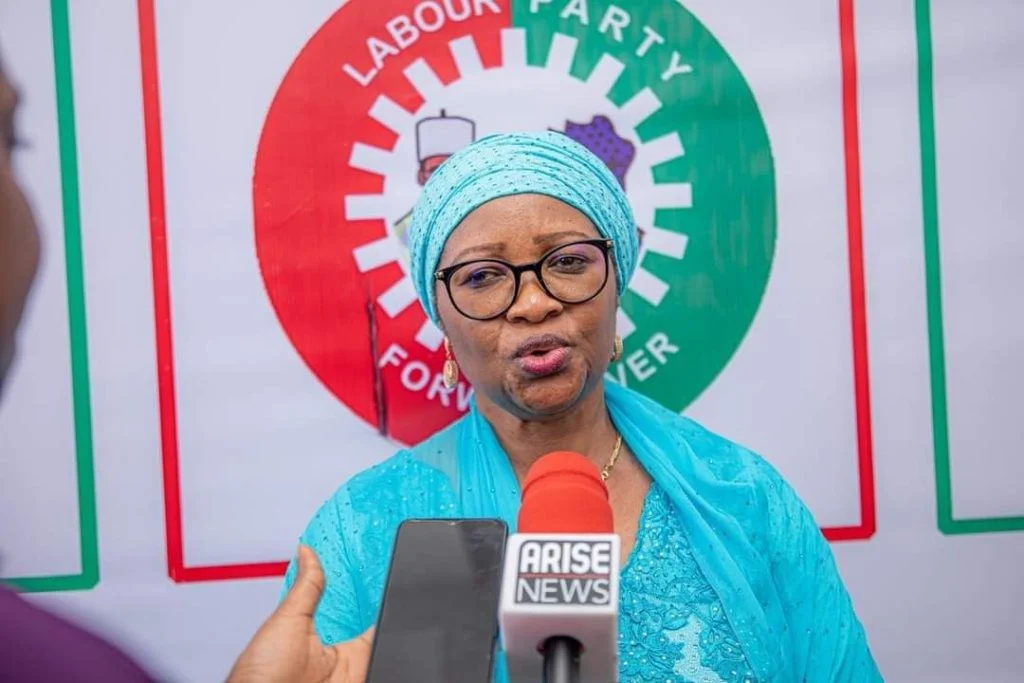

The Federal High Court in Abuja on Wednesday removed Julius Abure as the National Chairman of the Labour Party and ordered the Independent National Electoral Commission (INEC) to recognise the caretaker committee led by Senator Nenadi Usman pending the conduct of the party’s national convention. The ruling marked a significant turning point in the prolonged leadership crisis that has plagued the opposition party for more than a year and has repeatedly drawn the attention of Nigeria’s courts.
Delivering the judgment in suit number FHC/ABJ/CS/2262/2025, Justice Peter Lifu held that Abure’s tenure as national chairman had elapsed and that he no longer possessed the legal authority to continue occupying the position. The court ruled that the continued claim to office by Abure lacked constitutional backing within the party’s framework and could not be sustained in law, given existing judicial pronouncements on the matter.
Justice Lifu further directed INEC to recognise the caretaker committee chaired by Senator Nenadi Usman as the only valid authority empowered to act for and represent the Labour Party pending the conduct of a national convention. The judge anchored his decision on the subsisting position of the Supreme Court regarding the party’s leadership dispute, noting that lower courts were bound by the apex court’s pronouncements.
In dismissing Abure’s challenge, the court rejected the argument that the leadership dispute was a purely internal party affair and therefore non-justiciable. Justice Lifu held that the intervention of the court became necessary following the Supreme Court’s judgment, which necessitated the constitution of a caretaker committee to stabilise the party and guide it towards a valid national convention.
The ruling follows months of internal wrangling within the Labour Party, which intensified after disagreements over the expiration of Abure’s tenure and the legitimacy of decisions taken under his leadership. The crisis exposed deep divisions within the party’s hierarchy and raised concerns about its organisational cohesion ahead of future electoral contests.
Central to the court’s reasoning was the April 2025 judgment of the Supreme Court, which set aside an earlier decision of the Court of Appeal that had recognised Abure as National Chairman of the Labour Party. In that landmark ruling, a five-member panel of the apex court, led by Justice Inyang Okoro, unanimously held that the Court of Appeal lacked the jurisdiction to determine the leadership of a political party.
The Supreme Court’s decision clarified that disputes over party leadership, when they arise from the interpretation of internal processes linked to judicial directives, could fall within the scope of the courts, particularly where previous judgments had been misapplied. The apex court consequently upheld the appeal filed by Senator Nenadi Usman, who had been appointed caretaker chairperson in September 2024 alongside 28 other members.
Following that Supreme Court ruling, pressure mounted within the Labour Party for a political resolution to the crisis. This culminated in an expanded stakeholders’ meeting held in Umuahia, Abia State, which brought together party leaders, elected officials and key stakeholders from across the country.
The Umuahia meeting was hosted by Abia State Governor Alex Otti and chaired by the party’s former presidential candidate, Mr Peter Obi. At the meeting, the National Executive Committee resolved to remove Abure as national chairman, citing the expiration of his tenure and the need to align the party’s leadership structure with the Supreme Court’s decision.
Subsequently, the NEC constituted a 29-member caretaker committee and appointed Senator Nenadi Usman as its chairperson, with a mandate to oversee the affairs of the party and organise a credible national convention. Party leaders at the meeting described the move as a necessary step to restore internal stability and reposition the Labour Party.
Abure, however, rejected his removal and approached the Federal High Court in Abuja, seeking judicial validation of his continued stay in office as national chairman. He argued that the decisions taken at the Umuahia meeting were invalid and maintained that the dispute was an internal party matter beyond the jurisdiction of the courts.
In addressing Abure’s claims, Justice Lifu ruled that the caretaker committee was lawfully constituted in response to the Supreme Court’s judgment and that Abure’s reliance on the internal affairs doctrine could not override the binding decision of the apex court. The judge stressed that once the Supreme Court had spoken on the matter, all parties and institutions were duty-bound to comply.