

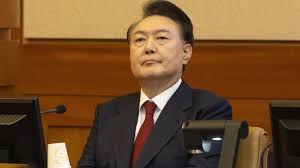

A South Korean court on Friday sentenced former President Yoon Suk Yeol to five years in prison after finding him guilty of obstruction of justice and related offences stemming from his controversial declaration of martial law on December 3, 2024. The ruling, delivered by Judge Baek Dae-hyun at the Seoul Central District Court, marks the first criminal conviction of the disgraced former leader since his removal from office and represents a major legal reckoning over one of the most turbulent episodes in South Korea’s recent democratic history.
In delivering the verdict, Judge Baek said the court found that Yoon had deliberately obstructed justice by blocking investigators from detaining him during probes into the martial law crisis. The court also ruled that Yoon unlawfully excluded several cabinet members from a key meeting where plans for the declaration of martial law were discussed, undermining collective decision-making at the highest level of government. However, the judge acquitted Yoon of charges relating to the forgery of official documents, citing insufficient evidence to sustain a conviction on that count.
“Despite having a duty, above all others, to uphold the Constitution and observe the rule of law as president, the defendant instead displayed an attitude that disregarded the Constitution,” Judge Baek said in court. Describing the former president’s actions as a serious breach of trust, he added that “the defendant’s culpability is extremely grave,” stressing that Yoon’s conduct struck at the heart of constitutional governance and democratic accountability.
Prosecutors had sought a much harsher punishment, urging the court to impose a 10-year prison sentence. They argued that Yoon’s actions during and after the declaration of martial law were calculated attempts to evade accountability and interfere with lawful investigations. Yoon, a former top prosecutor himself, rejected those claims throughout the trial, maintaining that he had not violated any laws and that his decisions were made in what he described as the national interest.
Under South Korean law, Yoon has seven days from the date of sentencing to file an appeal. His legal team has not publicly confirmed whether it will challenge the ruling, but the former president has consistently signalled his intention to contest all charges related to the martial law episode. Legal analysts say the appeals process could take months and may further inflame political divisions already sharpened by the crisis.
The case is rooted in Yoon’s dramatic and short-lived suspension of civilian rule on December 3, 2024, when he declared martial law citing what he described as threats to national stability and constitutional order. The move immediately triggered widespread outrage, with tens of thousands of South Koreans taking to the streets in mass protests, accusing the president of attempting to roll back democratic freedoms earned after decades of authoritarian rule.
The declaration also sparked a fierce confrontation in the National Assembly, where opposition lawmakers moved swiftly to challenge Yoon’s authority. After a tense standoff, parliament voted to nullify the martial law order, setting off a chain of events that ultimately led to Yoon’s impeachment and removal from office. The episode plunged South Korea into months of political turmoil and intensified scrutiny of executive power under the country’s constitution.
Friday’s ruling is the first in what is expected to be a series of verdicts against the former president, who still faces multiple trials connected to the martial law crisis and its chaotic aftermath. Prosecutors have argued that Yoon’s actions extended beyond a single decision and amounted to a broader pattern of abuse of power, obstruction and constitutional violations.
In a separate and more serious case, prosecutors have accused Yoon of being the “ringleader of an insurrection” and have sought the death penalty for his alleged role in orchestrating the imposition of martial law. They have argued that his conduct posed a direct threat to South Korea’s democratic system and constitutional order, and that he showed “no remorse” for the turmoil that followed.
While the death penalty remains on South Korea’s statute books, the country has observed an unofficial moratorium on executions since 1997, making it highly unlikely that such a sentence would be carried out even if imposed. Nonetheless, the prosecution’s demand underscores the gravity with which authorities view Yoon’s actions and the unprecedented nature of the charges against a former president.
Yoon appeared defiant throughout the proceedings, and local media reported that he was seen smiling in court as prosecutors outlined their arguments for the harshest possible punishment in the insurrection case. In his closing remarks earlier this week, Yoon insisted that his declaration of martial law was “a lawful exercise of a president’s constitutional emergency powers” and could not be construed as an act of rebellion.
“The exercise of a president’s constitutional emergency powers to protect the nation and uphold the constitutional order cannot be deemed an act of insurrection,” Yoon told the court. He accused the then-opposition-controlled legislature of imposing what he called an “unconstitutional dictatorship” and said his actions were intended to “awaken the people, who are the sovereign.”
The court is scheduled to deliver its ruling on the insurrection charges on February 19, a decision that could carry even more far-reaching legal and political consequences. Observers say the verdict will be closely watched both domestically and internationally, as it tests the strength of South Korea’s democratic institutions and the principle that no individual is above the law.
In addition to the insurrection case, Yoon also faces a separate trial on allegations that he ordered drone flights over North Korea in an effort to bolster his justification for declaring martial law. Prosecutors have framed those actions as aiding the enemy, a charge that further compounds the legal peril facing the former leader.