

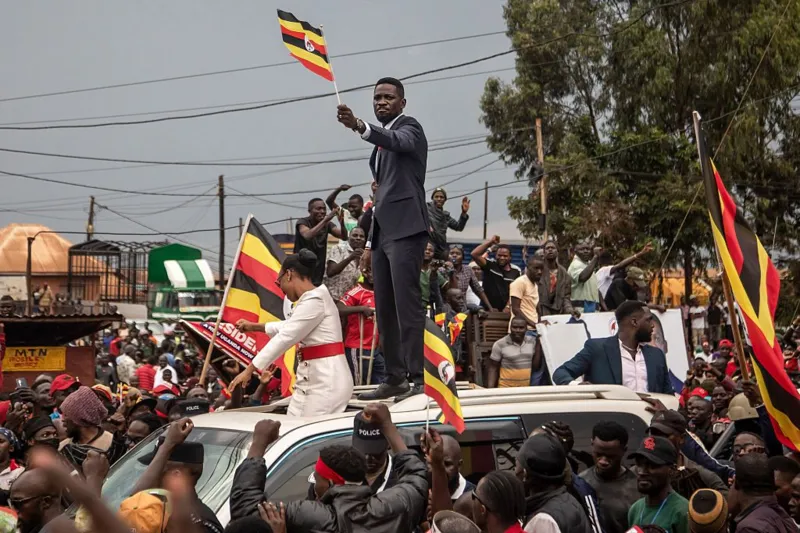

Bobi Wine, born Robert Kyagulanyi Ssentamu, has emerged as one of Uganda’s most prominent political figures over the past decade, leveraging his fame as a musician to challenge the long-standing rule of President Yoweri Museveni. At 43, Wine has become a symbol of resistance for many young Ugandans, a demographic that constitutes more than half of the country’s population. His rise in politics has been marked by charisma, determination, and an ability to connect with ordinary citizens, particularly those in urban slums. With the January 15, 2026 presidential election approaching, Bobi Wine is preparing to face Museveni for the second time, seeking to unseat the 81-year-old veteran who has ruled Uganda for four decades.
Wine’s early life in Kampala shaped his perspective and political inclinations. Growing up in the Kamwokya slum, he experienced firsthand the economic hardships and social inequalities faced by many Ugandans. “I am the most connected candidate to the population,” he told the BBC during his campaign for the forthcoming election. “That is why among the eight candidates, I am the most hounded, I am the most harassed, I am the most feared.” His mother, Margaret Nalunkuuma, worked as a nurse and was the main breadwinner, providing for the family and raising Wine on the modest land she purchased in the slum.
Bobi Wine developed a passion for the arts as a teenager and later attended Uganda’s prestigious Makerere University, earning a diploma in music, dance, and drama in 2003. It was during his university years that he met his wife, Barbara “Barbie” Itungo, and began shaping his vision of “edutainment”—music that entertains while educating. One of his earliest hits, Kadingo, addressed personal hygiene, demonstrating his early commitment to socially conscious themes. Despite growing fame, Wine continued to work from the Kamwokya neighborhood, building a music studio and recording locally.
His music, incorporating elements of reggae, Afrobeats, and traditional Ugandan rhythms, attracted a large following. Beyond entertainment, Wine used his platform to speak on social and political issues, focusing on inequality, youth unemployment, and human rights abuses. By 2016, while many prominent musicians publicly supported President Museveni’s re-election, Wine had begun expressing political dissent. He released Situka, a song in which he stated: “When the going gets tough, the tough must get going, especially when leaders become misleaders and mentors become tormentors.”
In 2017, Wine formally entered politics, contesting a by-election for the Kyadondo-East parliamentary seat as an independent candidate. He won decisively, securing more than five times the votes of his National Resistance Movement (NRM) opponent. Around this period, he also formed the People Power movement, a pressure group advocating for democratic reforms and better social conditions. Members of the movement wore red berets, which have since become a signature symbol of his political identity.
Bobi Wine initially attempted to register People Power as a political party but faced repeated obstacles. Consequently, he joined the lesser-known National Unity, Reconciliation and Peace Party (NURP), which later changed its name to the National Unity Platform (NUP), with Wine assuming leadership. By 2021, he was ready to contest the presidency against Museveni. The campaign period was marred by violence and intimidation; dozens of people were reportedly killed, many allegedly by security forces targeting his supporters. Wine ultimately lost, obtaining 35% of the vote compared to Museveni’s 59%.
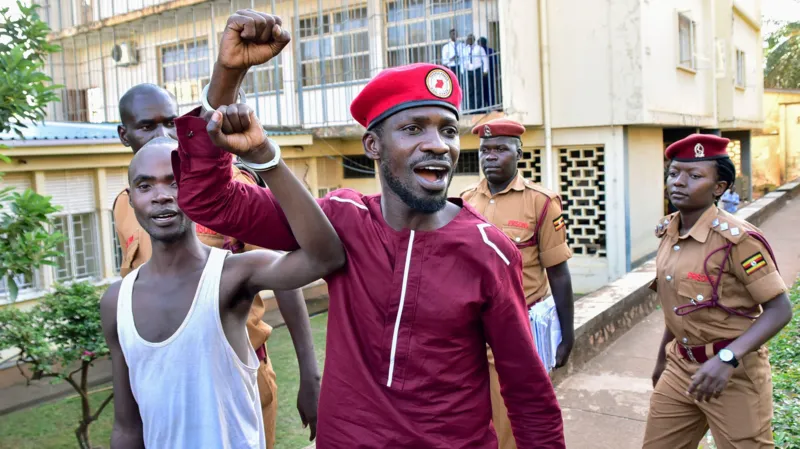
Throughout his political journey, Wine has faced repeated arrests and criminal charges, widely viewed as politically motivated. In 2018, for example, international artists, including Chris Martin of Coldplay and Damon Albarn of Gorillaz, signed a petition calling for his release from custody. He had been detained on allegations of illegal possession of firearms, and later charged with treason, although all these cases were eventually dropped. In 2021, the police shot at Wine during campaign activities, intensifying concerns about the treatment of opposition figures in Uganda.
Despite such challenges, Wine has remained undeterred. He told the BBC, “This election is about liberation. It is about freedom, it is about people asserting their voices. We are asking people to come out and protest in the ballot box.” His messaging resonates strongly with young Ugandans, particularly those frustrated with entrenched political structures, corruption, and lack of opportunities. Wine’s self-styled title as the “ghetto president” highlights his identification with marginalized communities and his appeal to grassroots supporters.
The authorities, however, maintain that the arrests and security measures against Wine and NUP members are necessary to maintain law and order. Museveni has accused Wine of holding violent rallies in densely populated areas, allegations the opposition leader has denied. International observers have raised concerns over the climate of political repression in Uganda, citing UN reports on the treatment of opposition figures and restrictions on peaceful assembly.
Wine’s political activism and popularity have drawn significant global attention. In 2023, National Geographic released a documentary, Bobi Wine: The People’s President, chronicling his journey from musician to political leader. The film, which was globally distributed and earned an Oscars nomination, further cemented Wine’s status as an international figure advocating for democracy and human rights.
His ability to mobilize Uganda’s youth has been central to his political strategy. With a substantial portion of the population under 40, Wine has positioned himself as a voice for younger generations who have only known Museveni’s long tenure. His campaign focuses on pressing issues, including wealth redistribution, unemployment, and corruption. Wine’s connection with the electorate is reinforced by his personal story and consistent presence in the communities he represents.
Yet, he faces structural challenges. The military in Uganda retains significant influence, having played a central role in the country’s political history, including coups and power transitions. Wine, with a background in music rather than the military or government, has expressed confidence in civilian supremacy, stating: “Uganda has been ready for a civilian leader since time immemorial,” and adding that “according to Uganda’s constitution, the military must be subordinate to the civilian authority.”
His campaign rallies have frequently drawn large crowds, often under tense conditions. Footage from recent events shows supporters braving tear gas and water cannon fired by security forces. At one rally in northern Uganda, uniformed personnel reportedly whipped supporters with sticks as they formed protective formations around Wine. Despite such challenges, attendance at his events remains high, reflecting the loyalty of his base.
Bobi Wine’s political narrative is inseparable from his musical and cultural identity. By combining entertainment and education, he has cultivated a movement that merges social activism with youth mobilization. His ongoing efforts aim to translate the energy of his musical following into tangible political outcomes, a strategy that has proven both innovative and controversial in Uganda’s political landscape.
Observers note that Wine’s rise has disrupted the traditional political order. By directly challenging Museveni, he has forced discussions on governance, human rights, and youth participation in politics, areas that had often been sidelined under long-term incumbency. Analysts suggest that his candidacy has also exposed vulnerabilities in the political system, particularly the limits of democratic institutions in the face of entrenched power.
Critics of Wine, however, caution that his lack of experience in governance and absence of a military or ministerial background could hinder his effectiveness in the presidency. The influence of the Ugandan armed forces in politics presents a unique challenge, given the country’s history of coups and military interventions. Wine, nonetheless, maintains that civilian leadership is both necessary and constitutionally mandated.
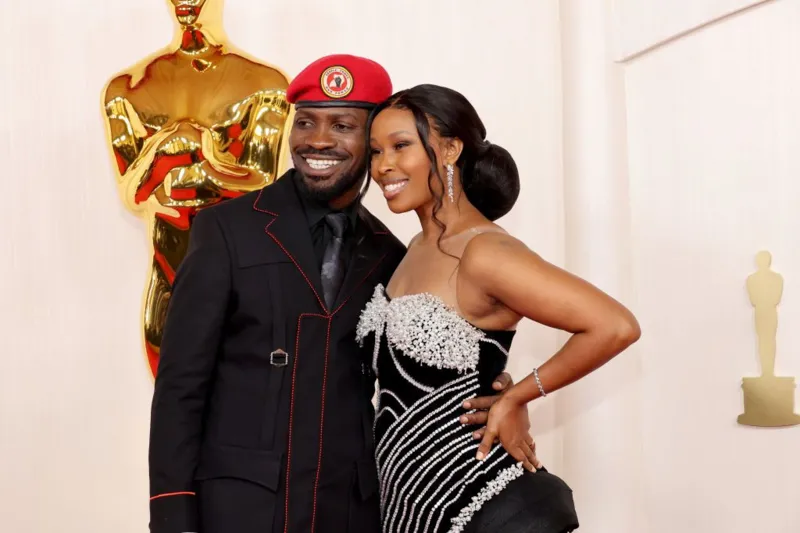
Supporters see him as a transformative figure capable of representing youth aspirations, bringing accountability, and addressing social inequalities. His nickname, the “ghetto president,” symbolizes this connection, while his adoption of the red beret serves as a rallying symbol for activism. His message emphasizes direct engagement with the population, community-based initiatives, and challenging systemic corruption.
Bobi Wine’s resilience in the face of arrests, harassment, and state-led intimidation underscores his role as a prominent opposition figure. “This election is about liberation. It is about freedom, it is about people asserting their voices. We are asking people to come out and protest in the ballot box,” he reiterates, emphasizing the stakes of the upcoming vote.
As the January 15 election approaches, Wine continues to campaign across Uganda, projecting both energy and determination. Despite security threats, he maintains a public presence, highlighting the contrast between his grassroots approach and Museveni’s long-established political machinery. His supporters remain committed, attending rallies and advocating for change despite the potential for state reprisal.
The 2026 election is expected to be a defining moment in Uganda’s contemporary political history. Wine’s candidacy represents both continuity and change: continuity in the sense of an ongoing struggle for democratic participation, and change in the possibility of challenging a four-decade incumbency. Whether he can overcome institutional and political obstacles remains uncertain, but his influence on Uganda’s political discourse is undeniable.