

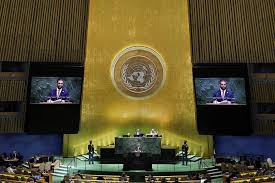

The United Nations General Assembly on Tuesday approved a $3.45 billion regular budget for 2026, authorising funding for the organisation’s core pillars of peace and security, sustainable development, and human rights, while endorsing sweeping cost-cutting measures linked to the UN80 reform initiative after weeks of intensive negotiations among its 193 member states.
The budget, formally set at $3,450,426,300, was adopted following deliberations in the Fifth Committee, the General Assembly’s main administrative and budgetary body, and reflects a major restructuring effort proposed by Secretary-General António Guterres aimed at reshaping the organisation’s financial and operational framework amid persistent fiscal pressures.
According to official documents presented to the Assembly, the approved appropriation represents a significant contraction in spending compared with previous budget cycles, incorporating a 15 per cent reduction in overall financial resources and a nearly 19 per cent cut in staffing, one of the most substantial retrenchments in the UN’s recent history.
The UN regular budget finances the organisation’s core, non-peacekeeping activities and is distinct from the separate peacekeeping budget, which operates on a July 1 to June 30 fiscal year and is approved independently by the General Assembly, while the regular budget follows the calendar year from January 1 to December 31.
Under long-established General Assembly resolutions, the regular budget supports the UN Secretariat’s work in political and peacebuilding affairs, international justice and law, human rights monitoring and advocacy, humanitarian coordination, regional economic and social development, public information, and conference services across the UN system.
Historical budget data from the UN Secretariat show that the regular budget has come under sustained pressure over the past decade, driven by rising mandates from member states, inflationary costs, expanding humanitarian and political responsibilities, and chronic delays in the payment of assessed contributions by some member countries.
The 2026 budget negotiations were closely tied to the UN80 reform initiative, a comprehensive restructuring agenda launched by the Secretary-General to modernise the organisation as it approaches its 80th anniversary, with a focus on efficiency, accountability, and financial sustainability.
UN80 builds on earlier reform efforts undertaken under previous Secretaries-General, including cost-containment measures, management reform, decentralisation of decision-making, and staffing reviews, many of which were introduced in response to calls from major contributors for tighter budget discipline and improved oversight.
Reports from UN News and international wire services have documented longstanding concerns among member states about the organisation’s growing arrears, operational inefficiencies, and the widening gap between expanding mandates and available resources, concerns that heavily shaped negotiations on the 2026 budget.
A central feature of the approved budget is the planned abolition of approximately 2,900 positions across the UN Secretariat beginning January 1, 2026, alongside the completion of more than 1,000 staff separations already finalised as part of the restructuring process.
UN officials said the staffing reductions would require careful internal reorganisation to maintain critical functions, manage institutional knowledge loss, and ensure compliance with staff regulations governing severance, pensions, and transitional entitlements for affected personnel.
Briefing delegates after the vote, UN Controller Chandramouli Ramanathan praised members of the Fifth Committee for concluding what he described as an unusually compressed and complex negotiation process under severe time constraints.
“It has been a year of challenges,” Ramanathan said, noting that the Secretariat was tasked with assembling an entire budget proposal in less than six weeks, producing hundreds of financial tables and responding to thousands of questions from oversight bodies and member states.
He cautioned, however, that the adoption of the budget marked “the beginning, not the end,” of a demanding implementation phase, warning that translating approved reductions into operational reality would test the organisation’s management systems and workforce planning.
Ramanathan also highlighted the need to ensure that staff affected by the restructuring continue to receive salaries and entitlements during the transition period, stressing that careful sequencing would be essential to avoid disruptions to ongoing UN programmes.
Beyond internal restructuring, the Controller drew attention to broader institutional challenges, including the persistent problem of delayed or unpaid assessed contributions, which have repeatedly strained the UN’s cash flow and forced the Secretariat to implement temporary spending controls.
He welcomed what he described as a record level of potential advance payments pledged by some member states toward the 2026 budget, while appealing for continued prompt payment of assessments to stabilise the organisation’s finances.
Oversight bodies and several delegations have warned that sustained underfunding, if combined with sharp staffing reductions, could weaken the UN’s ability to deliver on mandates approved by the General Assembly and the Security Council, particularly in politically sensitive and humanitarian contexts.
Despite these concerns, supporters of the budget said the reductions were necessary to align the organisation’s structure with fiscal realities and restore confidence among contributors, many of whom have pressed for demonstrable reforms before supporting future funding increases.
As the UN moves from budget approval to implementation, officials acknowledge that balancing financial discipline with effective mandate delivery will remain a central challenge, with the success of the UN80 reform initiative likely to shape the organisation’s credibility, operational capacity, and relevance in the years ahead.