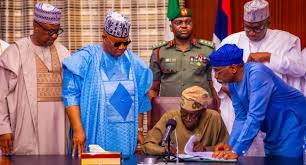


President Bola Tinubu on Monday reaffirmed that Nigeria’s newly enacted tax laws would be implemented as scheduled from January 1, 2026, insisting that the reforms were a critical component of his administration’s fiscal agenda and would not be derailed by what he described as unresolved controversies. The President said the tax laws, including those that took effect on June 26, 2025, and others billed to commence at the start of 2026, would proceed in line with government plans.
“The new tax laws, including those that took effect on June 26, 2025, and the remaining Acts scheduled to commence on January 1, 2026, will continue as planned,” Tinubu said. He described the reforms as “a once-in-a-generation opportunity to build a fair, competitive, and robust fiscal foundation for our country,” urging stakeholders to support what he characterised as the delivery phase of the process.
The President stressed that the tax reforms were not designed to impose additional burdens on Nigerians but to restructure the country’s fiscal framework. “The tax laws are not designed to raise taxes, but rather to support a structural reset, drive harmonisation, and protect dignity while strengthening the social contract,” he said, adding that public confidence would be built through consistent and principled decision-making.
Addressing allegations that some provisions of the tax laws were altered after passage by the National Assembly, Tinubu said his administration was aware of the public debate but maintained that no substantial issue had been established to justify suspending implementation. “Absolute trust is built over time through making the right decisions, not through premature, reactive measures,” he stated.
The President further pledged cooperation with the legislature, assuring Nigerians that due process would be upheld. “The Presidency pledges to work with the National Assembly to ensure the swift resolution of any issue identified,” Tinubu said. “I assure all Nigerians that the Federal Government will continue to act in the overriding public interest to ensure a tax system that supports prosperity and shared responsibility.”
However, the President’s position has triggered strong opposition from political rivals and civil society groups, who argue that proceeding with implementation amid allegations of discrepancies undermines democratic accountability. Former Vice President Atiku Abubakar and the Peoples Democratic Party have emerged as leading critics of the decision to maintain the January 1 commencement date.
In an interview with some journalists through his media adviser, Paul Ibe, Atiku described Tinubu’s insistence on proceeding with implementation as “irresponsible,” particularly in the absence of a completed investigation into the alleged alterations. “How do we know that nothing substantial was altered?” Atiku asked. “Was there an investigation by the Federal Government or the Presidency?”
Atiku noted that an ad hoc committee set up by the House of Representatives had not concluded its work, questioning the basis for the President’s confidence. “So why would the President go ahead?” he said, adding that tax laws had far-reaching consequences for citizens and required the highest level of transparency.
The former Vice President went further to allege that implementing disputed laws would amount to a grave abuse of process. “Otherwise, it amounts to forgery,” Atiku said. “And that, by the way, is the character of this administration. It appears that forgery has become a state policy.”
He also questioned why authentic copies of the laws had not been produced for public scrutiny. “There are supposed to be three copies: one with the Presidency, one with the Supreme Court, and one with the National Assembly,” Atiku said. “Why is it difficult to produce any of these documents so that Nigerians can independently determine what happened?”
Atiku warned that going ahead with implementation despite public outcry could have serious consequences. “If the President goes ahead with its implementation, I want to say clearly that this is an act of irresponsibility,” he said, describing the move as reflective of “elements of dictatorship and state capture.”
The Peoples Democratic Party echoed Atiku’s criticisms, accusing the Tinubu administration of prioritising revenue generation over citizens’ welfare. In a statement signed by its National Publicity Secretary, Ini Ememobong, the PDP said the President’s stance showed that “money, not Nigerians, is the priority of this government.”
“Rather than address these issues comprehensively, the Presidency has consciously minimised them and instead vehemently insisted that the commencement date must stand,” the party said. The PDP recalled the economic impact of fuel subsidy removal in 2023, arguing that the administration had consistently placed fiscal considerations above social consequences.
The controversy traces its origins to December 17, 2025, when a Peoples Democratic Party lawmaker representing Kebbe/Tambuwal Federal Constituency of Sokoto State, Abdussamad Dasuki, raised a matter of privilege in the House of Representatives. Dasuki alleged that the tax laws gazetted and made public “differed materially” from the versions debated and passed by lawmakers.
Dasuki warned that the alleged alterations posed “serious legal and constitutional risks,” arguing that provisions not approved by the National Assembly had appeared in the gazetted laws. Among the concerns he listed were coercive fiscal powers, including arrest authority, garnishment without court orders, compulsory dollar computation, and appeal security deposits.
In response, the National Assembly leadership directed the Clerk to the National Assembly to re-gazette the four tax reform laws and issue Certified True Copies of the versions duly passed by both chambers. The directive was aimed at clarifying the authentic texts of the legislation amid growing public concern.
House spokesman Akin Rotimi described the re-gazetting exercise as an administrative step rather than an admission of wrongdoing. “This review is strictly confined to institutional processes and procedures,” Rotimi said. “It does not constitute, imply, or concede any defect in the exercise of legislative authority by the House of Representatives or the Senate.”
The House also constituted a seven-man ad hoc committee chaired by Muktar Betara, the lawmaker representing Borno State, to investigate the allegations and reconstruct the sequence of events surrounding the passage, presidential assent, and gazetting of the tax laws.
Beyond partisan politics, labour unions and professional bodies have raised alarms over the implications of implementing disputed legislation. The Nigeria Labour Congress has joined calls for suspension, warning that uncertainty over the authenticity of the laws could erode public trust and worsen labour-government relations.
The Nigerian Bar Association also expressed reservations, emphasising the importance of due process. NBA President Afam Osigwe (SAN) said the association’s concern was not with tax reform itself but with the integrity of the legislative process. “If the President’s decision is to implement the authentic law as passed by the National Assembly, which has no controversy of having been doctored or tampered with, then the President would be right,” Osigwe said.
However, Osigwe warned that implementing any version alleged to have been altered would justify calls for suspension. “It is a suspension of the tax law that is alleged to be tainted with additions, modifications, and deletions,” he said, describing such changes as “a subversion of the will of the people as expressed by the legislature.”
Regional socio-political groups have also weighed in. The Arewa Consultative Forum faulted the January 2026 implementation timeline, saying unresolved controversies undermined the credibility of the reforms. ACF National Publicity Secretary, Prof. Tukur Muhammad-Baba, described the President’s stance as “unfortunate.”
“The complaints being raised are critical and legitimate,” Muhammad-Baba said, adding that Nigerians deserved clarity on what the National Assembly actually passed. “It is a fundamental credibility and integrity issue that must be addressed and resolved,” he stated.
Despite the backlash, the Federal Government has continued to defend the reforms. Chairman of the Presidential Committee on Fiscal Policy and Tax Reforms, Taiwo Oyedele, said the administration remained confident that the laws would deliver broad-based relief. “The plan to commence the new law, the two remaining new laws on the first of January 2026, will go ahead as planned,” Oyedele told journalists.
He argued that the reforms were designed to benefit the majority of Nigerians. “The bottom 98 per cent of workers will see either no pay tax or lower taxes to be paid,” Oyedele said, adding that 97 per cent of small businesses would be exempt from several major taxes.
As the January 1 deadline approaches, the clash between the executive, opposition parties, the legislature, and civil society underscores deeper tensions over governance, transparency, and public trust. With investigations ongoing and political pressure mounting, the fate of Nigeria’s most ambitious tax reforms in decades remains a defining test of democratic accountability and fiscal policy under the Tinubu administration.