

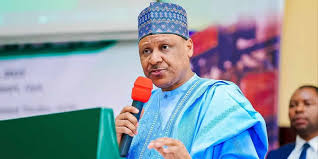

The Federal Government has disclosed that Nigerian security agencies are collaborating with major social media companies to identify and take down accounts used by terrorist and criminal groups to promote their activities, raise funds, and disseminate propaganda, as part of intensified efforts to protect national security. The disclosure was made on Tuesday by the Director‑General of the National Counter Terrorism Centre (NCTC), Maj.-Gen. Adamu Laka, during an end‑of‑year briefing in Abuja.
Maj.-Gen. Laka told journalists that platforms such as TikTok, Facebook, Instagram, Snapchat and X had been exploited by terrorists to publicise operations, display looted items, and communicate with supporters, prompting sustained engagement between Nigerian security agencies and the social media companies.
“The issue of social media platforms used by terrorist groups if you knew how many accounts we took down. We have had several meetings with these social media platforms like TikTok, Instagram, Snapchat, Facebook and X,” Laka said, explaining that while these companies are profit‑driven businesses, they have been responsive to governmental outreach and cooperation.
He noted that there was a time when bandits would go on TikTok and display their loot openly, and even conduct live streams and hold conversations targeted at their audiences, but that such accounts had been removed as part of ongoing efforts to curb the menace.
Background evidence shows that Nigeria has faced persistent use of social media by extremist elements. In recent years, jihadists and bandits have exploited platforms such as TikTok to broadcast propaganda, flaunt weapons, cash and even ransom payments, and in some cases host live sessions that could reach wide audiences, underscoring the challenges of moderating such content.
Analysts have documented how militant groups, including Boko Haram and its offshoots, shifted from traditional media to digital and social media platforms to spread their messages, recruit followers, and legitimise their narratives to both local and international audiences.
Laka acknowledged that terrorist tactics continue to evolve, noting that extremists now increasingly use aliases and unverified accounts to escape detection and continue their online presence. “Terrorist tactics keep changing, including use of aliases and unverified accounts,” he said, stressing that security agencies are constantly adapting to counter such developments.
He also highlighted that ransom payments remain a major source of terror financing, with kidnappers increasingly exploiting point‑of‑sale (POS) operators to move funds in ways that complicate tracking, making it harder for investigators to trace proceeds directly back to criminal networks.
“In many cases, ransom payments are transferred by victims directly to POS operators whose account details are provided by terrorists,” Laka explained. “The money is then withdrawn by the criminals,” adding that this tactic has complicated efforts to trace and disrupt terror financing.
The counter‑terrorism chief said security agencies have intensified efforts to track ransom payments, arrest suspects, prosecute offenders, and disrupt terror financing networks, but warned that operational details could not be publicly disclosed for security reasons.
Laka further revealed that several arrests and prosecutions had been carried out in connection with ransom payments and terrorism financing, and that asset recoveries and seizures form part of Nigeria’s compliance with international anti‑money laundering and counter‑terrorism financing standards.
He attributed Nigeria’s recent progress in meeting the requirements of the Financial Action Task Force (FATF) partly to coordinated investigations by a joint committee involving security agencies, financial intelligence units, and the judiciary, which have worked together to strengthen Nigeria’s financial oversight and accountability mechanisms.
While acknowledging the challenges posed by evolving terror tactics and porous borders in the Sahel region, Laka assured Nigerians that security agencies would continue to strengthen both physical and digital counter‑terrorism efforts. “We are doing our best, and we will not relent. In 2026, we are going to up our game,” he said.
He also noted that the wave of military coups and instability in neighbouring Sahel countries, including Mali, Niger, and Burkina Faso, had exacerbated insecurity in Nigeria by deepening regional instability and facilitating the spread of extremist networks across borders.
Laka stressed that Nigeria must play a leadership role in West Africa and the broader Sahel region to confront transnational threats, adding that the country’s counter‑terrorism strategy would continue to adapt to the changing security landscape.
Despite these efforts, security analysts and communities have raised concerns over the frequency of bandit attacks, kidnappings, and abductions that continue to affect states across Nigeria, creating fear and anxiety among citizens and underscoring the multifaceted nature of the security challenge.
The Federal Government’s push to work with social media companies to delete harmful content, combined with efforts to disrupt terrorist financing and strengthen regional cooperation, reflects a broader strategy to counter the digital and physical dimensions of terrorism and criminality in Nigeria.