

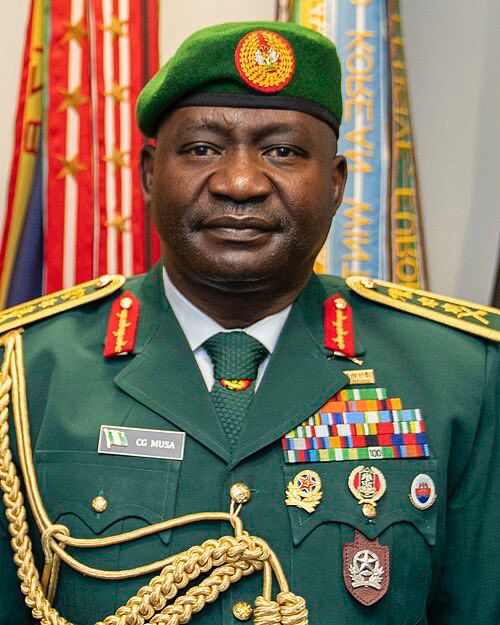

President Bola Tinubu’s newly appointed Minister of Defence and immediate past Chief of Defence Staff, retired General Christopher Musa, officially assumed duty on Friday at the Ministry of Defence headquarters, known as Ship House, in Abuja. His arrival marked the first major development since his appointment on Tuesday, which followed the unexpected resignation of former Defence Minister Mohammed Badaru due to health reasons. Confirmed by the Senate on Thursday, Musa’s transition into the role has been closely watched by security observers who believe his wealth of operational and administrative experience positions him as a stabilising force in Nigeria’s defence structure.
Musa arrived at the ministry at about 11:10 a.m., where he immediately observed military tradition by inspecting the quarter guard. The atmosphere at Ship House was one of ceremony and respect as he exchanged greetings with the service chiefs, senior officers, and top ministry officials who gathered to receive him. The formalities underscored not only his return to a familiar environment but also the significance of the leadership shift, occurring at a time when the nation continues to confront persistent security threats across multiple fronts.
Reactions to Musa’s appointment have been largely positive across defence circles, political institutions, and civil society groups. Analysts describe him as a firm, adaptive, and deeply experienced leader whose record as Chief of Defence Staff (CDS) earned him a reputation for strategic coordination and decisive action.
Many believe that his appointment is the continuation of Tinubu’s efforts to recalibrate Nigeria’s security architecture by placing tested hands in critical positions. Stakeholders also note that the level of respect he commands across the Army, Navy, and Air Force could strengthen inter-service cooperation, which has often been emphasised as essential for successful joint operations.
General Musa’s leadership credentials are backed by more than three decades of service in the Nigerian military, a journey that began when he graduated from the Nigerian Defence Academy in 1991 and was commissioned as a Second Lieutenant. Born on December 25, 1967, he completed his earlier education in Sokoto and attended the College of Advanced Studies, Zaria, before joining the NDA. His career trajectory has been defined by combat experience, strategic appointments, and frontline operational leadership, distinguishing him as one of Nigeria’s most seasoned military officers of his generation.
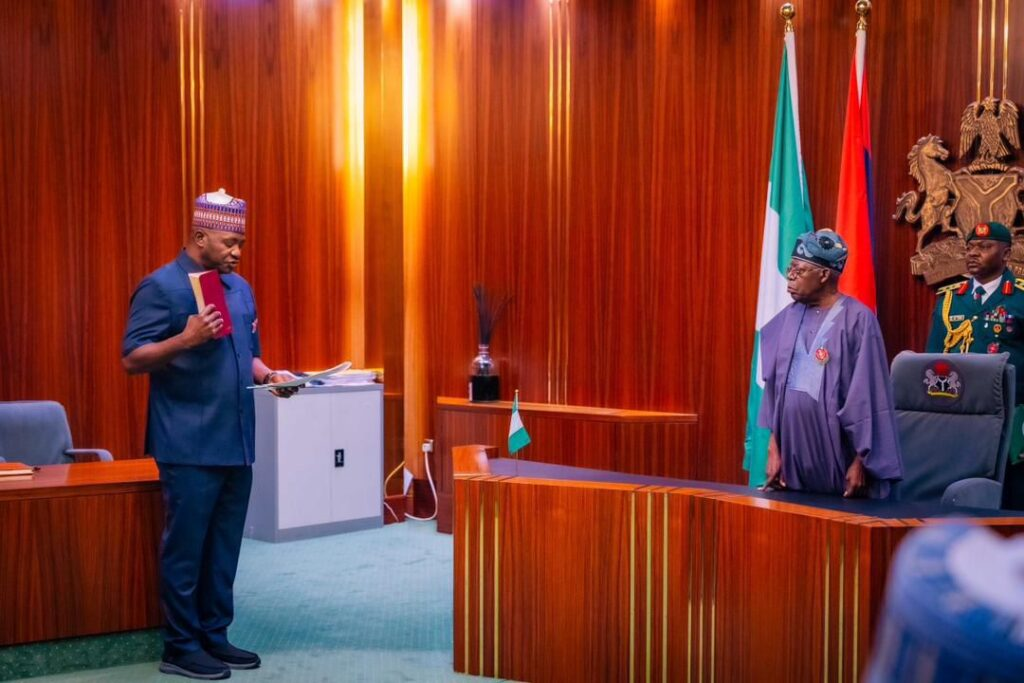
Between June 2023 and October 2025, Musa served as the 18th Chief of Defence Staff, where he oversaw integrated military operations across the Army, Navy, and Air Force at a time when the country faced a combination of insurgency, banditry, piracy, and communal violence. His approach prioritised synchronised operations, intelligence sharing, and improved troop welfare—areas in which he was widely praised by service members and independent analysts alike. His carriage and experience during this period cemented his reputation as an officer with both operational depth and administrative clarity.
Before rising to the apex of military leadership, Musa was the Commander of the Nigerian Army Infantry Corps from 2022 to 2023, a position that placed him at the centre of infantry training, doctrine development, and operational readiness. In the infantry, where the bulk of counter-insurgency operations are carried out, Musa played a key role in modernising training and strengthening troop deployment strategies. His leadership in this role earned him recognition for his commitment to discipline, preparedness, and innovation in combat operations.
His frontline experience is perhaps most evident from his tenure as Theatre Commander of Operation Hadin Kai in Northeast Nigeria from 2021 to 2022. During this period, he led the complex counter-terrorism operations against Boko Haram and ISWAP, coordinating air and ground strategies that disrupted several insurgent cells. Prior to this, he commanded Sector 3 of both the Multinational Joint Task Force (MNJTF) and Operation Lafiya Dole between 2019 and 2021, where he worked closely with forces from neighbouring Chad, Niger, and Cameroon to stabilise the Lake Chad region. His leadership helped enhance cross-border cooperation—an essential factor in the fight against insurgency.
In addition to his operational duties, Musa held several important strategic and administrative positions earlier in his career. These include serving as Deputy Chief of Staff (Training/Operations) at the Headquarters Infantry Centre and Corps, Assistant Director of Operational Requirements at Army Headquarters, Infantry Representative on the Training Team at the Army Armour Corps, Commanding Officer of 73 Battalion, and General Staff Officer 1 (Training/Operations) at the 81 Division. These roles, taken together, reflect a career built on the foundations of training, administration, field command, and inter-agency coordination.
General Musa is widely respected for his dedication to the profession of arms and has been honoured for his service, including receiving the Colin Powell Award for Soldiering in 2012, which recognised his outstanding leadership qualities. Such awards, according to officers who served under him, reflect not only his professional capability but also his emphasis on discipline, mentorship, and results-oriented leadership. These qualities are cited by security experts as strong indicators of his potential impact at the Defence Ministry.
As Musa settles into his new role as Minister of Defence, expectations are high that his appointment will inject fresh momentum into ongoing security reforms and operational strategies. He takes over at a time when Nigeria is grappling with heightened insurgency in the Northeast, banditry in the Northwest, separatist violence in the Southeast, and maritime insecurity in the Gulf of Guinea.
For many observers, his blend of frontline experience and policy-level leadership could bridge long-standing gaps in defence management. His tenure is expected to shape not only the operational direction of the armed forces but also the broader architecture of national security in the years ahead.