

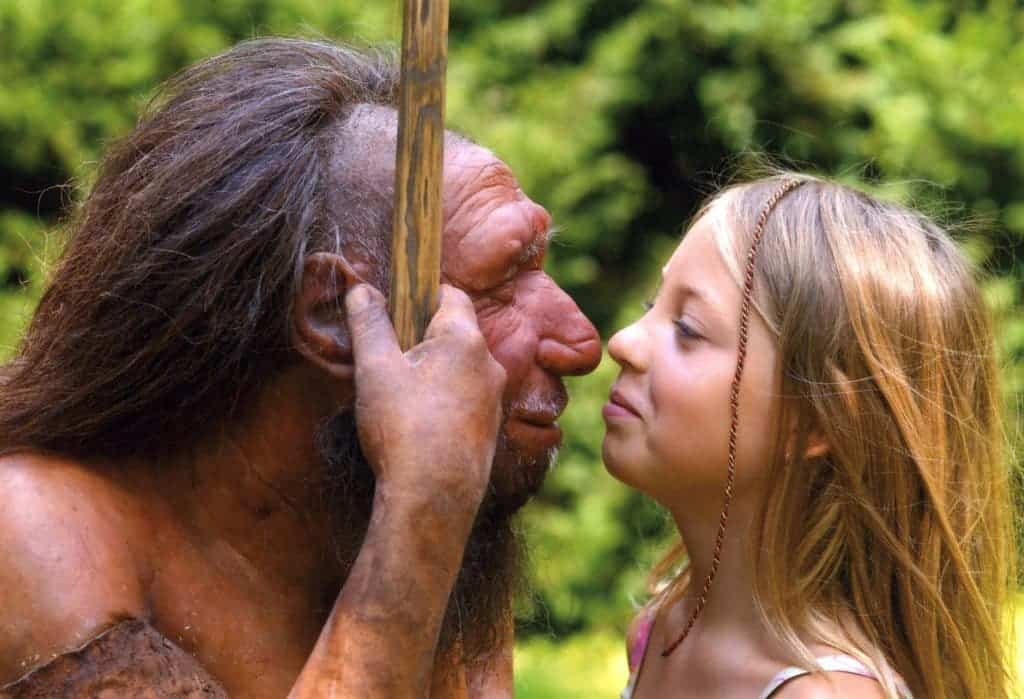

Around 45,000–60,000 years ago, Homo sapiens began migrating out of Africa into Europe, a land already inhabited by Neanderthals—robust, cold-adapted humans who had thrived there for hundreds of thousands of years.
They were not so different.
Both species made tools, controlled fire, buried their dead, and likely communicated through language. When they met, it was not necessarily immediate conflict. In many regions, they lived side by side for thousands of years. And during that overlap, something profound happened: they interbred.
Today, most people of European descent carry about 1–2% Neanderthal DNA, a genetic echo of those ancient encounters.
A Human Story of Attraction and Survival
Imagine a glacial European valley at dusk.
A small group of Homo sapiens settles near a river, their movements quick, their tools refined. Across the same landscape, Neanderthals—stronger, broader, adapted to the cold—watch from a distance. At first, there is caution. But over time, curiosity grows.
Encounters become less tense.
A shared hunting ground. A traded tool. A moment of eye contact that lingers longer than expected.
In such a world, it is not difficult to imagine relationships forming. Anthropologists now believe that interbreeding was not rare or accidental—it happened repeatedly over generations.
One compelling possibility is that Neanderthal males and Homo sapiens females formed unions, whether through cooperation, coexistence, or more complex social dynamics. Homo sapiens, with their expanding populations and social flexibility, may have gradually absorbed Neanderthal groups into their own.
The Subtle Power of Selection
Over time, natural selection would have shaped the descendants of these unions.
Homo sapiens traits—such as lighter skeletal structure, greater social adaptability, and advanced communication—may have provided advantages in larger, interconnected groups. Meanwhile, certain Neanderthal genes proved useful, especially for survival in colder climates.
These inherited traits include:
- improved immune responses to Eurasian diseases
- skin and hair adaptations suited to low sunlight
- metabolic traits for cold environments
But not all Neanderthal features persisted. Gradually, as generations passed, the distinctly Neanderthal form faded, replaced by a population that was overwhelmingly Homo sapiens in appearance—but still carrying traces of their ancient cousins.
Echoes in Modern Europeans
Today, populations across Europe still carry these genetic remnants. While it would be inaccurate to suggest that any modern group is “closer” in appearance to Neanderthals in a direct sense, certain remote or isolated populations may preserve slightly higher percentages of archaic DNA due to historical patterns of migration and limited gene flow.
The idea of “Aboriginal Swiss” or isolated Alpine groups reflects a broader truth: geographic isolation can preserve genetic traits longer than in highly mixed populations. However, modern science shows that Neanderthal DNA is widespread across all non-African populations, not concentrated in any single group.
The Disappearance That Wasn’t
Rather than a simple extinction, the fate of Neanderthals may be better understood as absorption.
They did not entirely vanish—they became part of us.
Through thousands of years of interbreeding, their lineage was gradually woven into the genetic fabric of Homo sapiens. What disappeared was not their DNA, but their distinct identity as a separate species.
A Shared Humanity
The story of Homo sapiens and Neanderthals is not just about evolution—it is about connection.
It challenges the idea that ancient human species were entirely separate or incompatible. Instead, it reveals a past where different kinds of humans met, interacted, and even formed families.
In that sense, every person of European or Asian descent carries a fragment of that story within them—a reminder that humanity has always been more interconnected, more complex, and more intertwined than we often imagine.
Conclusion
The possibility that modern Europeans emerged, in part, from the blending of Homo sapiens and Neanderthals is not just a theory—it is a genetic reality, though far more nuanced than simple narratives of dominance or replacement.
It is a story of migration, adaptation, and perhaps even attraction.
And in the quiet persistence of ancient DNA within us, it is a reminder that the past is never truly gone—it lives on, invisibly, in who we are.