

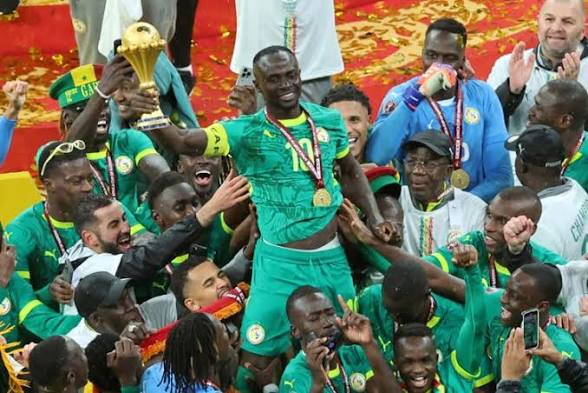

In a bold and symbolic act of defiance, the Senegal national football team has publicly paraded the Africa Cup of Nations (AFCON) trophy, despite being officially stripped of the title by the Confederation of African Football.
The development, reported by Punch on March 28, 2026, marks a dramatic escalation in the ongoing dispute between Senegal and CAF over the controversial 2025 AFCON final.
A Defiant Parade in Paris
Senegal’s players showcased the trophy before their international friendly against Peru at the Stade de France in Paris, taking part in what was described as a celebratory lap of honour led by captain Kalidou Coulibaly.
The moment was not just ceremonial—it was a clear statement of intent. By parading the trophy, Senegal signaled that, regardless of CAF’s ruling, they still consider themselves the rightful champions of Africa.
The event was further elevated by a pre-match performance from Senegalese music icon Youssou N’Dour, adding a sense of national pride and cultural symbolism to the occasion.
The Controversial CAF Decision
The controversy stems from the chaotic AFCON 2025 final, where Senegal initially defeated Morocco 1–0 after extra time.
However, on March 17, CAF’s appeals board overturned the result and awarded a 3–0 victory to Morocco, citing a 14-minute walk-off by Senegal players during the match as a violation of competition rules.
This decision effectively stripped Senegal of the title weeks after they had celebrated their victory, sparking outrage across the football world.
Senegal’s Firm Stance
Senegal’s football authorities have strongly rejected the ruling, describing it as unjust and unprecedented.
At the heart of their argument is a simple principle: football matches should be decided on the pitch, not in boardrooms.
Head coach Pape Thiaw reiterated this position, insisting that his team remains the true champions based on their on-field performance.
The country has since taken the matter to the Court of Arbitration for Sport (CAS), seeking to overturn CAF’s decision through legal means.
Symbolism Beyond Sport
The trophy parade goes beyond football—it represents:
- a protest against perceived injustice
- a show of solidarity with fans and players
- a challenge to CAF’s authority
By publicly displaying the trophy, Senegal is effectively refusing to accept the narrative imposed by the governing body, keeping the debate alive on the global stage.
Morocco’s Position
While Senegal continues its protest, Morocco—now officially recognized as AFCON 2025 champions—has maintained that the matter is settled following CAF’s ruling.
This divergence has created a unique situation where:
- CAF recognizes Morocco as champions
- Senegal continues to claim the title publicly
Such a scenario is rare in international football and has added to the controversy surrounding the tournament.
What Happens Next?
The final outcome now rests with the Court of Arbitration for Sport, which is expected to review the case.
Possible outcomes include:
- upholding CAF’s decision
- overturning the ruling and restoring Senegal’s title
- ordering a compromise or further disciplinary review
Until then, the dispute remains unresolved, with both sides holding firmly to their positions.
Conclusion
Senegal’s decision to parade the AFCON trophy despite being stripped of the title underscores the depth of frustration surrounding one of the most controversial rulings in African football history.
Far from closing the chapter, the act has intensified the debate—turning a football dispute into a broader conversation about fairness, governance, and the integrity of the game.
As the legal battle unfolds, one thing is clear: for Senegal, the title is not just a trophy—it is a matter of pride, principle, and identity.