

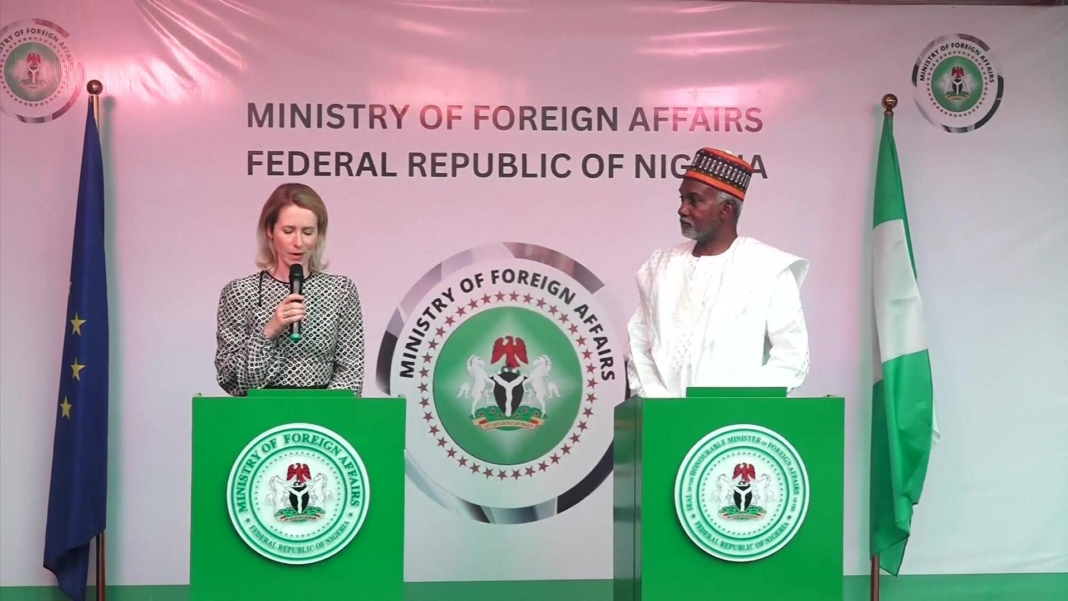

The European Union (EU) on Monday announced a major expansion of its strategic partnership with Nigeria, unveiling a €290 million investment package under its Global Gateway Strategy aimed at boosting digital infrastructure, healthcare manufacturing, agricultural value chains, and migration management, a move that underscores the deepening cooperation between the two partners amid growing regional and global challenges. The announcement was made during the Eighth Nigeria–EU Ministerial Dialogue held in Abuja, co-chaired by Nigeria’s Minister of Foreign Affairs, Yusuf Tuggar, and EU High Representative for Foreign Affairs and Security Policy and Vice President of the European Commission, Kaja Kallas, in a gathering that brought together top policymakers, financial institutions, and development partners to chart a roadmap for sustainable development, industrialisation, and regional integration.
On the side-lines of the summit, the development arm of the European Investment Bank, EIB Global, and the Bank of Industry (BoI) signed a €50 million financial agreement to strengthen the local healthcare sector in Nigeria, targeting unmet medical needs, alongside an €85 million agreement to support the development of the country’s agricultural value chains, with at least 70 per cent of the agricultural loans earmarked for cocoa and dairy production. The health financing intervention, structured as a dedicated credit line, is designed to support local manufacturers of pharmaceuticals, vaccines, diagnostics, and other essential medical devices, contributing directly to Nigeria’s national priorities in health and industrial development while fostering skills development and job creation in line with regional and global standards.
Speaking on the significance of the healthcare agreement, Dr. Olasupo Olusi, Managing Director and Chief Executive of BoI, said, “This partnership marks a pivotal step in Nigeria’s journey from being a major importer of essential health commodities to becoming a competitive producer within regional and global value chains. By mobilising long-term, patient capital into local pharmaceutical, vaccine and diagnostics manufacturing, we are not only strengthening health security but also catalysing industrial growth, skills development and high-quality job creation. At the Bank of Industry, we view healthcare manufacturing as both a public health imperative and a strategic economic opportunity. Through this collaboration with EIB Global under the Human Development Accelerator, we are building a sustainable financing architecture that empowers Nigerian enterprises to scale, innovate and meet international quality standards.
This initiative demonstrates how development finance, when aligned with national priorities and strong international partnerships, can unlock transformative impact improving lives today while laying the foundation for a more resilient and self-reliant healthcare system for future generations.” EIB Vice President, Ambroise Fayolle, echoed the sentiment, stating, “I am very pleased to announce this partnership with the Bank of Industry to improve public health and daily lives in Nigeria. By financing the development and local manufacture of essential medicinal and nutritional products, we enhance access to affordable, safe and high-quality treatments for diseases.
We support national health security while improving the resilience of supply chains. This is a concrete example of the added value of the EIB’s action in Africa as a key partner of Global Gateway.” Similarly, European Commission Commissioner for International Partnerships, Jozef Síkela, added, “This investment strengthens local manufacturing of medical products in Nigeria, giving companies better access to finance and the capacity to scale up production. We are investing so that Nigeria can produce more of what it needs at home and build stronger healthcare systems and regional value chains instead of relying on imports.”
The healthcare agreement forms part of the Global Gateway Health Package and aligns with the Team Europe Initiative for Manufacturing and Access to Vaccines (TEI MAV+), reinforcing both national and continental priorities. It directly supports Nigeria’s goal of improving self-sufficiency in healthcare and complements the African Union’s target of producing 60 per cent of vaccines and essential medicines locally by 2040. The initiative also presents regional industrialisation opportunities under the African Continental Free Trade Area (AfCFTA), potentially opening new markets in the ECOWAS region. Since beginning operations in Nigeria in 1978, EIB Global has invested over €2.3 billion across sectors including sustainable urban transport, climate adaptation, agribusiness, digitalisation, and SME financing, demonstrating a long-term commitment to transformative development projects in the country.
In parallel with healthcare, EIB Global and BoI’s €85 million investment in agricultural value chains aims to support private sector companies, cooperatives, and MSMEs across Nigeria, with a strong emphasis on cocoa and dairy sectors. The project prioritises compliance with Environmental and Social Standards (ESS), the EU Regulation on Deforestation (EUDR), and EIB’s public environmental and social standards, promoting sustainable agriculture, biodiversity conservation, and inclusive rural development.
Dr. Olusi said, “This agreement reinforces the Bank of Industry’s commitment to unlocking long-term, affordable finance for priority sectors that drive inclusive growth. By partnering with EIB Global, BoI is scaling support for sustainable agriculture, strengthening critical value chains and enabling Nigerian agribusinesses to grow competitively while meeting international environmental and social standards.” Fayolle added, “I am delighted that EIB is financing this project with the Bank of Industry for the development of agricultural value chains in Nigeria, including sustainable cocoa.
Such investment is important for the country in terms of employment, health, and economy, with real impact on local population. Our ambition is to support and accompany the sustainable transformation of Nigeria’s targeted value chains, in line with EU Global Gateway Initiative of which EIB, as the EU bank, is a key actor and partner in Africa.”
In the digital sector, the EU investment package earmarks €131 million to improve connectivity, expand digital services, and enhance digital skills development. The programme plans the rollout of approximately 90,000 kilometres of fibre-optic cable across Nigeria in partnership with the European Bank for Reconstruction and Development, aiming to provide secure and affordable internet access to an estimated 33 million Nigerians currently without reliable connectivity.
The investment will also support secure and interoperable digital public infrastructure and contribute to Nigeria’s technical talent development initiative, training millions of digital professionals. Migration management received €16 million in funding to enhance reintegration support for returning migrants and combat human trafficking networks, including the provision of social, economic, and psychological assistance, strengthening Nigeria’s capacity to tackle smuggling and trafficking while promoting human security.
European officials at the summit highlighted that the seven new investment operations reflect a renewed political commitment to deepening Nigeria–EU cooperation, with Kallas noting, “In the current geopolitical context, the European Union is keen to enhance its partnership with Nigeria. Bringing more EU investment to Nigeria, aligning with the Renewed Hope agenda for the Nigerian Federal Government, is a key priority for both sides.” Commissioner Síkela added, “Together with Nigeria, we are investing in the modernisation of the digital sector, a stronger health system and in the development of agriculture. These Global Gateway investments create quality infrastructure, sustainable jobs and long-term economic opportunities that benefit the Nigerian people while also creating new opportunities for Europe.”