

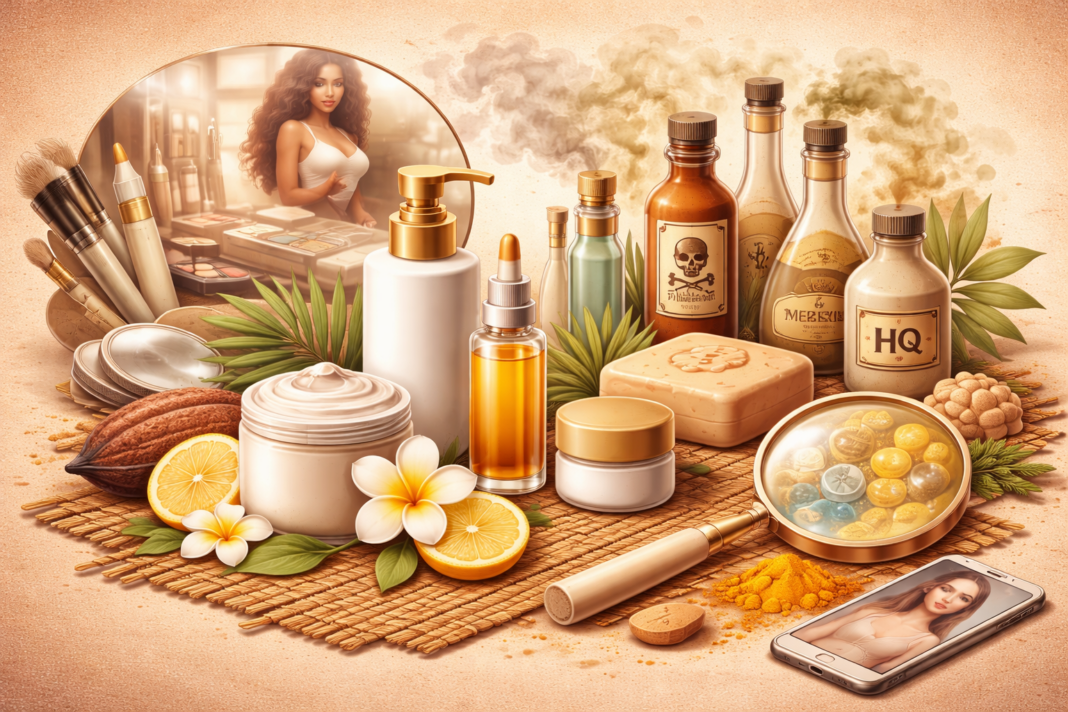

Beauty standards were not created in a vacuum; they were shaped by history, power, media, and economics. For many countries in Africa, including Nigeria, the idea of what is considered “beautiful” today can be traced back to colonial times, when European features lighter skin, straight hair, narrow noses, and thin bodies were presented as superior, modern, and more acceptable. Over time, these ideas did not just disappear after independence; they remained in advertising, in school systems, in television, in magazines, and later in social media. Slowly, many people began to associate light skin with success, sophistication, and opportunity, while dark skin became unfairly associated with poverty, stress, or being “less attractive.”
This is how colourism was born and normalized not necessarily racism in the obvious sense, but a system where lighter skin within the same race is treated as more beautiful or more valuable. Many people did not even realize when they started believing these ideas because they were everywhere: in the movies we watched, in the beauty pageants we celebrated, in the models on billboards, and even in the compliments people gave, like “You are beautiful for a dark girl,” a statement that sounds like praise but carries a deep insult.
Skin bleaching then became popular not just as a beauty choice, but as a social survival strategy for some people. In many African countries, including Nigeria, some women and even men began to feel that being lighter would give them better chances in life: better jobs, better treatment in public places, better chances in relationships, and more attention on social media. Creams and soaps that promised “brightening,” “lightening,” “toning,” and “glowing” flooded the markets, and bleaching slowly became a billion-dollar industry.
In markets across Nigeria, bleaching creams are sold openly, sometimes without regulation, and many users mix different products without fully understanding the health consequences. But beyond the physical act of bleaching is the emotional story behind it – the young girl who was called “too dark” in school, the woman who was told she would be prettier if she were lighter, the job applicant who noticed that the lighter-skinned candidates were treated more warmly, the social media influencer who gets more likes when her photos appear lighter due to filters.
These everyday experiences create silent pressure, and over time, that pressure can push people to change their skin, not because they hate themselves, but because society has convinced them that they will be more accepted if they look different.
The dangers of skin bleaching are not only social but also medical and psychological. Many bleaching products contain harmful chemicals like hydroquinone, mercury, and steroids, which can damage the skin, cause burns, stretch marks, infections, and in severe cases, kidney damage and other serious health problems. But even when people know the health risks, some still continue because the social rewards sometimes appear to outweigh the health warnings.
Psychologically, skin bleaching is deeply connected to self-esteem and identity. When a person feels that their natural skin colour is not good enough, it can lead to low self-worth, anxiety, and a constant need for validation. Colourism also affects how people treat each other: lighter-skinned people may be seen as more attractive or more successful, while darker-skinned people may be unfairly judged as less beautiful, less soft, less desirable, or less presentable.
This is not always said openly, but it shows in subtle ways — in casting for movies, in advertising, in who becomes the “face” of a brand, in who people describe as “fine,” and in who gets complimented more often.
Celebrities, influencers, movies, music videos, and social media have also played a powerful role in shaping modern beauty standards. Many images we see are edited, filtered, and carefully curated, but young people often compare their real lives to these edited images. Social media filters can lighten skin, smooth out skin texture, and reshape faces, creating a version of beauty that is not even real.
Teenagers and young adults grow up seeing these images every day, and many begin to feel that they are not attractive enough, not light enough, not slim enough, not perfect enough. This constant comparison can damage confidence and create identity struggles, especially for young people who are still trying to understand who they are. When the most celebrated people celebrities, models, influencers — all look a certain way, it sends a silent message about what society rewards and what society ignores.
But the conversation is slowly changing. Around the world and across Africa, more people are beginning to speak openly about colourism, self-acceptance, and redefining beauty. More dark-skinned models are appearing in campaigns, more natural hair movements are growing, and more people are challenging the idea that beauty must fit into one narrow definition.
Redefining beauty means understanding that beauty is not a single colour, a single body type, or a single facial structure. Beauty is diverse, cultural, human, and personal. Changing the narrative will not happen overnight, because these ideas were built over hundreds of years, but conversations, storytelling, media representation, and education can slowly reshape how people see themselves and others.
At the end of the day, the most powerful change happens when people begin to see their natural selves not as something to fix, but as something that was never broken in the first place.