

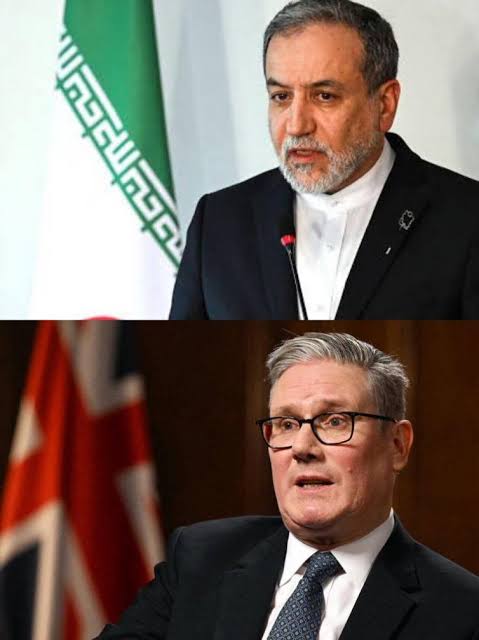

Iran’s Foreign Minister, Seyyed Abbas Araghchi, has issued a stern warning to the United Kingdom over its decision to allow the United States to utilise British military bases, describing the move as tantamount to “participation in aggression.”
The warning was delivered during a phone conversation with the UK’s Home Secretary, Yvette Cooper, and later detailed by Araghchi in his own account of the exchange. In his remarks, the Iranian foreign minister not only expressed deep concern over Britain’s role but also criticised what he described as the UK’s “negative and biased” posture toward Iran amid escalating tensions in the region.
He further demanded that London immediately halt any form of cooperation with Washington in relation to the ongoing conflict, framing such collaboration as a direct affront to Iran’s sovereignty and a destabilising factor in already fragile diplomatic relations.
While the UK government has sought to clarify its position, insisting that it did not participate in the initial offensive strikes against Iran, it acknowledged that it later granted permission for US forces to use British bases strictly for defensive purposes, particularly in response to Iranian missile activity.
Officials at 10 Downing Street were quick to emphasise that Britain’s involvement remains limited and carefully defined. In a statement, the government said, “We didn’t participate in the initial strikes, and we’re not getting drawn into the wider war.”
Expanding on this stance, the Prime Minister’s official spokesman explained, “We have authorised the US to use our bases for a specific defensive and limited purpose in response to Iran’s continued and outrageous aggression, and we’ve always said that this is the best way to eliminate the urgent threat and restore a path to diplomacy.”
Despite these assurances, the decision has continued to attract criticism from multiple quarters, including repeated and forceful remarks by US President Donald Trump, who has openly expressed dissatisfaction with what he perceives as Britain’s reluctance to play a more active role in the conflict.
British Prime Minister Keir Starmer has, however, firmly defended his government’s approach, stressing that his decisions are guided by national interest rather than external pressure. “It is for me to act in what I consider to be the best interests of Britain,” he said, underscoring his commitment to a measured and strategic response.
Meanwhile, Araghchi’s account of his conversation with Cooper, which he shared in Farsi on the messaging platform Telegram, painted a far more confrontational picture of the diplomatic exchange.
According to him, he warned that, “These actions will definitely be considered as participation in aggression and will be recorded in the history of relations between the two countries. At the same time, we reserve our inherent right to defend the country’s sovereignty and independence.”
He also criticised the UK for condemning what Iran described as its “retaliatory action,” which followed an Israeli strike on the South Pars natural gas field within Iranian territory. In response to that attack, Tehran launched strikes targeting an energy complex in Qatar, further escalating tensions in the region.
The broader geopolitical situation has been compounded by developments in the strategically vital Strait of Hormuz, a key global oil shipping route. Earlier in the week, President Trump called on allied nations, including the UK, to support efforts to reopen the strait, which has seen a sharp decline in shipping traffic since the onset of hostilities.
Iran has threatened to target certain vessels transiting the waterway with drones and missiles, creating significant disruptions to global energy supplies. The resulting blockage has triggered a dramatic surge in oil and gas prices, sending shockwaves through international financial markets and raising concerns about broader economic instability.
Prime Minister Starmer has acknowledged the seriousness of the situation, stating that he is working closely with international partners to develop a “viable, collective plan” to restore safe passage through the strait.
He warned that the prolonged conflict would have far-reaching economic consequences, noting that “the longer the conflict continues, the bigger the impact on the cost of living,” and emphasised that “the best way forward is a negotiated settlement with Iran.”
Domestically, the UK government is also facing mounting political pressure over its role in the crisis. The Green Party of England and Wales has called on the government to revoke permission granted to the United States to use British military bases for operations related to the conflict, urging ministers to “refuse any further complicity in this illegal war.”
In a formal letter addressed to the prime minister, Green Party MPs and peers demanded greater transparency regarding the use of UK bases, specifically asking the government to clarify what measures were being taken to ensure that such facilities are strictly limited to defensive purposes.
The letter also called for an assessment of civilian casualties, raising concerns about “how many Iranian civilians had been killed by US bombing missions from British air bases.”
These developments highlight the growing domestic and international scrutiny facing the UK as it navigates a complex and increasingly volatile geopolitical landscape, balancing its alliance with the United States against the risks of deeper entanglement in a widening conflict.