

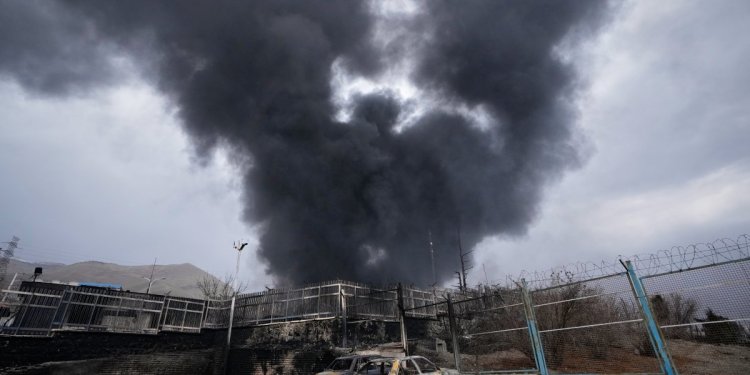

The lingering war which broke out on February 28th, 2026, after Israeli missiles struck several targets in Iran, has as of today, Friday, March 20th, entered its 21st day.
It was later confirmed by the government of the United States that the first strikes supported and backed by White House, decisively wiped out numerous Iranian top officials, including the former Supreme Leader, Ayatollah Ali Khamenei, his households, blood, and relatives.
However, the incident has only led to an increasing exchange of military offensive operations, leaving people inside and outside the Middle East vulnerable, as casualties rise.
Operations of global markets such as oil, aviation, and others continue to suffer deepening disruption. The death tolls have reportedly surpassed over 1,500, with the majority covering more than 1,400 people being recorded in Iran.
Also, attacks on major gas facilities in four Middle Eastern countries, including Saudi Arabia, Iran, Israel, continue to frustrate the economic impact of the crisis.
Therefore, PulseinNews brings you what the war looks like since its eruption in February.
Energy Tensions Escalate, Global Market Ripples
The tit-for-tat targeting of energy hubs has spiked prices, notably in the UK and Europe, as supply interruption feared to mount. Demand for alternatives like Russian oil has jumped in the wake of the conflict. Analysts warned that further escalation could cripple global supplies, with Iran’s threats to destroy regional infrastructure amplifying risks.
Iran has issued a stern warning amid the intensifying US-Israel-Iran war. It promised to react aggressively if its critical energy infrastructure faced further attacks. This came after Israeli strikes on the South Pars gas field, the world’s largest oil facility, prompting Tehran to retaliate against key facilities in the Gulf region.
With the escalating crisis from both parties, the global energy markets are now reeling, as oil and gas prices surging due to fears of widespread disruptions.
In Nigeria, a country not involved in the ongoing tensions, the implications are damning. The price of fuel has surged magically from N800 which Dangote Refinery pegged its price, to as high above N1,300 per litre.
Before the event, petrol was sold at a rate of $68 per barrel before jumping to $103 per barrel as the war intensified. This has escalated an existing economic crisis, while deepening suffering among the masses.
Iranian Leadership to Go Full Blown Out
Iran’s Foreign Minister Abbas Araghchi, speaking alongside President Masoud Pezeshkian, has taken to social media to warn against subsequent attack of any of its energy reserves, declaring that Tehran would show zero restraint and sympathy.
Araghchi emphasized that any conflict resolution must account for damage to civilian installations, underscoring Iran’s position that prior responses have used only a fraction of its military might.
President Pezeshkian had similarly cautioned earlier that attacks on energy sites could unleash uncontrollable consequences, signaling a shift from previous restraint influenced by international de-escalation pleas.
In retaliation for the South Pars assault, Iran launched strikes on Qatar’s Ras Laffan, the globe’s biggest liquefied natural gas hub, as well as energy installations in Saudi Arabia, Kuwait, and the United Arab Emirates. These actions have heightened alarms across the Middle East, with Iranian officials framing them as measured responses to aggression.
The vows of unrestrained action mark a potential escalation point, as Tehran asserted it has held back significantly in previous times.
US, Israeli Intensify Responses
From Washington, President Donald Trump has taken a strong stance, associating the conflict’s surprise elements to the 1941 Pearl Harbor attack during talks with Japan’s Prime Minister.
Trump has warned Iran against further retaliation, threatening unprecedented force in response to any heightened aggression. This rhetoric aligned with earlier statements demanding Iran’s unconditional surrender and the installation of an acceptable leader as prerequisites for mediation.
On the other hand, Israeli Prime Minister Benjamin Netanyahu has echoed the same sentiment, pointing to possible ground operations while declaring that Iran must cease uranium enrichment and ballistic missile production.
Recall that Israel’s military remained on high alert, intercepting incoming Iranian missiles and issuing repeated rocket warnings from Haifa to the Sea of Galilee.
The strikes that killed over 200 people, including top Iranian figures like former Supreme Leader Khamenei, have fueled the cycle of reprisals.
Broader Conflict Context, Casualties
Since the first strike on the Iranian nuclear sites and leadership gatherings, the Islamic Revolution Guard Corps (IRGC) have launched repeated missiles on 27 US based and Israeli targets like Tel Aviv’s army headquarters.
While the conflict has fueled regional instability, Iran has pledged to stop aggression on neighbouring states, unless if used as launchpads by US or Israeli forcesWorld leaders continue to weigh in, with earlier concerns over Iran’s nuclear rebuild post-US bombings last June.
Oman’s mediation efforts faltered despite Iranian concessions, leading to the current hostilities. The human toll of the war is lamentable, exposing the indiscriminate nature of weapons of mass destruction, and why international law frowned on it on paper, but had little to no effect in practice.The number of casualties in the war is rising.
The Iranian Red Crescent has earlier reported that the number of children killed by US-Israel strikes has risen to 204.
With the death toll in Iran exceeding 1,500, and 18,551 people undergoing medical treatment, Lebanon has recorded more than 1,000 people who have been killed in Israeli attacks, including 118 children.
At least 13 military personnel from the US have been hit and died in the war, with over 200 others suffering from injuries. In Israel, 18 people have been killed, with 3730 others injured.
Meanwhile, the Director-General of the World Health Organisation (WHO), Tedros Ghebreyesus, has condemned recent missile attacks across parts of the Middle East, shifting concerns to rising health and humanitarian risks.
Mr Ghebreyesus disclosed that airstrikes in the United Arab Emirates (UAE) killed eight people and injured 158 others. The revelation was made earlier today in a post on X, adding that at least two people were killed in Oman, and in Kuwait, two paramedics were injured after shrapnel struck their ambulance centre.
Financial Burden on US, as Pentagon Assures No Timeline for Ongoing Conflict
The Defence Secretary to the US, Pete Hegseth, has declared that the war disrupting worldwide energy supplies has “no timeframe,” brushing off repeated demands for renewed talks.
He made the remarks on Thursday, March 19th, during comments on a proposed $200 billion funding package. The cost of prolonging the conflict is escalating sharply for the United States, prompting the Pentagon to seek over $200 billion in additional resources.
According to The New York Times, the funding request has been forwarded to the White House for initial review prior to official submission to Congress. Citing anonymous officials, the newspaper noted that the amount sought represented almost one-quarter of the U.S. annual defence budget.
“It obviously takes money to take out the bad guys,” Hegseth remarked when questioned on the figure. “Regarding the $200bn, that figure might shift.”
“We’re heading back to Congress and stakeholders to secure adequate funding for past efforts and any future requirements,” he added.