

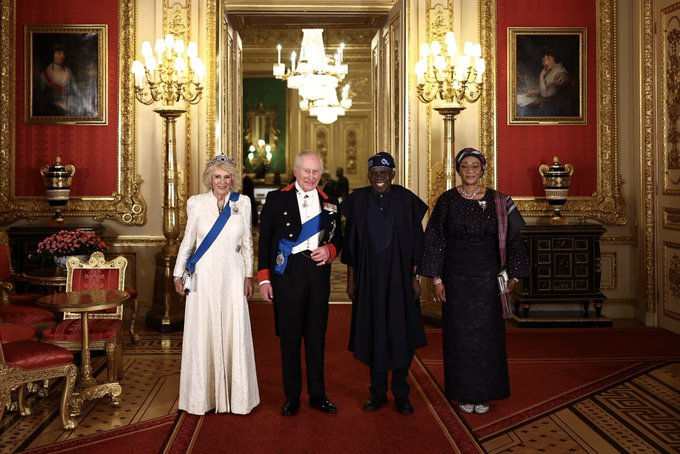

King Charles III of Britain has paid an elastic tribute to Nigeria, portraying the West African nation as a vibrant, dynamic force shaping Britain’s culture, economy, and global outlook. The revelation was made during a state banquet at St George’s Hall of Windsor Castle.
The event formed the centrepiece of President Bola Ahmed Tinubu’s two‑day state visit to the United Kingdom, showing efforts by both countries to deepen bilateral cooperation across trade, security, and cultural exchange.
In his keynote address to an audience of dignitaries, business leaders, and members of the Nigerian diaspora, the British monarch reflected on Nigeria’s transformation from a developing nation often viewed through a colonial lens into a youthful, innovation‑driven powerhouse. He described Nigeria as a country of more than 230 million people, with half of the population under 18, “full of energy, ingenuity, ambition and resolve” to tackle contemporary global challenges.
“Nigeria has arrived,” the King declared, emphasising that the country is no longer a marginal player but a central actor on the international stage.Culture, Football, and Diaspora PrideKing Charles singled out Nigerian cultural exports as a defining feature of modern Britain.
He spoke of Afrobeats reverberating through concert halls and Nollywood films captivating British screens, painting a picture of a cultural tide flowing from Lagos to London.
The British monarch also noted Nigerian‑born or‑descended stars competing in the Premier League and presiding over high‑profile cases in British courts, underscoring how Nigeria continues to reshape the UK’s sporting and legal landscapes.
He praised the several hundred thousand Nigerians and people of Nigerian heritage thriving in the UK, calling them a “living bridge” that enriches society across business, technology, academia, law, science, literature, arts, and public service.
This diaspora, he argued, embodies the human‑scale connection, exposing the broader UK–Nigeria relationship.
Shared History, Faith, and Global Leadership
Without shying away from the past, the King acknowledged the shadow of colonialism and the painful traces left in the shared history of the two nations. He stressed that no words could erase that history but insisted on the need to learn from it and build a future defined by mutual respect and partnership.
The religious municipality also featured prominently in his remarks, pointing to Nigeria’s long‑standing example of coexistence among Christians, Muslims, and other faith communities. He highlighted a recent meeting between British Christian and Muslim leaders as a mirror of Nigeria’s model of peaceful interfaith life.
Nigeria, he noted, is not only an economic powerhouse but also a cultural force and an influential diplomatic voice, particularly within the Commonwealth.
Trade, Tourism, and the Rise ofMade in UK-Nigerian Flavoured
On the economic front, King Charles underscored the growing depthness of UK–Nigeria trade. He pointed to Nigerian banks operating in the City of London, Nigerian companies listing on the London Stock Exchange, and deepening technology partnerships as evidence of converging business ecosystems.
Nigeria recently bypassed other nations to become the UK’s biggest export market in Africa, a milestone he described with evident pride.
In 2024, King Charles mentioned, Nigerian visitors spent £178 million in Britain, while British tourists spent the same amount in Nigeria, revealing a near‑symmetrical flow of tourism funds.
The King quickly stated that the phrase “Made in UK” now carries a “distinctively Nigerian flavour,” reflecting how Nigerian tastes, networks, and consumers are reshaping British export identity.
Jollof Rice, Proverbs, and a Pidgin Punchline
King Charles Left the podium with a lighter touch, briskly joking about the perennial Jollof rice debate. He recalled a Jollof and Tea party he hosted for a group of young Nigerians at St James’s Palace.
He said that he was told the best Jollof was “Nigerian, of course… or perhaps Ghanaian or Senegalese.” He diplomatically claimed he could not remember which version he endorsed.
He further drew attention to Yoruba, Hausa, and Igbo proverbs to elaborate more on the importance of knowledge, adaptability, and unity within the Commonwealth. He personified Nigeria as a country whose wisdom and openness can help revitalise the Commonwealth bloc.
He quoted the Yoruba’s proverbs “rain does not fall on one roof alone,” the Hausa’s “when the music changes, so does the dance,” and the Igbo’s “knowledge is never complete; two heads are better than one.”
“Naija No Dey Carry Last” – A Closing Toast in Pidgin
The speech reached its peak with the most memorable moment when King Charles concluded his address with the Nigerian Pidgin slogan “Naija No Dey Carry Last,” meaning Nigerians Never Come Last. This triggered appreciation and laughter from the audience.
The phrase, widely used in Nigerian popular culture to express resilience and competitive spirit, served as both a compliment and a challenge.
By adopting it in Windsor Castle, the monarch symbolically placed Nigeria and its diaspora at the heart of the UK’s evolving global narrative.