

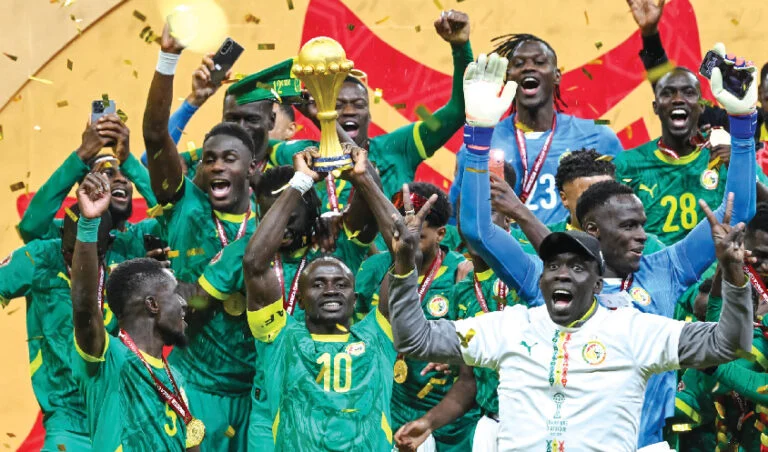

The Senegalese Football Federation (FSF) has formally rejected the decision of the Confederation of African Football (CAF) Appeal Board that awarded the 2025 Africa Cup of Nations (AFCON) title to Morocco, signaling its intent to challenge the ruling at the Court of Arbitration for Sport (CAS) in Lausanne, Switzerland. Morocco were declared champions on Tuesday after CAF overturned the result of the final against Senegal, ruling that the West African side had forfeited the match following a brief walk-off during the game in Rabat on January 19.
In its official statement, CAF declared that “the Senegal national team is declared to have forfeited the final match of the TotalEnergies CAF Africa Cup of Nations Morocco 2025, with the result recorded as 3–0 in favour of the Fédération Royale Marocaine de Football.” The decision followed a formal protest lodged by Morocco after chaotic scenes late in the final, when Senegal players temporarily left the pitch following a disallowed goal and a penalty awarded to the hosts. The appeal board cited Articles 82 and 84 of the competition regulations, which pertain to misconduct and forfeiture, as the basis for its ruling.
The FSF, in a statement issued on Wednesday, said it had taken note of the notification of the decision rendered on March 17, 2026, by the CAF Appeals Committee in case DC23316, following Morocco’s complaint during the final, referred to as match 52 of the TotalEnergies AFCON Morocco 2025. The Senegalese federation noted that the appeal board had overturned the earlier decision of the CAF Disciplinary Board due to a procedural flaw, asserting that the Royal Moroccan Football Federation’s right to be heard had not been respected during the initial proceedings.
“With this decision, the CAF Appeals Board declared the appeal of the Royal Moroccan Football Federation admissible and accepted it. In doing so, the board overturned the decision rendered by the CAF Disciplinary Board, on the grounds that the appellant’s right to be heard had not been respected during the initial proceedings,” the FSF stated. According to the Senegalese federation, the appeal committee ruled that the conduct of the Senegal national team fell under Articles 82 and 84 of the AFCON regulations, leading to the forfeiture decision and the awarding of the match with a recorded score of 3–0 in favor of Morocco.
Reacting to the verdict, the Senegalese Football Federation strongly criticized the ruling, describing it as unfair, unprecedented, and damaging to the credibility of African football. “The Senegalese Football Federation denounces an unfair, unprecedented and unacceptable decision that discredits African football,” the statement read. The federation confirmed that it would pursue an appeal before the Court of Arbitration for Sport to defend its rights and protect the interests of Senegalese football.
“To defend its rights and the interests of Senegalese football, the Federation will initiate, as soon as possible, an appeal procedure before the Court of Arbitration for Sport,” the FSF said, adding that it remained committed to due process and pledged to keep the public informed as the case progresses. “The FSF reaffirms its unwavering commitment to the values of integrity and sporting justice, and will keep the public informed of the follow-up to this matter,” the statement concluded.
The events leading to the appeal stemmed from the final clash between Senegal and Morocco, during which Senegal briefly left the pitch after a controversial disallowed goal and a penalty awarded to Morocco, prompting the hosts to lodge an official protest. CAF initially adjudicated the matter through its Disciplinary Board, but the Appeals Committee later ruled in favor of Morocco, citing procedural errors and the violation of competition regulations by the Senegalese team. The case highlights both the complexity of disciplinary procedures in international football and the challenges facing CAF in enforcing competition rules while maintaining the integrity of the sport.
The ruling and the resulting dispute have stirred significant debate across African football, raising questions about the credibility of CAF’s adjudication processes and the handling of high-stakes tournaments. Senegal’s decision to challenge the verdict at CAS emphasize the seriousness with which the federation views the outcome and its potential impact on the nation’s footballing reputation. As the FSF pursues its appeal, football authorities and fans alike will closely monitor proceedings to determine whether the ruling will stand or be overturned, with implications for the governance, fairness, and integrity of African football at the highest level.