

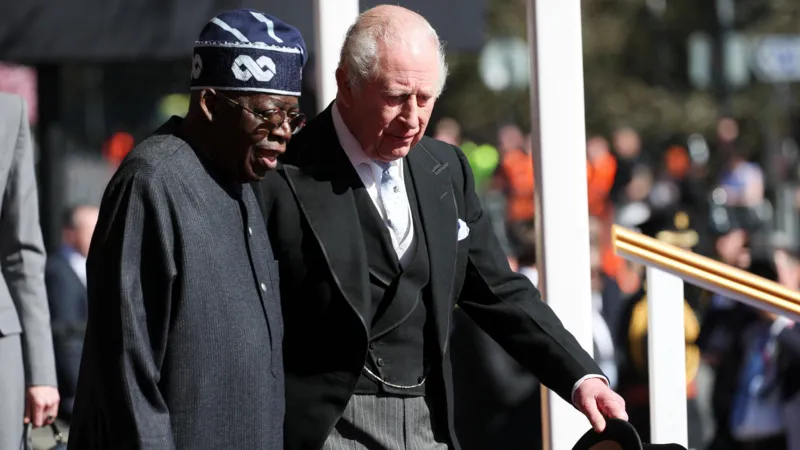

King Charles III on Wednesday hosted the first Nigerian state visit to the United Kingdom in 37 years, welcoming President Bola Ahmed Tinubu and First Lady Oluremi Tinubu with a ceremonial reception at Windsor Castle in a display of royal pageantry and diplomatic symbolism aimed at strengthening ties between both countries.
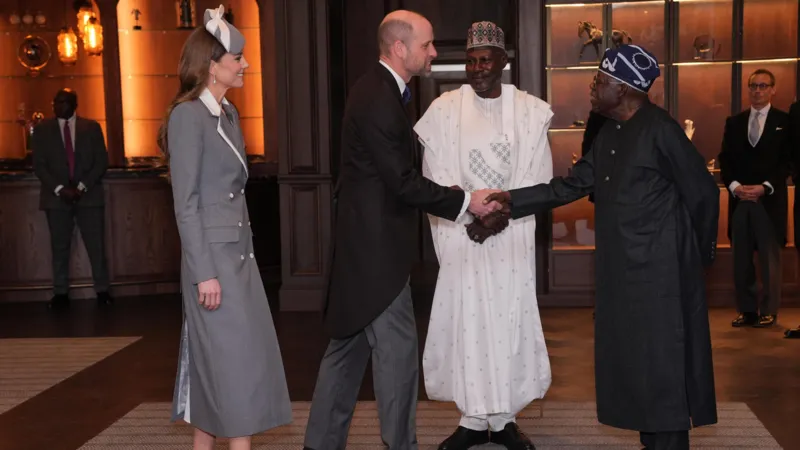
The two-day visit marks a historic moment in relations between the UK and Africa’s most populous nation, whose population is more than three times that of the United Kingdom. At the start of the visit, the Nigerian president and his wife were received by senior members of the British royal family, including Queen Camilla as well as the Prince and Princess of Wales, Prince William and Catherine, who played a key role in welcoming the Nigerian delegation.
The state visit, which is designed to reinforce political, cultural, and economic partnerships, comes at a time when both countries are seeking to deepen cooperation across multiple sectors, including trade, finance, immigration, and diplomacy.
The ceremonial welcome began with the president and first lady being received by Prince William and Catherine at the luxury spa hotel Fairmont Windsor Park before they were escorted to Windsor to formally meet the King and Queen. Upon their arrival, the grandeur of royal protocol unfolded as the leaders were carried in a carriage procession into Windsor Castle’s quadrangle, where they were greeted by a guard of honour and the band of the Grenadier Guards.
As the procession made its way around the square, the band played both the Nigerian and British national anthems in a moment reflecting the diplomatic ties between the two nations. In the spring sunshine, President Tinubu ceremonially inspected the troops on display while King Charles walked a few steps behind him, observing the proceedings as part of the traditional military welcome accorded to visiting heads of state.
The ceremony formed part of the long-standing diplomatic tradition of state visits, which are used by the British monarchy to foster relationships with international partners and strengthen cooperation between governments.
The visit is expected to focus strongly on expanding economic and diplomatic ties between the United Kingdom and Nigeria, particularly in sectors such as financial services and business partnerships. Nigeria’s government believes the trip presents an opportunity to transform historic ties into deeper economic cooperation.
Government spokesman Mohammed Idris emphasised the significance of the visit, saying, “This state visit is about turning a historic relationship into a modern economic partnership – transforming trust into opportunity.” Idris further highlighted Nigeria’s economic prospects and the role the UK could play in supporting future growth, stating, “Nigeria’s economic reforms are unlocking the potential of Africa’s largest consumer market.
The United Kingdom is a natural partner in what comes next. This visit marks the next step in deepening co-operation across trade, finance and defence.”
The strong Nigerian presence in the United Kingdom also emphasized the close relationship between the two countries, with more than 270,000 Nigerian-born people currently living in the UK.
Later during the visit, the programme will include exchanges of gifts between the leaders and a viewing of items connected to Nigeria that are preserved in the Royal Collection. These cultural displays will highlight historical connections between the British monarchy and Nigeria.
The day’s events will culminate in a lavish state banquet in St George’s Hall, where both King Charles III and President Tinubu are expected to deliver speeches in front of political leaders, diplomats, and celebrities who maintain links to Nigeria.
However, in a departure from some royal traditions, there will be no customary luncheon with the King at Windsor Castle, as President Tinubu is a Muslim who is observing the Ramadan fast. The absence of the lunch reflects respect for the president’s religious observance during the holy month.
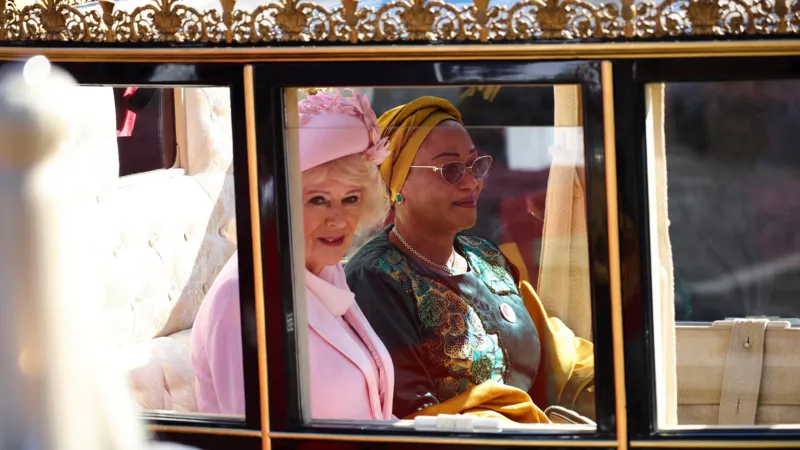
The schedule for the visit also includes several symbolic and interfaith engagements. President Tinubu and the First Lady are expected to lay a wreath of flowers at the tomb of the late Queen Elizabeth II at St George’s Chapel in Windsor, paying tribute to the former monarch who maintained strong ties with Commonwealth nations during her reign.
The Nigerian delegation will also participate in an interfaith event aimed at strengthening dialogue between different religious traditions and promoting understanding across communities. On Thursday, First Lady Oluremi Tinubu, who is also an ordained pastor, is expected to preach at a service at Lambeth Palace and meet representatives of the Church of England as part of a programme designed to reinforce religious cooperation and dialogue between faith groups.
The Tinubus themselves come from the Yoruba community of south-west Nigeria, one of the country’s largest ethnic groups and one that reflects Nigeria’s religious diversity, as it includes both Muslims and Christians. Nigeria, with an estimated population of about 220 million people, is roughly divided between followers of Islam and Christianity, with Muslims forming the majority in the northern regions while Christians dominate in the southern parts of the country.
This religious balance is a defining feature of Nigeria’s social and political landscape and often plays a role in shaping discussions about national unity and governance.
The state visit also takes place amid growing international scrutiny of Nigeria’s security challenges and human rights issues. President Tinubu is facing increasing pressure from foreign partners to improve security conditions and better protect vulnerable groups.
In particular, the administration of United States President Donald Trump has raised concerns about the treatment of Christians in Nigeria, drawing attention to attacks and violence in certain parts of the country. Nigerian authorities, however, maintain that members of all faiths have been affected by the country’s complex security crises.
Officials say the violence stems from multiple overlapping challenges, including an Islamist insurgency in the north-east, kidnappings for ransom carried out by criminal gangs, conflicts over land between farming and herding communities, and separatist unrest in some regions—factors that frequently intersect with ethnic and religious identities.
The ongoing insecurity was highlighted this week in the north-eastern state of Borno, where at least 23 people were killed and 108 others injured in a series of suspected suicide bombings believed to have been carried out by militants linked to the extremist group Boko Haram.
The attacks renewed fears about the resilience of insurgent networks in the region despite years of military operations against them. President Tinubu strongly condemned the violence, describing those responsible as “evil-minded” terror groups determined to destabilise communities. The attacks have also prompted reactions abroad, with several members of the UK Parliament calling for stronger protections for freedom of worship and religious communities in Nigeria.

The Nigerian president’s visit to the United Kingdom also unfolds against the backdrop of broader global tensions, including ongoing conflicts in the Middle East and the continuing war in Ukraine. Just a day before receiving the Nigerian leader, King Charles III had met Ukrainian President Volodymyr Zelensky on Tuesday, highlighting the monarch’s diplomatic engagements with world leaders during a period of heightened geopolitical uncertainty.
The state banquet scheduled during President Tinubu’s visit is expected to attract significant international attention, not only because of the diplomatic significance of the Nigerian visit but also because it will mark King Charles’s first major speech since the arrest of his brother, Andrew Mountbatten-Windsor.
The convergence of global political developments, security concerns, and diplomatic outreach points out the broader context in which the historic Nigerian state visit to the United Kingdom is taking place.