

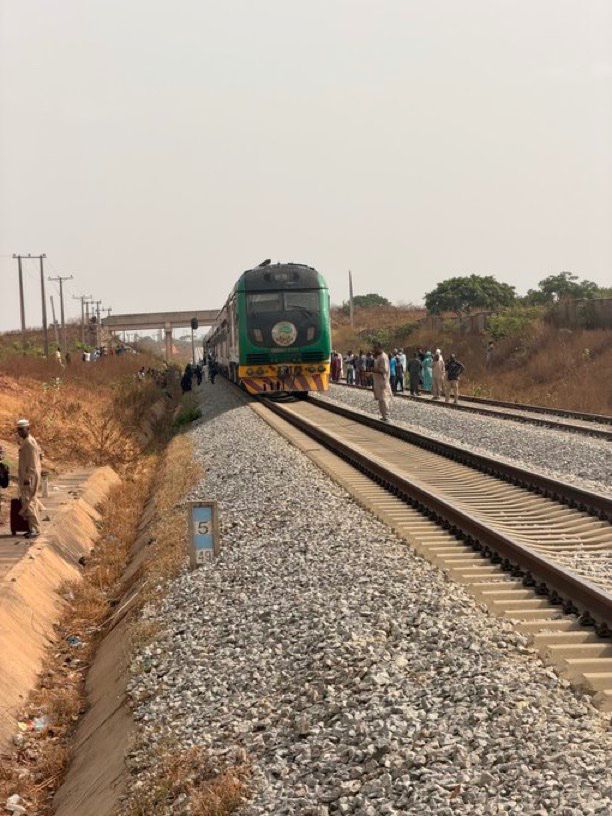

Hundreds of passengers travelling along the Kaduna-Abuja rail corridor were left stranded on Monday morning after a passenger train collided with another train along the track.
The incident occurred in the early hours of Monday during the peak commuting period. The Abuja-bound train reportedly collided with another train on the same track, halting operations and forcing railway officials to suspend movement along the corridor while the situation was assessed.
Passengers aboard the affected train described scenes of confusion and uncertainty as the journey abruptly stopped. Many travellers were forced to remain inside the coaches for extended periods while railway officials evaluated the damage and attempted to restore order. Several reports indicated that some passengers sustained injuries during the incident, although the exact number of those injured was not immediately confirmed by authorities. 
Eyewitness videos circulating on social media showed damaged wagons and halted trains on the track, indicating the scale of disruption caused by the collision. Railway operations on the line were temporarily suspended following the incident, leaving hundreds of commuters stranded as officials worked to determine the cause and extent of the accident. 
The Kaduna–Abuja rail corridor is a critical transport link for travellers, avoiding the Abuja–Kaduna highway due to security issues. The rail service offers a vital alternative for commuters, business travellers, and officials between the two cities.
The Abuja–Kaduna rail line was commissioned in July 2016 as part of Nigeria’s broader standard gauge railway project, designed to modernize the country’s rail infrastructure and improve connectivity between major cities. The project forms part of the Lagos-Kano standard gauge railway network, intended to link Nigeria’s commercial and administrative hubs through modern rail transport. 
Since its inauguration, the rail service has recorded significant patronage, particularly because the Abuja–Kaduna highway has developed a reputation as one of the most dangerous roads in the country due to frequent cases of kidnapping and bandit attacks. As insecurity on the highway worsened over the years, thousands of Nigerians began relying on the train service as a safer and more reliable means of travel between the two cities. 
However, the railway corridor has also experienced several safety incidents in recent years, which have raised concerns among passengers and transport analysts about operational standards and infrastructure maintenance.
In August 2025, a passenger train travelling from Abuja to Kaduna derailed shortly after leaving the station, causing panic among passengers and leaving several people injured. The derailment forced authorities to temporarily halt operations on the route while investigations were carried out to determine the cause of the accident. 
Subsequent investigations by railway authorities suggested that human error played a role in one of the previous accidents on the line, further highlighting the need for stronger operational discipline and safety procedures in managing train traffic along the corridor. 
Beyond technical incidents, the Abuja–Kaduna railway has also faced serious security threats. In March 2022, armed bandits attacked a passenger train travelling along the route after explosives were used to damage the track. The attackers opened fire on passengers and kidnapped dozens of people, leaving several others dead and injured. The attack shocked the nation and led to the temporary suspension of rail services while security measures were reviewed. 
Following that attack, the Nigerian government introduced additional security measures, including improved surveillance and the deployment of armed personnel along the corridor. Rail operations eventually resumed after months of suspension, but concerns about safety have continued to linger among passengers.
Monday’s collision has now added another layer of concern about the reliability and safety of the rail system, particularly as the Abuja–Kaduna line remains one of the most heavily used passenger rail services in the country.
For many commuters, the train represents not just a convenient transport option but also a vital lifeline. Civil servants, traders, students, and business people frequently rely on the early morning and evening train services to commute between Kaduna and Abuja.
As of the time of reporting, railway authorities had not released a detailed official explanation for how the two trains ended up on the same track, nor had they confirmed whether signalling failure, operational error, or mechanical malfunction may have contributed to the incident.
The Nigerian Railway Corporation is expected to conduct a formal investigation to establish the circumstances surrounding the collision and determine whether safety protocols were properly followed.
Samuel Aina