

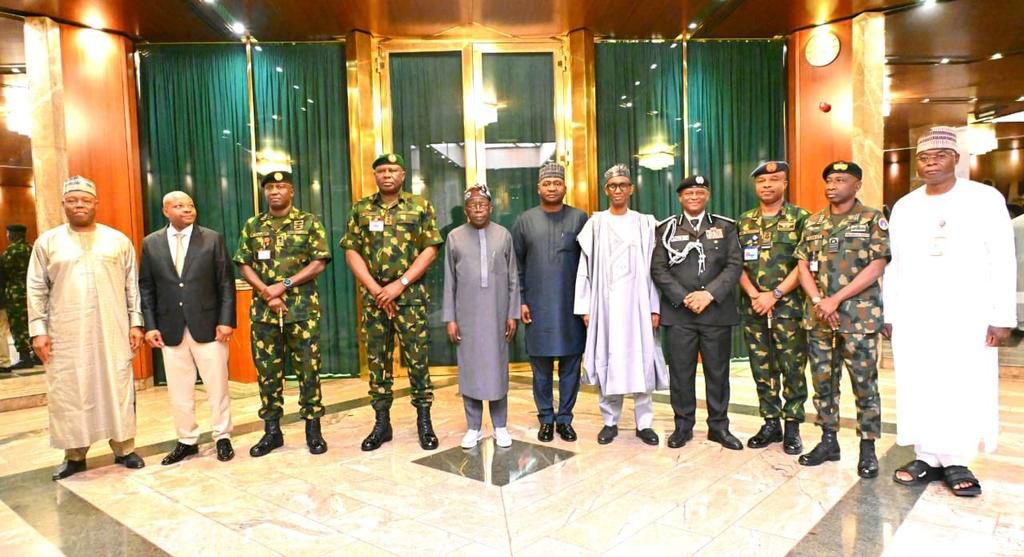

President Bola Ahmed Tinubu on Thursday held a closed-door meeting with Nigeria’s top security chiefs at the Presidential Villa in Abuja amid growing concern over a surge in terrorist attacks and violent assaults on military formations and civilian communities across parts of the country. 
The meeting, which lasted nearly two hours, brought together the heads of Nigeria’s security and intelligence agencies, including the newly appointed Inspector General of Police Tunji Disu. It marked the first high-level security briefing involving the new police chief since he assumed office in late February 2026. 
Officials said the security chiefs arrived discreetly at the Presidential Villa earlier in the day, and the discussions continued until about 5:10 p.m., underscoring the urgency surrounding Nigeria’s worsening security environment. 
The meeting took place against the backdrop of renewed terrorist violence and coordinated attacks on military positions in the northern part of the country, particularly in the North East region, where extremist groups affiliated with Boko Haram and the Islamic State West Africa Province continue to operate. 
In recent weeks, the insurgent groups have intensified their assaults on military bases and communities, raising alarm among citizens and security officials. Reports indicate that militants carried out coordinated raids on several military installations in Borno and neighbouring areas, killing soldiers and seizing weapons and equipment during the attacks. 
Some of the incidents occurred within the first week of March when armed militants stormed multiple army locations around the Lake Chad region. The attackers reportedly used advanced weaponry and demonstrated a high level of planning in the operations, targeting both military personnel and infrastructure. 
The renewed wave of violence has also led to large-scale displacement and abductions. In several communities across the North East, hundreds of civilians have reportedly been kidnapped in recent attacks linked to Islamist militant groups operating in the region. 
Nigeria has faced insurgency for more than a decade, particularly since 2009 when Boko Haram began its armed rebellion against the Nigerian state. Over the years, the conflict has spread across the Lake Chad basin, affecting neighbouring countries and creating one of Africa’s longest-running security crises. 
The insurgency has led to thousands of deaths and massive humanitarian challenges. Millions of people have been displaced across the North East as communities continue to face attacks on villages, schools, markets, and military outposts.
Recent events have further highlighted the continuing threat posed by extremist groups. Earlier in March, militants reportedly launched coordinated raids on military bases in Borno State, killing dozens of soldiers during the attacks, while additional clashes occurred as Nigerian forces attempted to repel the insurgents. 
In some of the operations, terrorists reportedly used sophisticated weapons such as drones and anti-aircraft guns, reflecting a shift in tactics and raising concerns about the ability of the insurgents to access advanced equipment. 
Earlier in the week, Nigeria’s Defence Minister Christopher Musa also convened an emergency meeting with service chiefs to review military operations following the attacks on military formations in the North East. 
The defence authorities have maintained that the Nigerian Armed Forces are responding to the evolving security threats and that counterterrorism operations are being strengthened in affected areas.
The security challenges confronting the country extend beyond the North East insurgency. Nigeria has also witnessed attacks linked to banditry, kidnapping networks, and other armed groups operating across the North West and North Central regions.
In February 2026, one of the deadliest incidents occurred in Kwara State when hundreds of armed militants attacked villages in the Kaiama area, killing more than 160 residents and kidnapping dozens of others. The assault shocked the country and prompted the federal government to deploy additional troops to the area. 
Following that massacre, the federal government announced new security measures and military deployments aimed at preventing further attacks and strengthening protection for vulnerable communities.
The meeting convened by President Tinubu on Thursday is therefore seen as part of ongoing consultations between the presidency and the security establishment as authorities attempt to contain the rising violence and restore public confidence in national security efforts.
Although details of the deliberations were not immediately made public, the closed-door briefing is expected to focus on the operational response of the armed forces, intelligence coordination, and strategies for tackling the growing threat posed by terrorist groups and other armed actors across Nigeria.
Samuel Aina