

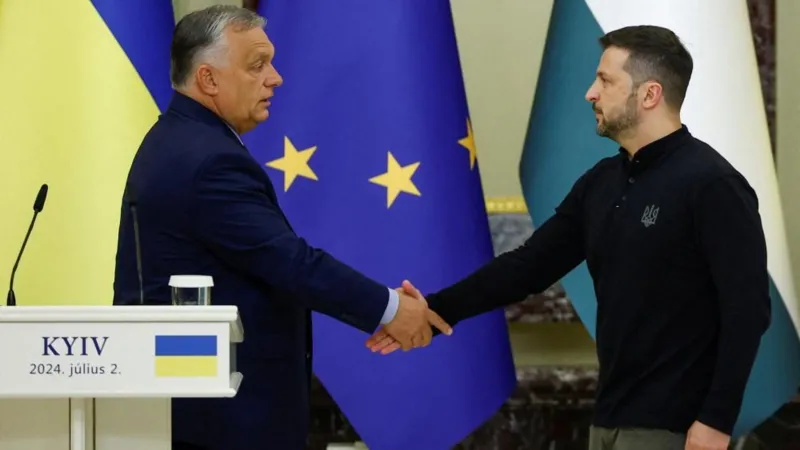

Hungary is embroiled in a mounting political and diplomatic standoff with war-torn Ukraine ahead of the country’s parliamentary elections scheduled for 12 April, with the Hungarian government claiming that Kyiv “will stop at nothing” to prevent Prime Minister Viktor Orbán and his Fidesz party from securing another term in office. Officials allege that Ukraine is planning physical violence against Orbán and his family, as well as attacks or sabotage targeting key energy installations crucial to the nation’s fuel supply. Kyiv, in turn, has accused Hungary of inflating the threat to frighten voters into supporting Fidesz, intensifying political polarization in the run-up to the vote. The situation has taken on an international dimension, with Russia allegedly playing a role through its influence over disinformation campaigns intended to sway the election outcome in Budapest.
Reports from the Financial Times on Wednesday morning indicate that the Kremlin-linked media consultancy Social Design Agency is preparing a mass disinformation campaign in Hungary, designed to bolster Orbán and discredit the opposition Tisza Party and its leader, Peter Magyar. Analysts suggest that the campaign underscores the precarious position of the Hungarian prime minister, whose Fidesz party currently trails Tisza by 39% to 50% in the latest polls.
While some observers interpret the anti-Ukraine narrative as evidence of panic within Orbán’s camp, others argue that the prime minister is adeptly leveraging fear of foreign interference to galvanize his electorate and potentially secure a fifth consecutive victory. The campaign coincides with heightened political tension linked to disruptions in Hungary’s energy supply, amplifying fears of national insecurity in a politically charged climate.
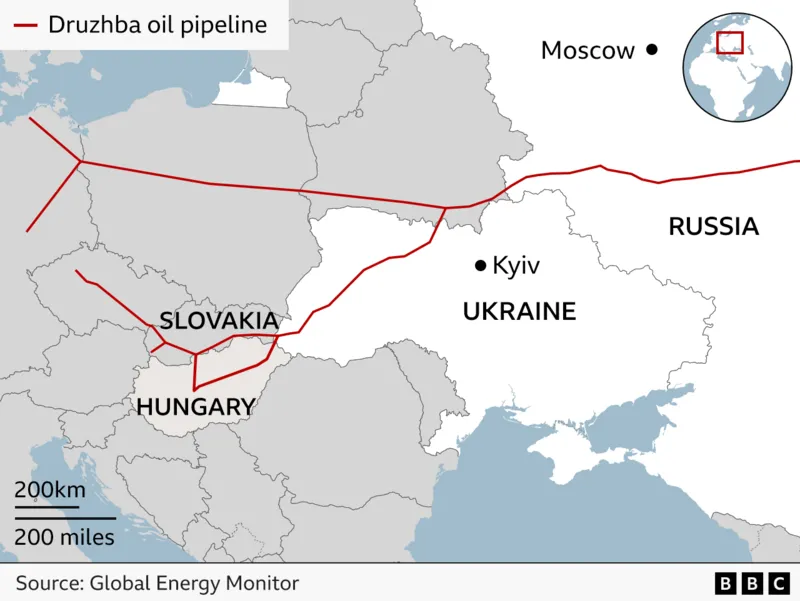
Central to the dispute is the disruption of the Druzhba (Friendship) oil pipeline, which supplies crude to Hungary and Hungarian-operated refineries in Slovakia. Oil deliveries through the pipeline halted on 27 January following a Russian drone strike at the Brody oil hub in western Ukraine, causing a fire that has effectively suspended shipments to Hungary ever since. Prime Minister Orbán and his ministers have released satellite images purporting to show that the pipeline itself remains intact, accusing Ukraine of intentionally delaying repairs to exacerbate a fuel shortage and undermine Fidesz’s re-election bid.
Security analyst András Rácz of the German Council on Foreign Relations disputed aspects of this narrative, explaining to the BBC that “The Orbán government is not telling the full truth,” adding that technical obstacles remain, including damage to an oil tank containing 75 million litres of crude at Brody. “To save the oil and prevent an environmental disaster, it was pumped into the pipeline for storage. The presence of that oil, and other technical damage resulting from the first and a subsequent Russian attack, prevent the restoration of supply.” Ukraine has estimated that repairs could take up to six weeks, leaving Hungary without Druzhba oil in the lead-up to the elections.
The Hungarian government’s messaging around Ukraine has taken on dramatic and highly visible forms. Across the country, giant billboards and city-light posters depict Ukrainian President Volodymyr Zelensky pleading for funds from EU leaders or juxtapose Zelensky with opposition leader Peter Magyar, suggesting that the Tisza Party is aligned with a so-called “pro-war lobby” in Brussels. Magyar has repeatedly countered the narrative, telling crowds at daily rallies, “We are the real party of peace.” The government has also released an artificial intelligence-generated video showing a young girl asking her weeping mother when her father will return home, cutting to a blindfolded man facing a firing squad, implying that such violence could befall Hungarians if the opposition wins.
Facebook has rejected user complaints that the video violates rules against political violence. To reinforce the government’s narrative, the Hungarian army has been deployed to patrol key energy installations, a measure framed by Fidesz as reassuring the public but criticized by Tisza supporters as a form of intimidation. In Debrecen, Defence Minister Kristof Szalay-Bobrovniczky warned that the city could be targeted for “hybrid operations” such as sabotage, underscoring the government’s heightened security posture.
Tensions between Hungary and Ukraine have escalated further in recent weeks. On 21 February, Orbán vetoed the delivery of a €90 billion EU loan until Druzhba oil flow was restored, forcing Ukraine to secure a €1.5 billion International Monetary Fund loan to manage fiscal pressures. On 4 March, Zelensky appeared to exacerbate the dispute, warning, “We hope that no-one in the European Union will block the €90bn of EU aid, otherwise we will give that person’s address to our armed forces so they can call on him and speak to him in their own language,” a comment widely interpreted as directed at Orbán. The prime minister responded on 6 March, telling state radio, “They want to get rid of us, with threats if possible, because if nice words don’t work, then with threats and blackmail.”
A day earlier, two vehicles belonging to the Ukrainian state savings bank, Oschadbank, were seized crossing Hungary, prompting pro-government media to depict TEK anti-terror troops on the cover of HVG weekly as moving gold bars around Tisza party symbols, while alleging links between Ukrainian bank lawyers and the opposition. Hungarian authorities issued a decree ordering prosecutors to investigate “whether Hungarian criminal organisations, terrorist organisations or political organisations present in Hungary may have benefited from the transported assets,” further intensifying the political and legal dispute.
Amid the escalation, Hungary sent a fact-finding mission into Ukraine to inspect the Druzhba pipeline. Deputy Energy Minister Gábor Czepek posted on Facebook, “Our job is to assess the status of the pipeline and create conditions for its restart.” Ukraine, however, rejected the mission’s legitimacy, stating, “This group of individuals holds no official status, nor do they have any scheduled official meetings; therefore, it is fundamentally incorrect to refer to them as a delegation.”
A diplomatic exchange followed, with Hungarian Foreign Minister Péter Szijjártó accusing Zelensky of lying after the Ukrainian president claimed he was unaware of the delegation, citing an official note from the Hungarian embassy in Kyiv to corroborate the planned visit. Ukraine responded that the proposed visit dates were “not acceptable for the Ukrainian side,” maintaining a firm stance on sovereignty and control over its territory.
As Hungary moves closer to its April elections, the confluence of domestic politics, energy security, and international diplomacy has created a highly charged environment. The anti-Ukraine messaging, the ongoing pipeline dispute, the deployment of troops, and the controversial fact-finding mission collectively highlight a complex triangle involving Hungary, Ukraine, and Russia.