

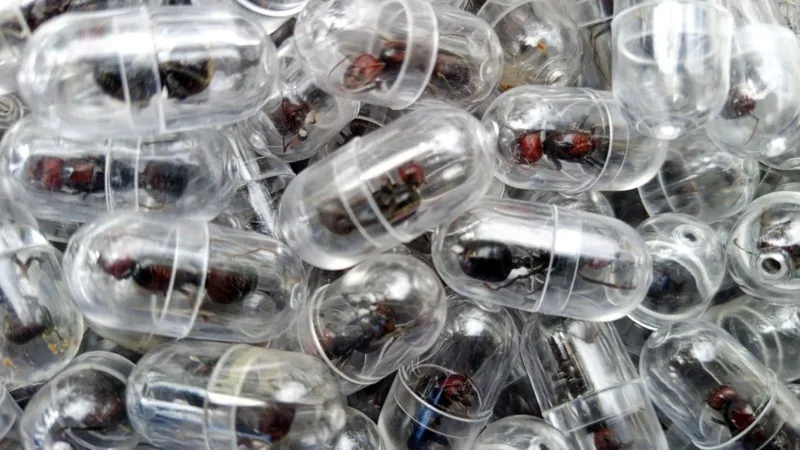

A Chinese national, Zhang Kequn, has been arrested at Nairobi’s Jomo Kenyatta International Airport (JKIA) for attempting to smuggle more than 2,000 queen garden ants out of Kenya, authorities confirmed on Wednesday. Zhang, who was intercepted during a routine security check, is accused of being linked to an ant-trafficking network that was dismantled in Kenya last year. The insects, known scientifically as Messor cephalotes, are protected under international biodiversity treaties, and their trade is highly regulated due to their ecological importance and growing demand in exotic pet markets across Europe and Asia. Investigators allege that Zhang concealed the ants in his luggage, circumventing legal protocols designed to protect Kenya’s unique biodiversity.
During proceedings at the Nairobi court, state prosecutor Allen Mulama provided details of the discovery, stating, “Within his personal luggage there was found 1,948 garden ants packed in specialised test tubes.” He added, “A further 300 live ants were recovered concealed in three rolls of tissue paper within the luggage.” Mulama further requested that the court allow the forensic examination of Zhang’s electronic devices, including his phone and laptop, to uncover any additional evidence linking him to the trafficking network.
The arrest comes as part of a wider investigation into ant trafficking, with Duncan Juma, a senior official from the Kenya Wildlife Service (KWS), indicating that more arrests are expected as authorities expand their probe into other towns where ant harvesting is suspected to be ongoing. “Investigations are still ongoing, and we anticipate that further arrests may be made as we identify other players involved in this illegal trade,” Juma told the BBC.
Zhang’s case follows a landmark ruling in Kenya last May, when four men two Belgians, a Vietnamese, and a Kenyan—were sentenced to one year in prison or fined $7,700 (£5,800) for attempting to smuggle thousands of live queen ants out of the country. Those individuals had pleaded guilty after a coordinated, intelligence-led operation by the KWS. According to court records, the Belgians claimed they were collecting the ants as a hobby and had not realized their actions were illegal. Investigators now say Zhang was the mastermind behind the trafficking ring and had evaded capture last year by fleeing Kenya using a different passport, allowing him to continue operations undetected until his recent arrest at JKIA.
The ecological significance of the queen garden ants, as highlighted by the KWS, underscores the seriousness of the crime. The agency noted that removing these ants from the ecosystem could disrupt soil health and biodiversity, as they play a critical role in nutrient recycling and maintaining ecological balance. KWS officials have repeatedly warned of a rising demand for Messor cephalotes in Europe and Asia, where collectors keep the ants as exotic pets. The court also approved a five-day detention period for Zhang to allow detectives to conduct further investigations into the case, during which time authorities will explore the extent of his network and the intended destinations of the confiscated ants.
Authorities emphasized that Zhang had used sophisticated methods to conceal the insects, with some ants packed in specialized test tubes and others hidden inside tissue paper rolls, reflecting the organized nature of the operation. The arrest highlights the growing concern over illegal wildlife trade in Kenya, which, until recently, focused largely on larger animals such as lions and elephants.
With this latest case, the KWS aims to send a clear message that trafficking of ecologically significant species, regardless of size, will be pursued with the full force of the law. The case remains under active investigation, with authorities committed to dismantling the network and preventing future smuggling attempts that could threaten Kenya’s biodiversity.