

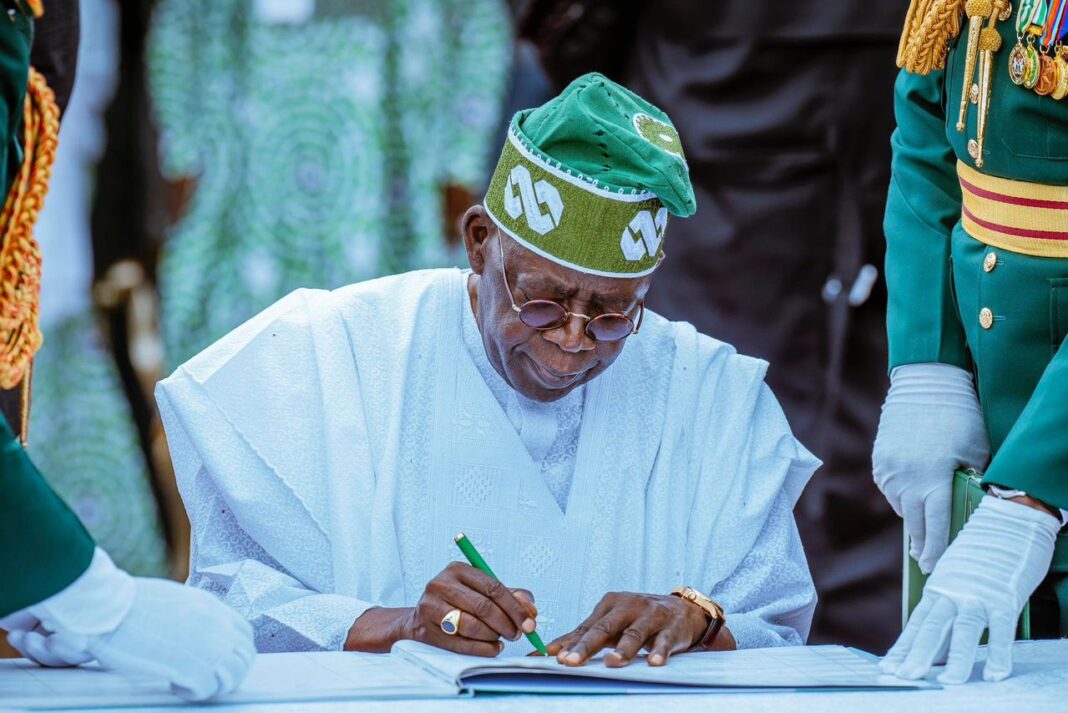

President Bola Ahmed Tinubu has approved a targeted fiscal incentive framework that clears the way for the Final Investment Decision on the long-delayed Bonga Southwest Aparo deepwater oil project, a development expected to attract about 20 billion dollars in foreign direct investment into Nigeria’s oil and gas sector and potentially reshape the country’s offshore production outlook for years to come. 
The approval, announced by the Nigerian National Petroleum Company Limited on Tuesday, aims to unlock one of Nigeria’s most significant deepwater oil developments, the long-stalled Bonga project, delayed for nearly two decades by fiscal uncertainties and global investment shifts.
According to the national oil company, the presidential approval is intended to accelerate the long-awaited Final Investment Decision on the Bonga Southwest Aparo development, widely referred to within the industry as BSWA. The investment, estimated at around 20 billion dollars, is expected to draw substantial international capital into Nigeria’s upstream petroleum sector while strengthening the country’s position as a leading deepwater producer in Africa. 
Officials of the NNPC stated that the decision followed months of negotiations involving key government agencies and energy sector stakeholders. Among those involved in the discussions were the Federal Inland Revenue Service, the Special Adviser to the President on Energy, Olu Verheijen, and senior executives from Shell Plc, including the company’s Chief Executive Officer, Wael Sawan. 
The Bonga Southwest Aparo project is operated by Shell Nigeria Exploration and Production Company, a subsidiary of Shell Plc, in partnership with international oil companies and the Nigerian national oil company. Industry records indicate that the project partners include Shell as the operator alongside major global firms such as ExxonMobil, TotalEnergies, and Eni, together with NNPC Limited as the national partner. 
The project is expected to mark one of the largest deepwater oil investments in Nigeria in recent years and could signal a renewed phase of offshore petroleum development in the country. Officials say the fiscal incentives approved by the presidency are designed to restore investor confidence and ensure that Nigeria remains competitive with other oil-producing regions that are actively seeking capital for large-scale offshore projects. 
NNPC explained that the incentive package was carefully structured to unlock the project without undermining government revenue. According to the company, the policy is part of broader efforts by the current administration to attract strategic investments into the energy sector while ensuring long-term economic growth. 
The Bonga oilfield itself occupies a central place in Nigeria’s offshore petroleum history. Located approximately 120 kilometres offshore in Oil Mining Lease 118 in the Gulf of Guinea, the field represents Nigeria’s first deepwater oil development. The project achieved its first oil in 2005 and has since remained one of the most technologically advanced offshore operations in the country. 
The field sits in water depths exceeding one thousand metres and is developed using a floating production storage and offloading vessel. The facility has the capacity to produce up to about 225000 barrels of crude oil per day and also processes significant volumes of associated natural gas. 
Over the years, the Bonga complex has expanded with additional discoveries in nearby reservoirs. Among these are Bonga North and Bonga Southwest, both of which were identified as commercially viable extensions of the original deepwater development. These discoveries provided the basis for plans to expand production in the area through new offshore infrastructure and additional wells. 
The Bonga Southwest Aparo development in particular has long been viewed as one of the most promising deepwater oil projects awaiting sanction in Nigeria. The project involves the drilling of multiple subsea wells and the installation of new offshore production infrastructure that will be connected to a floating production storage and offloading vessel designed to process crude oil from the field. 
Industry projections suggest the new development could reach roughly 150,000 barrels of oil per day at full operation, significantly boosting Nigeria’s offshore crude supply.
For nearly two decades, however, the project remained in limbo as investors and government authorities struggled to reach a consensus on fiscal terms that would make the development commercially viable. Oil companies operating in deepwater environments often face high capital costs, including offshore drilling, subsea equipment installation, and the construction of large floating production vessels capable of operating in deep ocean conditions.
These factors, combined with evolving global energy policies and uncertainty surrounding Nigeria’s petroleum fiscal framework in previous years, led many companies to delay final investment decisions on large offshore projects.
The situation began to change in recent years following reforms within Nigeria’s petroleum sector, including the implementation of new regulatory structures and policy adjustments intended to improve the investment climate. Officials within the federal government have repeatedly stated that attracting large-scale capital into the upstream petroleum sector remains a strategic priority for sustaining government revenues and maintaining production levels.
The approval of incentives for the Bonga Southwest Aparo project, therefore, represents a major milestone in Nigeria’s effort to revive large-scale upstream investments. Energy analysts believe that the project could generate thousands of jobs during construction and operational phases while also boosting foreign exchange inflows through increased crude oil exports. 
The presidential approval of the fiscal framework is expected to pave the way for the formal Final Investment Decision by project partners in the coming period. Once that decision is reached, the project will move into the development phase, involving engineering design, procurement of offshore equipment, drilling of production wells, and installation of subsea infrastructure.
If it proceeds as planned, the project could become one of the most significant offshore developments undertaken in Nigeria in the past decade.
Samuel Aina