

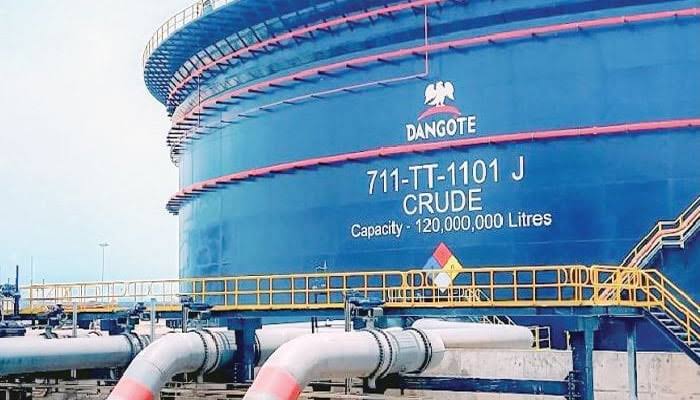

The Dangote Petroleum Refinery has acknowledged that it remains fully exposed to the vagaries of international commodity markets, with crude oil prices, freight charges, insurance, and financing costs all exerting significant pressure on its operational expenditures. Speaking at a press conference on Monday, the Managing Director and Chief Executive Officer of the refinery, David Bird, said that while the Nigerian government has introduced a crude-for-naira arrangement intended to allow local refineries to purchase crude oil in the local currency, the pricing of the commodity continues to be pegged to international benchmarks.
“Although the crude-for-naira policy provides a framework for local transactions, we still buy Nigerian crude at global market prices, and there is no discount for local refineries,” Bird explained, highlighting the persistent link between domestic operations and international pricing structures.
Bird noted that global market volatility has directly contributed to rising operational costs at the Dangote refinery, as crude oil prices have experienced sharp and sudden fluctuations over recent weeks. “Crude prices have surged from the mid-$60 range to nearly $120 per barrel within a week, reflecting heightened uncertainty across international energy markets,” he said, illustrating how rapidly changing conditions abroad affect local refining operations.
He added that these price swings are compounded by rising shipping expenses, which have escalated sharply in the current market climate. “Freight costs have surged dramatically, with tanker costs rising from about $800,000 to roughly $3.5 million per shipment in the current market environment,” Bird said, a figure the company confirmed on its official X handle, underscoring the significant financial implications of transporting crude in an increasingly unpredictable global shipping landscape.
Despite these mounting pressures, Bird emphasized that the Dangote refinery continues to operate at its full nameplate capacity, maintaining production levels of approximately 650,000 barrels per day, with potential output that could reach around 700,000 barrels per day.
He reassured stakeholders that the refinery’s operations remain robust and resilient, even amid rising costs and global market uncertainty. “We are fully operational at our design capacity, and we continue to explore efficiencies and strategic approaches to mitigate the impact of these global cost pressures,” he said, noting the company’s commitment to sustaining supply for domestic and regional markets while managing financial exposure to external market shocks.
The Dangote Petroleum Refinery, Africa’s largest single-train refinery, thus remains highly sensitive to fluctuations in global oil and shipping markets, with both crude prices and freight costs playing pivotal roles in shaping its operational and financial strategies.
Bird’s remarks highlight the delicate balance that local refineries must maintain: leveraging government policies like the crude-for-naira arrangement while navigating a market where commodity prices, shipping logistics, insurance premiums, and financing costs are increasingly dictated by international trends.
“The challenges are real and ongoing,” he said, “but our focus remains on maximizing throughput, ensuring operational excellence, and meeting our production targets despite the uncertainty in global markets.
Domestic Fuel Prices Surge Amid Global Oil Market Volatility
The refinery has revised its ex-depot prices for petroleum products, significantly increasing the gantry price of Premium Motor Spirit (PMS), commonly referred to as petrol, to ₦1,175 per litre, while Automotive Gas Oil (AGO), widely known as diesel, has been raised to ₦1,620 per litre.
The adjustments represent the fourth consecutive price review in less than two weeks, a reflection of ongoing volatility in international oil markets and the ripple effects of global supply constraints on domestic fuel costs, according to a report by Petroleumprice.ng. Industry sources cited in the report confirmed that the new pricing structure has already been communicated to marketers, following earlier upward adjustments implemented earlier in the month.
Under the revised template, the ₦1,175 per litre petrol price marks a steep increase from the previous ₦995 per litre level, while diesel has surged sharply from ₦1,430 per litre, illustrating the sustained upward trend in domestic fuel pricing.
The increases come amid a sharp rise in global crude oil benchmarks, as reflected in data recorded at 1:00 pm WAT, with Brent Crude trading at $102.8 per barrel, up 10.91 percent, and West Texas Intermediate (WTI) Crude at $101.0 per barrel, up 11.08 percent. The surge in international crude prices has been attributed to tensions in the Middle East, which have intensified uncertainty in energy markets worldwide and exerted upward pressure on local fuel pricing.
Speaking on the latest adjustments, industry observers explained that the steep rises in both petrol and diesel prices are directly linked to the refinery’s exposure to global commodity markets, including crude oil pricing, freight charges, insurance, and financing costs.
“While local policies such as the crude-for-naira arrangement exist, domestic refineries like Dangote still buy crude at global market prices, and therefore, fluctuations abroad immediately affect the prices we pay,” one source familiar with the refinery’s operations told reporters. The source added that logistical costs, including surging freight rates, have compounded operational expenses, further justifying the need for incremental price adjustments.
The recent domestic price hike is expected to have broad economic implications, particularly as fuel remains a critical input for transportation, logistics, and power generation. Analysts note that continued increases in petrol and diesel prices may translate to higher costs for goods and services, affecting household budgets and overall inflationary trends.
“Every increase in fuel pricing feeds into the cost of production across multiple sectors,” an industry expert said. “This is why global oil market volatility is closely monitored by policymakers and private operators alike, as it has direct consequences for domestic economic stability.”
The Dangote Petroleum Refinery, which continues to operate at its full nameplate capacity of around 650,000 barrels per day, has reiterated that it remains committed to sustaining production levels despite rising input costs and market uncertainty.
“We are fully operational and continue to maximise throughput, even as global crude prices and freight costs rise sharply,” said the refinery’s Managing Director and CEO, David Bird. Bird’s comments underline the delicate balance refineries must maintain: ensuring consistent domestic fuel supply while navigating external market pressures that influence pricing decisions on a near-daily basis.
Middle East Tensions Drive Global Energy Market Volatility
The ongoing turbulence in global energy markets has been sharply exacerbated by escalating hostilities involving the United States, Israel, and Iran, developments that have disrupted international commerce and created significant volatility in energy flows worldwide.
Analysts note that the conflict has had immediate consequences for global shipping, insurance, and crude oil pricing, underlining the interconnectedness of geopolitical developments and energy markets. Observers stress that prolonged hostilities could have far-reaching implications, particularly for major oil-exporting nations and refineries dependent on steady crude supply.
“Geopolitical tensions in the Middle East have a direct impact on energy markets globally. Any disruption along key shipping routes or at energy facilities translates into higher costs and operational challenges for refiners and consumers alike,” one energy market analyst said.
Central to the current market anxiety is the Strait of Hormuz, a critical maritime corridor through which roughly one-fifth of the world’s crude oil shipments transit. Heightened security risks associated with the conflict have compelled some vessels to reroute or delay passage through the strait, slowing tanker traffic and significantly increasing shipping and insurance costs.
Reports indicate that several shipping companies have temporarily suspended operations along the corridor to mitigate exposure to potential attacks or accidents, further contributing to supply chain bottlenecks. Industry sources warn that even short-term disruptions in this strategic passage can trigger sharp spikes in global fuel prices and ripple effects across financial markets worldwide.
The conflict’s impact extends beyond shipping challenges. Several energy facilities in the Gulf region have reportedly halted operations due to security concerns, further tightening supply and intensifying upward pressure on global energy prices.
Analysts point out that any sustained suspension of production at these facilities could exacerbate shortages in crude and refined products, forcing refiners across Africa, Asia, and Europe to contend with higher input costs and uncertainty over supply continuity.
“When energy production is curtailed due to security threats, the effects are felt across the supply chain. Refineries must navigate higher procurement costs, logistical bottlenecks, and unpredictable delivery schedules,” an industry insider explained, noting that such disruptions inevitably affect domestic fuel pricing and inflation in importing countries.
Financial markets have also reacted sharply to the crisis. International oil benchmarks, including Brent and West Texas Intermediate (WTI) crude, have recorded steep gains in recent weeks, reflecting both supply constraints and speculative pressures driven by geopolitical uncertainty.
Analysts warn that continued instability could generate sustained volatility in commodity markets, with potential knock-on effects for currencies, interest rates, and investment flows in energy-dependent economies.
“The current situation highlights the profound influence of geopolitics on global energy markets. Even localized conflicts can have far-reaching consequences for refining operations, energy pricing, and economic stability across multiple regions,” the analyst added.
The latest developments underscore the vulnerabilities of refineries and energy-dependent industries worldwide in the face of geopolitical crises. With tanker traffic slowed, insurance premiums surging, and regional production threatened, global refiners are forced to operate in a highly uncertain environment, balancing the imperative of maintaining supply against rising operational costs.
“Global energy markets remain extremely sensitive to geopolitical events, particularly in strategic regions like the Middle East. Refineries must adapt quickly to price fluctuations and logistical disruptions to ensure continuity of supply,” the source said.
The ongoing tensions, coupled with the resulting energy market volatility, serve as a reminder of how international political conflicts can directly shape the economics of energy production, distribution, and consumption worldwide.