

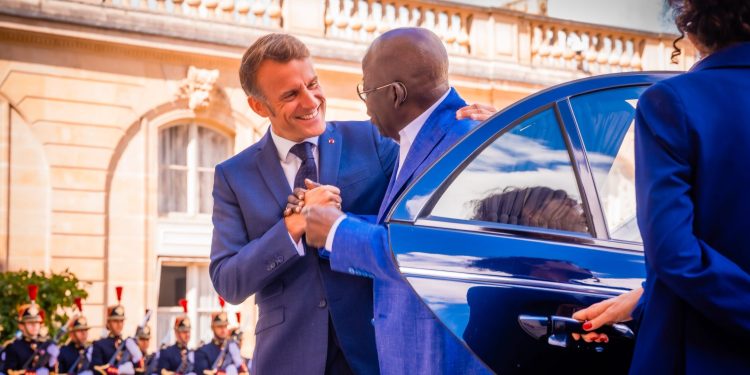

Nigeria’s deepening diplomatic and economic relations with France are not a new strategy triggered by President Bola Tinubu’s administration but stem from a deliberate policy shift dating back to the 1990s, French Ambassador to Nigeria Marc Fonbaustier has clarified during an exclusive interview with PREMIUM TIMES.
The ambassador dismissed popular Nigerian assumptions linking the renewed closeness to France’s waning influence in Francophone West Africa, emphasizing a long-term expansion of French engagement beyond its former colonies. This comes as President Tinubu has made France his top foreign destination since assuming office in 2023, including high-profile visits focused on bilateral partnerships in security, trade, and defense.
The French diplomat traced the origins of improved Nigeria-France ties to the era of former French Presidents François Mitterrand and Jacques Chirac in the 1990s and early 2000s, when Paris recognized the need to bolster presence in English-speaking nations like Nigeria, previously overlooked in favor of Francophone states.
This pivot accelerated after Nigeria’s return to democracy in 1999, marked by then-President Olusegun Obasanjo’s early state visit to France, which laid the foundation for sustained cooperation.
Relations further solidified amid shared regional challenges, such as the jihadist insurgency in the Lake Chad Basin, positioning France as a key Western partner for Nigeria. Under subsequent Nigerian leaders, high-level exchanges intensified.
Former President Muhammadu Buhari visited France multiple times, including in 2015 with President François Hollande to discuss security and trade, followed by Hollande’s reciprocal trip to Abuja for a regional summit.
In 2021, Buhari held talks with President Emmanuel Macron on economic ties and counter-terrorism, a pattern Ambassador Fonbaustier described as consistent continuity rather than novelty under Tinubu.
“It has a long history. It did not start at all with anything linked to Francophone countries,” the envoy stressed.
France’s traditional dominance in West and Central Africa, often critiqued as “Françafrique” has eroded sharply due to military coups in Mali, Niger, and Burkina Faso, now united in the Alliance of Sahel States (AES).
These juntas expelled French troops, accusing Paris of neo-colonial interference and failing to curb insecurity, with Burkina Faso’s leader recently branding France an imperialist force.
Tensions spilled over to Nigeria, as Niger’s military head Abdourahmane Tiani alleged collusion between Abuja and Paris to arm militants and destabilize his regime, claims Nigeria’s National Security Adviser Nuhu Ribadu dismissed as baseless.
The AES nations’ withdrawal from ECOWAS in 2025, after accusing the bloc of ineffective anti-terror support and harmful sanctions, has heightened regional divides. Despite this, Fonbaustier affirmed France’s commitment to partnerships across all 54 African nations, rejecting scapegoating narratives and highlighting Paris’s expansive continental footprint.
For Nigeria, sustained France ties offer avenues for defense collaboration and economic deals, evident in Tinubu’s 2024 state visit yielding agreements on investment and security. Critics, however, question if this risks entangling Abuja in France’s Sahel setbacks, amid accusations of neo-colonial traps.