

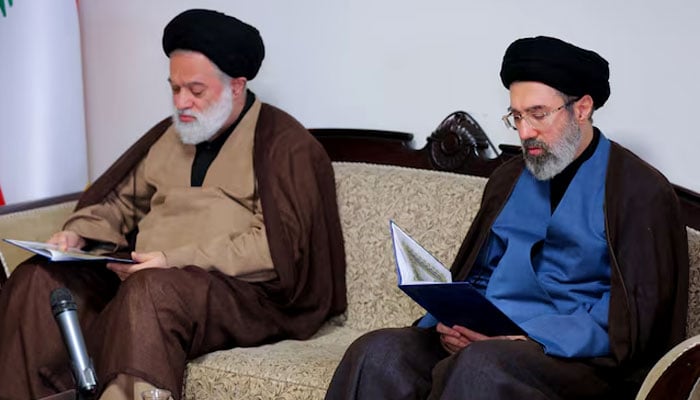

Mojtaba Khamenei, the second son of the assassinated Iranian supreme leader, Ali Khamenei, is being widely tipped as the leading contender to succeed his father, a development that would place a staunch hardliner at the helm of the Islamic Republic at a moment widely regarded as the most turbulent period in the country’s 48-year history.
His potential elevation to the position of supreme leader is viewed by analysts as a powerful indication that the Iranian political establishment has no immediate intention of altering its ideological course or moderating its posture toward the West. Although speculation surrounding his succession has intensified in recent days, no official confirmation has yet been issued by Iranian authorities, and any formal announcement could be delayed until after the funeral of Ali Khamenei, which had originally been scheduled earlier but was on Wednesday postponed.
Observers say the timing of the announcement may be carefully calibrated to allow the country’s political and religious leadership to manage the sensitive transition of power during a period of regional uncertainty and domestic tension.
Sources familiar with Iran’s power structure suggest that Mojtaba Khamenei has the backing of the Islamic Revolutionary Guard Corps (IRGC), the powerful military and political institution that has long played a decisive role in shaping the direction of the Islamic Republic.
The perceived support of the IRGC has significantly strengthened his prospects within the clerical and political establishment. At the same time, the prospect of his rise to power has drawn sharp warnings from abroad. Israel’s defence minister, Gideon Saar, has issued a stark warning regarding the potential successor, stating that Mojtaba Khamenei would be assassinated.
Within Iran itself, signals have begun to emerge from the clerical establishment that the process of selecting a new supreme leader may be nearing its conclusion. Ayatollah Seyed Khatani, a member of the Assembly of Experts the constitutional body responsible for selecting and supervising the country’s supreme leader indicated that deliberations were advancing, saying the assembly was close to selecting a new leader.
The possibility that Mojtaba Khamenei could assume the position has also reverberated internationally, particularly in Washington, where officials have long viewed Iran’s leadership through a highly critical lens. Known for his rigid anti-Western views, Mojtaba Khamenei would likely be seen in the United States as a continuation of the ideological stance associated with his father’s leadership.
As such, he is not regarded as the type of candidate that United States President Donald Trump would have preferred to see guiding the Islamic Republic in the future. Speaking on Tuesday, US Secretary of State Marco Rubio sharply criticised the Iranian leadership, stating that Iran was run by “religious fanatic lunatics,” a comment that underscores the deep hostility and mistrust that continue to define relations between Tehran and Washington.
Analysts note that the possible appointment of Mojtaba Khamenei is unlikely to soften such views in Western capitals. Trump himself has previously commented on the question of succession in Iran, remarking that the worst-case scenario would be if Khamenei’s successor were “as bad as the previous person,” an observation that reflects the continuing geopolitical tensions surrounding Iran’s leadership transition.
Under Iran’s constitutional framework, the selection of the supreme leader is entrusted to the Assembly of Experts, an 88-member clerical body elected to oversee and appoint the highest authority in the Islamic Republic. In the current succession process, the assembly is reportedly considering a field of six possible candidates, among whom Mojtaba Khamenei has emerged as a prominent figure.
Should he ultimately be chosen, his appointment would be interpreted as a clear and powerful signal that the Iranian leadership is not seeking a new accommodation with the United States or a major shift in foreign policy orientation. The speculation surrounding his possible succession is not new.
For more than a decade, political observers inside and outside Iran have suggested that Mojtaba Khamenei was being groomed to succeed his father. Those predictions gained additional momentum after the death of Ebrahim Raisi, the Iranian president and a key ally of Ali Khamenei, who had widely been viewed as a favourite to eventually assume the position of supreme leader.
Raisi’s death in a helicopter crash removed a major potential successor and further intensified speculation about Mojtaba Khamenei’s prospects.
Born in 1969, Mojtaba Khamenei pursued religious education after completing his secondary schooling, embarking on the traditional theological path expected of clerics within Iran’s religious establishment. At the age of 17, he joined the Iran-Iraq war, which lasted from 1980 to 1988 and remains a defining event in the political identity of the Islamic Republic.
Despite his early involvement in that conflict, Mojtaba Khamenei remained largely outside the public spotlight for many years and did not emerge as a significant political figure until the late 1990s. His profile began to rise following the political upheaval surrounding the 1997 presidential election, in which Ali Akbar Nategh Nuri — the preferred candidate of his father — suffered a landslide defeat, securing only 25 percent of the final vote.
The election result prompted conservative factions within Iran to reassess their political strategies and organisational structures, and Mojtaba Khamenei is widely believed to have played a central role in the efforts by conservative groups to reorganise and strengthen their influence within the country’s political system.
His political influence became particularly controversial during the unrest that followed the disputed 2009 presidential election, when widespread protests erupted after allegations that the vote had been rigged. Reformist figures accused Mojtaba Khamenei of playing an instrumental role in suppressing the demonstrations, and his name was reportedly chanted in the streets by protesters who viewed him as one of the key figures behind the crackdown.
Among those who levelled accusations was Mostafa Tajzadeh, a senior member of Iran’s reformist political camp who was imprisoned following the contested vote. Tajzadeh later alleged that the legal proceedings against him and his wife, Fakhr al-Sadat Mohtashamipour, had been conducted under the direct supervision of Mojtaba Khamenei, a claim that further fuelled criticism of the younger Khamenei among reformist circles.
In 2022, Mojtaba Khamenei received the clerical title of ayatollah, a designation regarded as essential for anyone aspiring to the role of supreme leader. By that stage, he had already become a regular presence at his father’s side during key political meetings and was widely perceived to wield considerable influence behind the scenes.
His involvement extended beyond the clerical sphere into the realm of state media, where he was believed to play an influential role within the Islamic Republic of Iran Broadcasting Corporation, the government’s official media organisation. The broadcaster has often been criticised by many Iranians for producing what critics describe as monotonous political propaganda, leading large segments of the population to turn instead to foreign satellite channels for news and entertainment.
In addition to these roles, Mojtaba Khamenei has also been deeply involved in the administration of his father’s extensive financial empire, which encompasses a wide range of economic assets and institutions tied to the office of the supreme leader.
Politically, Mojtaba Khamenei is said to maintain close alliances with several powerful figures within Iran’s security and political establishment. Among his closest associates are Ahmad Vahidi, the newly appointed commander of the Islamic Revolutionary Guard Corps; Hossein Taeb, a former head of the IRGC’s intelligence organisation; and Mohammad Bagher Ghalibaf, the current speaker of Iran’s parliament.
The network of alliances linking these figures has reinforced perceptions that Mojtaba Khamenei enjoys strong backing within the security apparatus of the state, a factor that could prove decisive in the final deliberations of the Assembly of Experts.
Nevertheless, the possibility of his succession — and particularly the perception that it would represent a hereditary transfer of power — has long provoked resistance among Iran’s reformist politicians and activists. Critics argue that such a development would contradict the revolutionary principles upon which the Islamic Republic was founded.
Former Iranian prime minister Mir Hossein Mousavi has been among the most vocal critics of the prospect. Referring to the persistent rumours that Mojtaba Khamenei was being prepared to succeed his father, Mousavi wrote in 2022: “News of this conspiracy have been heard for 13 years. If they are not truly pursuing it, why don’t they deny such an intention once and for all?” His remarks reflected a broader concern among reformists that the country’s leadership might effectively become dynastic in nature.
In response to such criticisms, the Assembly of Experts has rejected suggestions that the succession process is predetermined or influenced by hereditary considerations. The body has dismissed scepticism about the process, denouncing what it described as the “meaninglessness of doubts” and insisting that it would ultimately select only “the most qualified and the most suitable” individual to serve as the next supreme leader.
Meanwhile, tensions surrounding the succession have been compounded by developments in the wider region. On Tuesday, Israeli forces carried out a strike on a building in the Iranian city of Qom one of the most important centres of Shia Islamic scholarship and authority where the Assembly of Experts had been scheduled to convene.
According to media outlets affiliated with the IRGC, the building targeted in the attack was empty at the time, and no casualties were reported, but the incident underscored the volatile environment in which Iran’s leadership transition is now unfolding.