

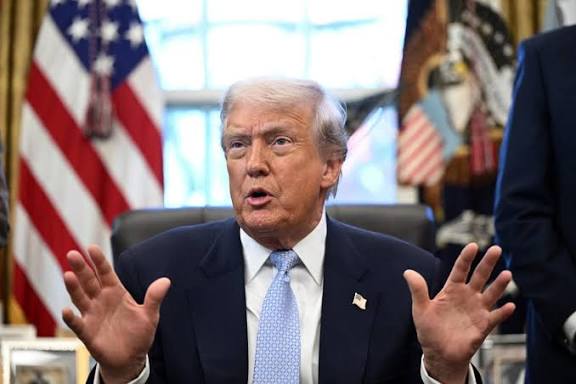

United States President Donald Trump has said he is unconcerned about whether Iran’s national football team participates in the 2026 FIFA World Cup, as uncertainty grows over the country’s involvement in the tournament against the backdrop of escalating geopolitical tensions.
Speaking in an interview with Politico on Tuesday, Trump dismissed questions surrounding Iran’s potential participation, stating bluntly, “I really don’t care,” if the country takes part in the competition. Expanding on his remarks, the president added, “I think Iran is a very badly defeated country. They’re running on fumes.”
His comments come at a time when diplomatic and military confrontations between Iran, the United States, and Israel have intensified, raising concerns about the broader implications for international events scheduled to take place on American soil.
Questions over Iran’s presence at the 2026 tournament have emerged amid rising tensions in the Middle East and growing debate about whether Iranian officials, players, and supporters would be permitted entry into the United States, which is one of the host nations.
Over the weekend, the United States and Israel launched coordinated strikes on Iranian targets, an operation that significantly heightened regional instability. In response, Iran carried out missile and drone attacks targeting American and allied facilities across the Gulf region, sparking fears of a wider regional conflict.
Although no formal decision has been announced regarding Iran’s eligibility or travel arrangements for the tournament, the deteriorating security situation has fueled speculation about potential diplomatic and logistical obstacles that could affect the team’s participation.
The global governing body of football, FIFA, has traditionally maintained that politics should remain separate from the World Cup, emphasizing the tournament’s role as a unifying global sporting event.
The 2026 edition of the competition will be jointly hosted by the United States, Canada, and Mexico, marking the first time in history that three nations will co-host the event. The tournament is expected to attract millions of fans from around the world and generate significant economic and cultural impact across North America.
Against this backdrop, any uncertainty involving qualified teams carries both sporting and diplomatic implications, particularly when host nations are directly involved in geopolitical disputes with participating countries.
Iran had already secured qualification for the 2026 World Cup and is scheduled to face the New Zealand national football team, the Belgium national football team, and the Egypt national football team during the group stage.
However, recent developments have cast doubt over whether preparations can proceed as planned. Iran’s football federation president, Mehdi Taj, suggested that the prevailing security climate could have direct consequences for the country’s participation.
Speaking to the Iranian sports outlet Varzesh3 following the strikes, Taj said, “What is certain is that after this attack, we cannot be expected to look forward to the World Cup with hope.” His remarks reflect growing unease within Iran’s sporting community about the feasibility of competing in a tournament partly hosted by a nation currently engaged in military confrontation with Tehran.
The unfolding situation underscores the complex intersection between geopolitics and global sport, particularly at a time when international tournaments are increasingly entangled with diplomatic realities.
While FIFA has long positioned the World Cup as a platform for unity beyond political divisions, the current tensions highlight the practical challenges of hosting multinational events in politically sensitive environments.