

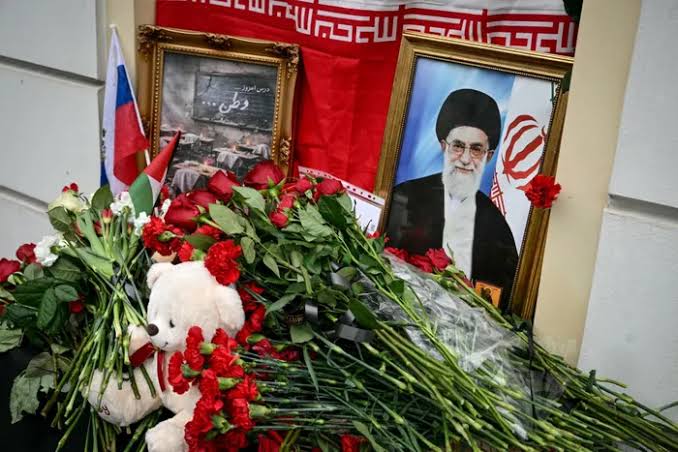

Ayatollah Ali Khamenei, who led Iran for 36 years, was killed at the age of 86 during a wave of US-Israeli attacks on Saturday, leaving the nation grappling with both security challenges and an imminent leadership transition.
According to the Fars news agency, Khamenei will be buried in the holy city of Mashhad, his birthplace and Iran’s second-largest city, where his father is interred at the revered Imam Reza shrine.
In the lead-up to the burial, the Revolutionary Guards announced via their Telegram account that a “large farewell ceremony” will be held in Tehran, although no specific date for the burial has been disclosed, reflecting both logistical planning and security considerations surrounding the national mourning process.
Following Khamenei’s death, the reins of power have been temporarily entrusted to a three-member interim council, which will exercise authority until the Assembly of Experts elects a permanent successor.
The interim council is composed of the President, the head of the judiciary, and a jurist from the Guardian Council, the body responsible for overseeing legislation and vetting candidates for elections. Citing an official familiar with the process, Fars news agency reported that “for security reasons”, the Assembly’s final meeting to select a new supreme leader could be postponed until after Khamenei’s burial, underscoring the delicate balance between ceremonial obligations and the urgency of political continuity.
The situation has been further complicated by ongoing military actions, with Iranian media reporting that the building housing the 88-member Assembly of Experts in the holy city of Qom, south of Tehran, was struck by US-Israeli attacks on Tuesday, following strikes on the Assembly’s main headquarters in Tehran the day before.
These developments have heightened concerns about both the security of key government institutions and the smooth execution of the leadership transition.
Analysts note that the concurrent attacks and leadership vacuum underscore the volatility in Iran, as the nation navigates both external military pressure and internal political realignment. The timing of Khamenei’s burial in Mashhad, coupled with a planned “large farewell ceremony” in the capital, is therefore seen as pivotal for consolidating authority and reassuring the populace amid heightened tensions.
Mashhad’s historical and religious significance adds further weight to the burial arrangements. As the birthplace of Khamenei and the location of his father’s grave at the Imam Reza shrine, the city represents both familial lineage and spiritual authority, reinforcing the symbolic continuity of leadership.
Meanwhile, Tehran will serve as the focal point for national mourning and public homage, as orchestrated by the Revolutionary Guards, reflecting the intertwining of religious, political, and military elements in the ceremonial proceedings.
The combined sequence of events.from the interim council assuming power, to the delayed Assembly meeting, to the ceremonial observances in Tehran and Mashhad demonstrates the layered complexity of succession in the Islamic Republic’s political system.
As Iran confronts this period of transition, the interplay between ongoing US-Israeli military operations and internal governance structures highlights the fragility of security and the urgency of a coordinated succession plan.