


France has announced a major expansion of its nuclear capabilities, unveiling plans to increase the number of its warheads, launch a new nuclear-armed submarine, and extend its deterrent strategy to include eight European countries.
President Emmanuel Macron made the announcement in Brittany on Monday, framing the move as a response to what he described as an increasingly unstable strategic environment.
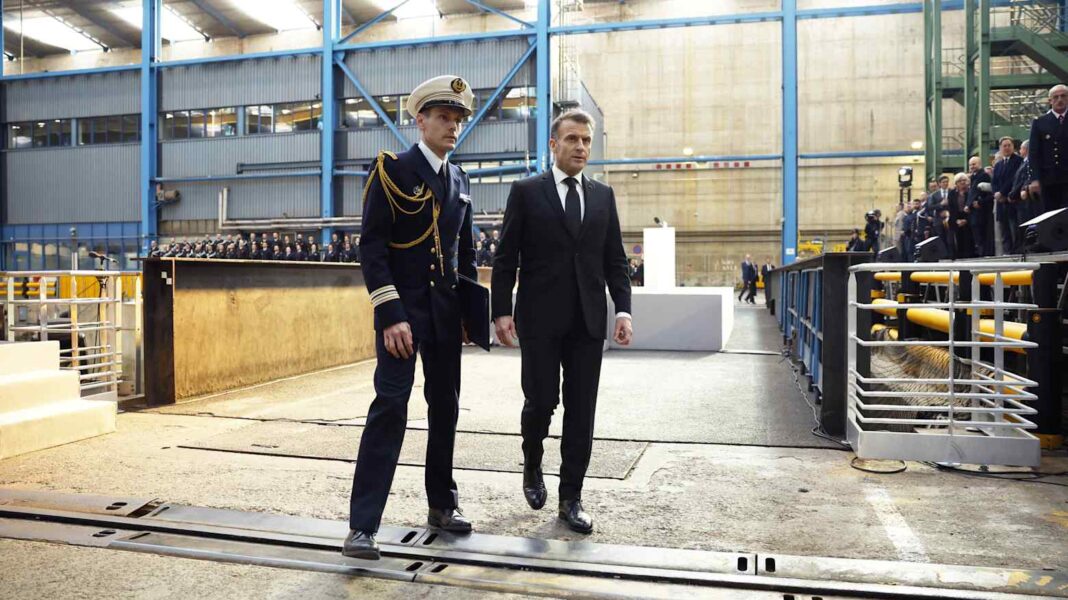
Speaking to naval officers in front of a nuclear submarine at the Ile Longue base near Brest, Macron said, “The next 50 years will be an era of nuclear weapons,” signalling a long-term commitment to bolstering France’s strategic deterrent and deepening defence cooperation across the continent. The announcement underscores a significant shift in French defence policy, which officials have described as the most substantial change in strategic thinking since 1960, when then-President Charles de Gaulle first established France’s independent nuclear doctrine.
Under the new policy, France will increase the number of its nuclear warheads from the current estimated level of around 300 and will launch a new nuclear-armed submarine, The Invincible, in 2036.
The “advanced deterrence” strategy will involve eight European countries – the United Kingdom, Germany, Poland, the Netherlands, Belgium, Greece, Sweden, and Denmark – which have agreed to participate in joint exercises and strategic planning.
Polish Prime Minister Donald Tusk, responding to Macron’s announcement on X, said: “We are arming up together with our friends so that our enemies will never dare to attack us.” Macron explained that the initiative would allow France’s Strategic Air Forces (FAS) to project air-launched nuclear capacity, or force de frappe, across the continent, with partner nations hosting air bases and participating in exercises.
According to the French president, this arrangement would enable the FAS to “spread out across the depth of the European continent… and thus complicate the calculations of our adversaries,” thereby enhancing deterrence against potential threats.
In addition to the direct deployment of nuclear assets, France and its European partners will collaborate on developing “auxiliary” capacities under the new doctrine. These include space-based early warning systems, air defences capable of intercepting incoming missiles and drones, and long-range missile technologies.
Macron emphasised that, despite the broadening of the deterrent to Europe, much of the original strategic doctrine formulated under Charles de Gaulle remains intact, and France retains sole authority over the use of nuclear weapons.
He said: “if they have the audacity to attack France… there will be an unsustainable price to be paid,” underscoring the continuity of France’s policy of ensuring any aggression against its vital interests incurs severe consequences. As part of the doctrinal revision, Macron also announced that France will no longer publicly disclose the number of nuclear warheads it possesses, signalling a more opaque posture intended to increase strategic uncertainty for potential adversaries.
While France’s nuclear force remains designed primarily for national defence, the concept of “vital interests” is now interpreted to potentially include European partners without providing an explicit guarantee of protection.
Historically, France’s nuclear policy dates back to the 1960s when Charles de Gaulle pursued an independent deterrent, creating the force de frappe to ensure France could respond autonomously to threats.
France has long maintained nuclear independence while coordinating selectively with NATO allies. Recently, the United Kingdom, Europe’s only other nuclear power, took part in exercises involving France’s Strategic Air Forces for the first time, reflecting growing operational cooperation. Macron’s announcement also coincided with a joint statement from France and Germany, outlining plans for “closer cooperation” in nuclear deterrence.
The text, signed by Macron and German Chancellor Friedrich Merz, stated: “This cooperation will complement, not replace, Nato’s nuclear deterrent,” while also highlighting German participation in French nuclear exercises and joint development of conventional capacities with European partners.
Analysts note that these steps demonstrate a broader effort to integrate European powers in strategic defence while retaining the primacy of NATO’s collective deterrent.
The announcement of “advanced deterrence” has far-reaching implications for the security landscape in Europe. By extending its nuclear posture beyond national borders and involving multiple European partners, France seeks to strengthen deterrence credibility against potential adversaries while signalling solidarity among continental allies.