

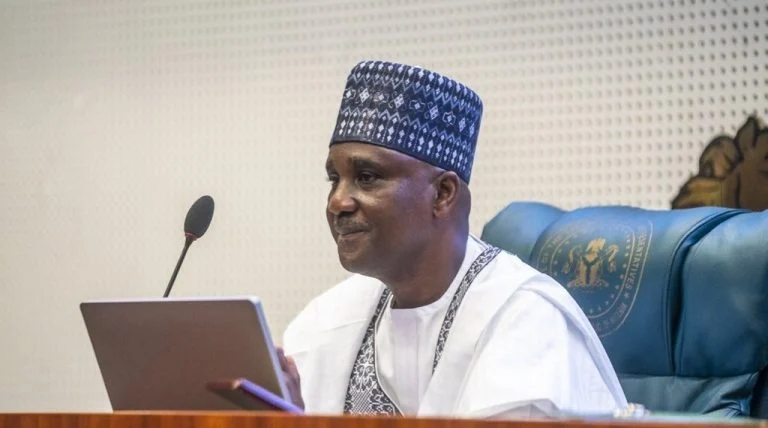

The Speaker of the House of Representatives, Tajudeen Abbas, has defended the National Assembly’s decision to adopt a hybrid system of election result transmission combining electronic and manual methods – arguing that the approach is necessary to curb voter disenfranchisement and address persistent voter apathy ahead of the 2027 general elections.
He explained that the amendment to the Electoral Act was guided by practical realities on ground rather than abstract ideals, stressing that the goal was to ensure inclusiveness and credibility across Nigeria’s diverse electoral landscape.
According to Abbas, Nigeria’s current level of internet penetration and the country’s longstanding electricity challenges make it unrealistic to rely solely on real-time electronic transmission of results nationwide.
He noted that while technology plays a vital role in strengthening democratic processes, deploying it without adequate infrastructure could exclude millions of eligible voters, particularly those in rural and underserved communities, thereby undermining the very essence of democratic participation.
The Speaker made these remarks while hosting the Ambassador of Spain to Nigeria, Félix Costales, who paid him a courtesy visit at the National Assembly complex in Abuja. The meeting, he said, provided an opportunity to exchange views on democratic governance, electoral reforms, and legislative collaboration between both countries.
In a statement released by his Special Adviser on Media and Publicity, Musa Krishi, Abbas was said to have received the Spanish envoy alongside key lawmakers, including the Chairman of the House Committee on Appropriations, Abubakar Bichi; the Chairman of the House Committee on Foreign Affairs, Wole Oke; and the Chairman of the Nigeria–China Parliamentary Friendship Group, Jafaru Yakubu.
The statement further disclosed that the Spanish ambassador acknowledged that Spain itself operates an electoral system that accommodates manual transmission of results, reinforcing the argument that electronic-only models are not universally applicable and must be adapted to local contexts and capacities.
Abbas also reassured Nigerians that his engagements with the leadership of the Independent National Electoral Commission had given him confidence that the 2027 general elections would be more credible, transparent, and inclusive than previous polls, particularly with the refinements introduced by the amended Electoral Act.
Addressing criticisms surrounding the new law, the Speaker remarked, “Sometimes, people scream far beyond the exact level of the issue. A lot of people think that we need to embrace electronic transmission in real-time in Nigeria, but within the very little period that you’ve been in Nigeria, you should be able to speak on the quality of our internet network. You should know that even in advanced cities like Abuja, you are not guaranteed stable internet services all the time.”
He went on to cite official data to support his position, stating, “Based on the NCC report, they said Nigeria is still underserved by almost 40 per cent, which means 40 per cent of territories at large in Nigeria are not covered by the internet. Now, tell me, for those who are saying we should go ahead and do that, already, if you look at the number of our registered voters in this country, it is alarming.”
Drawing attention to the scale of voter apathy, Abbas lamented the low turnout figures recorded in previous elections despite the existing manual system. “It is sad to say that even with the manual arrangement we are using, we are only able to capture about 12–15 per cent of registered voters who, after every four years, come to vote. That’s voter apathy. Very few people go out to vote,” he said.
The Speaker warned that an exclusively electronic transmission framework could worsen the situation by further shrinking participation. He explained, “Now, if we are to introduce only the electronic system, it will further reduce the number because 40 per cent of the country will probably not be able to vote as they don’t have adequate internet services. It means what we should be expecting is not only disenfranchising the voters—denying some people the right to vote—we will also record, perhaps, the lowest number of voters in the next elections.”
He stressed that such an outcome would be avoidable with a more flexible system, adding, “These are all avoidable. That is why we said, in our wisdom, the Electoral Act should be hybrid—a combination of both the manual and electronic systems. Where it is feasible to use the electronic transmission, use the electronic transmission; where it is not possible, use the manual, because there is no way one form, particularly the electronic, can be used entirely in all parts of the country for the elections.”
Abbas further argued that even the loudest critics of the hybrid provision were fully aware of Nigeria’s infrastructural deficits. “The opposition, even though they know the truth—are Nigerians, they live in Nigeria, they travel all over Nigeria—they know that the level of internet penetration in Nigeria is inadequate,” he said, noting that transparency cannot be achieved through systems that are structurally weak.
He also linked the challenge of electronic transmission to the country’s energy crisis, observing that internet connectivity is inseparable from reliable power supply. “There is no way you will be able to have transparent elections using an inadequate system, and through our energy crisis in the country as well, we do not have enough electricity,” Abbas stated.
Expanding on this point, he asked rhetorically, “The internet is always backed by energy. How do you power the entire country on the day of the election to have phones that are working and internet that is working, backed by adequate electricity? All those are challenges that, for now, will not be able to provide us the opportunity to do transmission in real time online.”
The Speaker described democracy as an evolving process that improves incrementally over time, rather than through abrupt, one-size-fits-all reforms. “In our entire democracy, we will continue to improve year after year, election after election. I believe Nigeria, with the support of countries like Spain, will do better,” he said optimistically.
He appealed for continued collaboration and technical assistance from Spain, noting, “We expect you to continue to guide us and give us all the technical advice and support to do better, particularly in the National Assembly, through collaboration between your country and our parliament. It will go a long way in strengthening our competence, particularly in areas of legislative drafting and so on.”
Abbas maintained that despite its challenges, Nigeria was making steady progress. “You cannot say you have everything that you require. You keep on learning. We believe that Nigeria is not doing badly, even though it may not be at the rate that the international community would want to see, but we are moving slowly and gradually,” he added.
Earlier in his remarks, Ambassador Costales explained that his visit was aimed at deepening legislative diplomacy and strengthening bilateral relations between Spain and Nigeria. He assured that Spain would continue to observe Nigeria’s electoral reforms closely and support initiatives that promote democratic consolidation.
“You can count on us whatever we can do to deepen Nigerian democracy. Yes, there may be challenges, but you can count on us in any way possible,” the envoy said, underscoring Spain’s commitment to democratic cooperation.
Costales also observed that political polarisation is not unique to Nigeria but a global phenomenon. “Sometimes when you dig down, you realise that the issues are not that big, or not as big as they seem in the public discourse. It happens a lot in Spain… At the end of the day, if you want to move forward in democracy, you have to reach some level of compromise. We have to try to rule and govern on the level of consensus,” he noted.
The remarks come against the backdrop of recent reforms, following the assent of President Bola Tinubu to the amended Electoral Act passed by the National Assembly. The amendment seeks to enhance the credibility and inclusiveness of future elections, with particular focus on the 2027 general polls.
The revised law clarifies the legal framework governing the transmission of election results, explicitly authorising the use of both electronic and manual methods depending on infrastructure availability and operational feasibility across different parts of the country.
While the reform has sparked intense debate among political actors and civil society organisations, supporters describe the hybrid model as a pragmatic response to Nigeria’s realities.
Critics, however, warn that without strict oversight and effective monitoring, the system could be abused, potentially weakening transparency sn issue lawmakers insist can be mitigated through robust regulation and institutional accountability.